
肾周脂肪组织炎症:代谢功能障碍与肾脏疾病关联的新见解。
Perirenal Adipose Tissue Inflammation: Novel Insights Linking Metabolic Dysfunction to Renal Diseases.
机构信息
Department of Pharmacology and Therapeutics, Faculty of Pharmacy, Beirut Arab University, Beirut, Lebanon.
Department of Pharmacology and Toxicology, Faculty of Medicine, American University of Beirut, Beirut, Lebanon.
出版信息
Front Endocrinol (Lausanne). 2021 Aug 2;12:707126. doi: 10.3389/fendo.2021.707126. eCollection 2021.
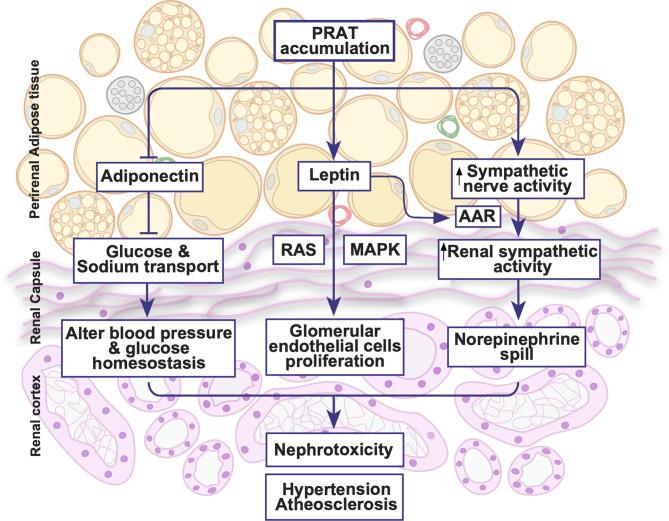
A healthy adipose tissue (AT) is indispensable to human wellbeing. Among other roles, it contributes to energy homeostasis and provides insulation for internal organs. Adipocytes were previously thought to be a passive store of excess calories, however this view evolved to include an endocrine role. Adipose tissue was shown to synthesize and secrete adipokines that are pertinent to glucose and lipid homeostasis, as well as inflammation. Importantly, the obesity-induced adipose tissue expansion stimulates a plethora of signals capable of triggering an inflammatory response. These inflammatory manifestations of obese AT have been linked to insulin resistance, metabolic syndrome, and type 2 diabetes, and proposed to evoke obesity-induced comorbidities including cardiovascular diseases (CVDs). A growing body of evidence suggests that metabolic disorders, characterized by AT inflammation and accumulation around organs may eventually induce organ dysfunction through a direct local mechanism. Interestingly, perirenal adipose tissue (PRAT), surrounding the kidney, influences renal function and metabolism. In this regard, PRAT emerged as an independent risk factor for chronic kidney disease (CKD) and is even correlated with CVD. Here, we review the available evidence on the impact of PRAT alteration in different metabolic states on the renal and cardiovascular function. We present a broad overview of novel insights linking cardiovascular derangements and CKD with a focus on metabolic disorders affecting PRAT. We also argue that the confluence among these pathways may open several perspectives for future pharmacological therapies against CKD and CVD possibly by modulating PRAT immunometabolism.
健康的脂肪组织(AT)对人类健康是不可或缺的。除了其他作用外,它有助于能量平衡,并为内部器官提供隔热。脂肪细胞以前被认为是多余卡路里的被动储存库,但这种观点演变为包括内分泌作用。脂肪组织被证明可以合成和分泌与葡萄糖和脂质代谢平衡以及炎症有关的脂肪因子。重要的是,肥胖引起的脂肪组织扩张会刺激大量能够引发炎症反应的信号。肥胖 AT 的这些炎症表现与胰岛素抵抗、代谢综合征和 2 型糖尿病有关,并被认为会引发肥胖引起的合并症,包括心血管疾病(CVD)。越来越多的证据表明,以 AT 炎症和器官周围脂肪堆积为特征的代谢紊乱可能最终通过直接的局部机制导致器官功能障碍。有趣的是,肾周脂肪组织(PRAT)环绕肾脏,影响肾脏功能和代谢。在这方面,PRAT 已成为慢性肾脏病(CKD)的独立危险因素,甚至与心血管疾病相关。在这里,我们综述了不同代谢状态下 PRAT 改变对肾脏和心血管功能影响的现有证据。我们全面概述了将心血管紊乱和 CKD 与影响 PRAT 的代谢紊乱联系起来的新见解。我们还认为,这些途径的融合可能为针对 CKD 和 CVD 的未来药物治疗开辟多个视角,可能通过调节 PRAT 的免疫代谢。

 Zotero 插件