
晚年抑郁症(LLD)与衰弱之间的纵向关联:一项前瞻性队列研究(MiMiCS-FRAIL)的结果
Longitudinal Association between Late-Life Depression (LLD) and Frailty: Findings from a Prospective Cohort Study (MiMiCS-FRAIL).
作者信息
Borges M K, Romanini C V, Lima N A, Petrella M, da Costa D L, An V N, Aguirre B N, Galdeano J R, Fernandes I C, Cecato J F, Robello E C, Oude Voshaar R C, Aprahamian I
机构信息
Ivan Aprahamian, MD, MS, PhD, FACP, FISAD. Group of Investigation on Multimorbidity and Mental Health in Aging (GIMMA). Division of Geriatrics, Department of Internal Medicine, Jundiaí Medical School. 250 Francisco Telles st. ZIP 13202-550. Jundiaí. Brazil; E-mail:
出版信息
J Nutr Health Aging. 2021;25(7):895-902. doi: 10.1007/s12603-021-1639-x.
OBJECTIVES
The aim of the present study was to investigate whether late-life depression (LLD) is associated with incident frailty over time.
DESIGN
Prospective cohort study, one-year follow-up.
SETTING
Geriatric outpatient clinic, Southwestern of Brazil.
PARTICIPANTS
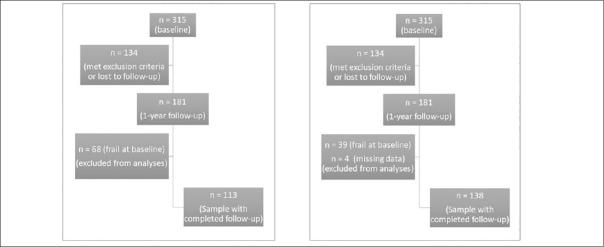
181 follow-up participants aged 60 years or over.
MEASUREMENTS
Depressive disorders were classified as Major Depressive disorder (MDD) or Subthreshold Depression (STD) according to DSM-5 criteria. Depressive symptoms were assessed with validated versions of 15-item Geriatric Depression Scale (GDS-15) and 9-item Patient Health Questionnaire (PHQ-9). We performed binary logistic regressions to estimate the odds ratio (OR) for frailty in LLD adjusting for multiple confounders. Participants who were frail at baseline were excluded from the analyses according to measures of frailty (FRAIL questionnaire and 36-item Frailty Index, FI-36). We also estimated the risk ratio or relative risk (RR) and the risk difference (RD) for incident frailty.
RESULTS
We observed a 2 to 4-fold increased risk for incident frailty among participants with LLD. The presence of a depressive disorder was significantly associated with the onset of frailty (adjusted OR for FRAIL and FI-36: 3.07 [95% CI = 1.03 - 9.17] and 3.76 [95% CI = 1.09 - 12.97], respectively. Notably, the risk for frailty due to LLD was significantly higher with the FI-36 compared to the FRAIL (RR: 3.03 versus 2.23). RD was of 17.3% and 12.7% with the FRAIL and the FI-36, respectively.
CONCLUSION
Our data support the association between LLD and incident frailty over one year among geriatric outpatients, reinforcing longitudinal evidence from population-based studies.
目的
本研究旨在调查晚年抑郁症(LLD)是否与随时间推移出现的衰弱相关。
设计
前瞻性队列研究,为期一年的随访。
地点
巴西西南部的老年门诊。
参与者
181名60岁及以上的随访参与者。
测量方法
根据《精神疾病诊断与统计手册》第5版标准,将抑郁障碍分为重度抑郁症(MDD)或阈下抑郁症(STD)。使用经过验证的15项老年抑郁量表(GDS - 15)和9项患者健康问卷(PHQ - 9)评估抑郁症状。我们进行二元逻辑回归,以估计在调整多个混杂因素后LLD患者衰弱的比值比(OR)。根据衰弱测量指标(衰弱问卷和36项衰弱指数,FI - 36),将基线时衰弱的参与者排除在分析之外。我们还估计了新发衰弱的风险比或相对风险(RR)以及风险差(RD)。
结果
我们观察到LLD参与者新发衰弱的风险增加了2至4倍。抑郁障碍的存在与衰弱的发生显著相关(FRAIL和FI - 36调整后的OR分别为:3.07 [95%置信区间 = 1.03 - 9.17] 和3.76 [95%置信区间 = 1.09 - 12.97])。值得注意的是,与FRAIL相比,FI - 36显示LLD导致衰弱的风险显著更高(RR:3.03对2.23)。FRAIL和FI - 36的RD分别为17.3%和12.7%。
结论
我们的数据支持老年门诊患者中LLD与一年中出现的衰弱之间的关联,加强了基于人群研究的纵向证据。


 Zotero 插件