
重症监护病房中产生VIM碳青霉烯酶的铜绿假单胞菌暴发及其通过实施无水患者护理措施而终止
Outbreak of Pseudomonas aeruginosa producing VIM carbapenemase in an intensive care unit and its termination by implementation of waterless patient care.
作者信息
Catho Gaud, Martischang R, Boroli F, Chraïti M N, Martin Y, Koyluk Tomsuk Z, Renzi G, Schrenzel J, Pugin J, Nordmann P, Blanc D S, Harbarth S
机构信息
Infection Control Program, WHO Collaborating Center for Patient Safety, Faculty of Medicine, Geneva University Hospitals, Rue Gabrielle Perret-Gentil, 4, CH-1205, Geneva, Switzerland.
Division of Critical Care, Faculty of Medicine, Geneva University Hospitals, Geneva, Switzerland.
出版信息
Crit Care. 2021 Aug 19;25(1):301. doi: 10.1186/s13054-021-03726-y.
BACKGROUND
Long-term outbreaks of multidrug-resistant Gram-negative bacilli related to hospital-building water systems have been described. However, successful mitigation strategies have rarely been reported. In particular, environmental disinfection or replacement of contaminated equipment usually failed to eradicate environmental sources of Pseudomonas aeruginosa.
METHODS
We report the investigation and termination of an outbreak of P. aeruginosa producing VIM carbapenemase (PA-VIM) in the adult intensive care unit (ICU) of a Swiss tertiary care hospital with active case finding, environmental sampling and whole genome sequencing (WGS) of patient and environmental strains. We also describe the implemented control strategies and their effectiveness on eradication of the environmental reservoir.
RESULTS
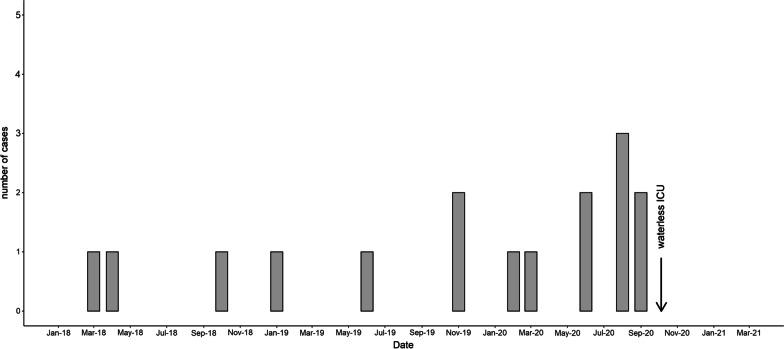
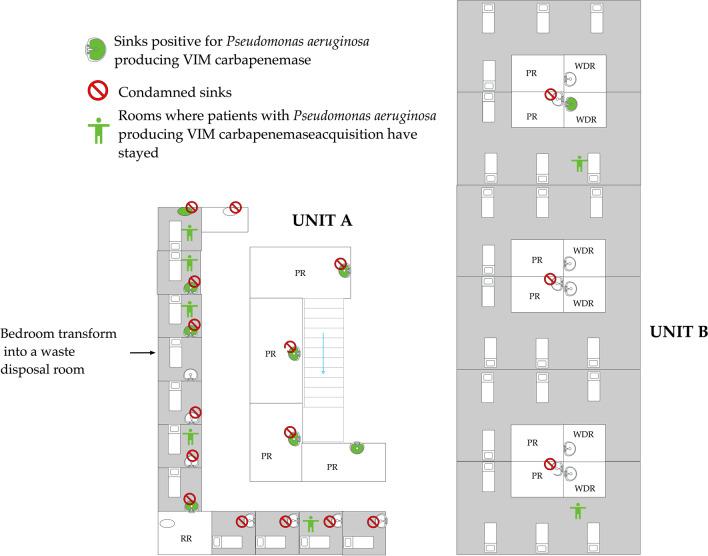
Between April 2018 and September 2020, 21 patients became either infected or colonized with a PA-VIM strain. For 16 of them, an acquisition in the ICU was suspected. Among 131 environmental samples collected in the ICU, 13 grew PA-VIM in sink traps and drains. WGS confirmed the epidemiological link between clinical and environmental strains and the monoclonal pattern of the outbreak. After removing sinks from patient rooms and implementation of waterless patient care, no new acquisition was detected in the ICU within 8 months after the intervention.
DISCUSSION
Implementation of waterless patient care with removal of the sinks in patient rooms was successful for termination of a PA-VIM ICU outbreak linked to multiple environmental water sources. WGS provides highly discriminatory accuracy to investigate environment-related outbreaks.
背景
已有文献报道了与医院建筑供水系统相关的耐多药革兰氏阴性杆菌长期暴发情况。然而,成功的缓解策略却鲜有报道。特别是,环境消毒或更换受污染设备通常无法根除铜绿假单胞菌的环境来源。
方法
我们报告了瑞士一家三级护理医院成人重症监护病房(ICU)中一次产VIM碳青霉烯酶铜绿假单胞菌(PA-VIM)暴发的调查及终结情况,采用了主动病例发现、环境采样以及对患者和环境菌株进行全基因组测序(WGS)的方法。我们还描述了所实施的控制策略及其对根除环境储源的有效性。
结果
在2018年4月至2020年9月期间,21例患者感染或定植了PA-VIM菌株。其中16例怀疑是在ICU获得感染。在ICU采集的131份环境样本中,有13份在水槽存水弯和排水管道中培养出PA-VIM。WGS证实了临床菌株与环境菌株之间的流行病学联系以及暴发的单克隆模式。在从病房移除水槽并实施无水患者护理后,干预后8个月内ICU未检测到新的感染病例。
讨论
在病房移除水槽并实施无水患者护理对于终结与多个环境水源相关的PA-VIM在ICU的暴发是成功的。WGS为调查与环境相关的暴发提供了高度 discriminatory 准确性。 (注:“discriminatory”此处可能有误,结合语境推测可能是“鉴别性的”之类意思,但按要求保留原文)

 Zotero 插件