
B7 评分和 T 细胞浸润可分层前列腺癌的免疫状态。
B7 score and T cell infiltration stratify immune status in prostate cancer.
机构信息
Department of Urology, Sun Yat-sen Memorial Hospital, Sun Yat-sen University, Guangzhou, Guangdong, China.
Guangdong Provincial Key Laboratory of Malignant Tumor Epigenetics and Gene Regulation, Sun Yat-Sen Memorial Hospital, Sun Yat-Sen University, Guangzhou, Guangdong, China.
出版信息
J Immunother Cancer. 2021 Aug;9(8). doi: 10.1136/jitc-2021-002455.
BACKGROUND
Although immune checkpoint inhibitors (ICIs), especially programmed cell death protein 1 (PD-1)/programmed death ligand 1 (PD-L1) axis blockers, exhibit prominent antitumor effects against numerous malignancies, their benefit for patients with prostate cancer (PCa) has been somewhat marginal. This study aimed to assess the feasibility of B7-H3 or HHLA2 as alternative immunotherapeutic targets in PCa.
METHODS
Immunohistochemistry was performed to evaluate the expression pattern of PD-L1, B7-H3 and HHLA2 and the infiltration of CD8 and Foxp3 lymphocytes in 239 PCa tissues from two independent cohorts. The correlations between B7-H3 and HHLA2 and clinicopathological features, including the presence of CD8 and Foxp3 tumor-infiltrating lymphocytes (TILs), were explored.
RESULTS
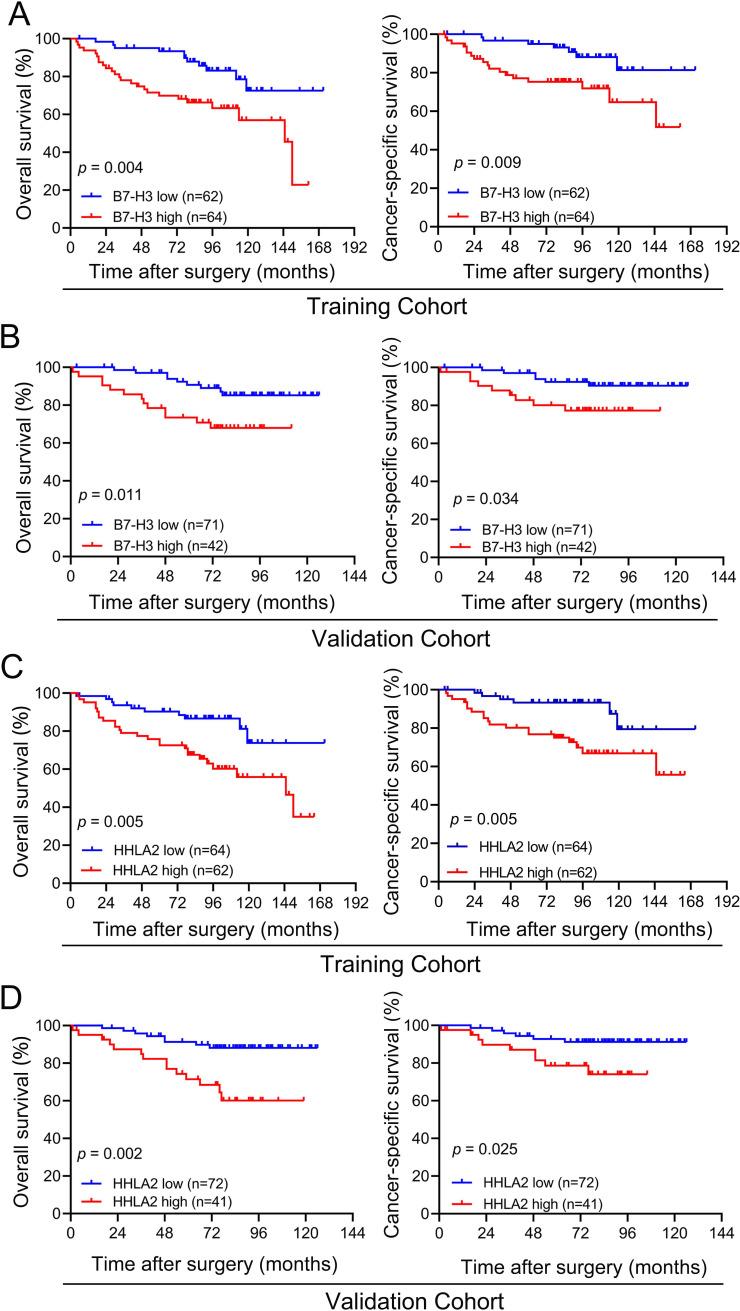
HHLA2 expression was much higher than PD-L1 expression but lower than B7-H3 expression in PCa tissues. High expression of both B7-H3 and HHLA2 was significantly associated with higher Gleason score and tumor stage, lymph node metastasis and dismal overall survival (OS) and cancer-specific survival (CSS). Moreover, a high B7 score, defined as high B7-H3 expression and/or high HHLA2 expression, was an independent prognostic predictor for PCa. Of note, a high B7 score was negatively correlated with CD8 TILs. Importantly, a new immune classification, based on the B7 score and CD8 TILs, successfully stratified OS and CSS in PCa.
CONCLUSIONS
Both B7-H3 and HHLA2 have a critical impact on the immunosuppressive microenvironment, and the B7 score could be used as an independent prognostic factor for PCa. The B7 score combined with CD8 TILs could be used as a new immune classification to stratify the risk of death, especially cancer-related death, for patients with PCa. These findings may provide insights that could improve response to immune-related comprehensive therapy for PCa in the future.
背景
尽管免疫检查点抑制剂(ICIs),尤其是程序性死亡受体 1(PD-1)/程序性死亡配体 1(PD-L1)轴阻滞剂,对多种恶性肿瘤表现出显著的抗肿瘤作用,但它们对前列腺癌(PCa)患者的益处有些微不足道。本研究旨在评估 B7-H3 或 HHLA2 作为 PCa 替代免疫治疗靶点的可行性。
方法
对来自两个独立队列的 239 例 PCa 组织进行免疫组织化学染色,以评估 PD-L1、B7-H3 和 HHLA2 的表达模式以及 CD8 和 Foxp3 淋巴细胞的浸润情况。探讨了 B7-H3 和 HHLA2 与临床病理特征之间的相关性,包括 CD8 和 Foxp3 肿瘤浸润淋巴细胞(TILs)的存在。
结果
HHLA2 的表达在 PCa 组织中高于 PD-L1 的表达,但低于 B7-H3 的表达。B7-H3 和 HHLA2 的高表达与更高的 Gleason 评分和肿瘤分期、淋巴结转移和不良的总生存期(OS)和癌症特异性生存期(CSS)显著相关。此外,高 B7 评分(定义为 B7-H3 表达和/或 HHLA2 表达高)是 PCa 的独立预后预测因子。值得注意的是,高 B7 评分与 CD8 TILs 呈负相关。重要的是,基于 B7 评分和 CD8 TILs 的新免疫分类成功地对 PCa 的 OS 和 CSS 进行了分层。
结论
B7-H3 和 HHLA2 对免疫抑制微环境都有重要影响,B7 评分可作为 PCa 的独立预后因素。B7 评分与 CD8 TILs 相结合可作为一种新的免疫分类,用于分层 PCa 患者死亡风险,特别是癌症相关死亡风险。这些发现可能为改善未来 PCa 免疫相关综合治疗的反应提供思路。



 Zotero 插件