
早期生活肠道微生物群与南加州西班牙裔婴儿快速生长有关。
Early life gut microbiota is associated with rapid infant growth in Hispanics from Southern California.
机构信息
Department of Integrative Physiology, University of Colorado Boulder, Boulder, CO, USA.
Department of Pediatrics, The Saban Research Institute, Children's Hospital Los Angeles, Los Angeles, CA, USA.
出版信息
Gut Microbes. 2021 Jan-Dec;13(1):1961203. doi: 10.1080/19490976.2021.1961203.
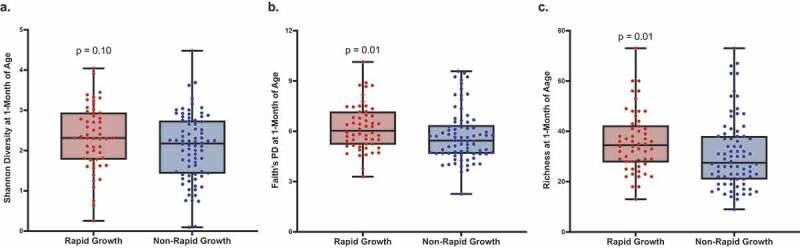
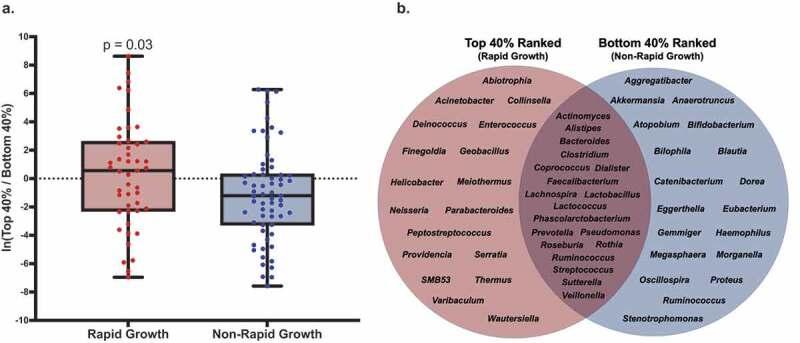
We aimed to determine if the newborn gut microbiota is an underlying determinant of early life growth trajectories. 132 Hispanic infants were recruited at 1-month postpartum. The infant gut microbiome was characterized using 16S rRNA amplicon sequencing. Rapid infant growth was defined as a weight-for-age z-score (WAZ) change greater than 0.67 between birth and 12-months of age. Measures of infant growth included change in WAZ, weight-for-length z-score (WLZ), and body mass index (BMI) z-scores from birth to 12-months and infant anthropometrics at 12-months (weight, skinfold thickness). Of the 132 infants, 40% had rapid growth in the first year of life. Multiple metrics of alpha-diversity predicted rapid infant growth, including a higher Shannon diversity (OR = 1.83; 95% CI: 1.07-3.29; = .03), Faith's phylogenic diversity (OR = 1.41, 95% CI: 1.05-1.94; = .03), and richness (OR = 1.04, 95% CI: 1.01-1.08; = .02). Many of these alpha-diversity metrics were also positively associated with increases in WAZ, WLZ, and BMI z-scores from birth to 12-months (p<0.05). Importantly, we identified subsets of microbial consortia whose abundance were correlated with these same measures of infant growth. We also found that rapid growers were enriched in multiple taxa belonging to genera such as , and . Moreover, measures of the newborn gut microbiota explained up to an additional 5% of the variance in rapid growth beyond known clinical predictors (R = 0.37 vs. 0.32, < .01). These findings indicate that a more mature gut microbiota, characterized by increased alpha-diversity, at as early as 1-month of age, may influence infant growth trajectories in the first year of life.
我们旨在确定新生儿肠道微生物群是否是早期生长轨迹的潜在决定因素。在产后 1 个月招募了 132 名西班牙裔婴儿。使用 16S rRNA 扩增子测序来描述婴儿肠道微生物组。快速生长被定义为出生至 12 个月龄时体重 - 年龄 z 评分(WAZ)变化大于 0.67。婴儿生长的测量包括 WAZ 的变化、体重 - 长度 z 评分(WLZ)和出生至 12 个月龄时的 BMI z 评分以及 12 个月龄时的婴儿人体测量(体重、皮褶厚度)。在 132 名婴儿中,有 40%的婴儿在生命的第一年出现快速生长。包括更高的 Shannon 多样性(OR = 1.83;95%CI:1.07-3.29; =.03)、Faith 的系统发育多样性(OR = 1.41,95%CI:1.05-1.94; =.03)和丰富度(OR = 1.04,95%CI:1.01-1.08; =.02)在内的多种 alpha 多样性指标都可以预测婴儿快速生长。这些 alpha 多样性指标中的许多也与出生至 12 个月龄时 WAZ、WLZ 和 BMI z 评分的增加呈正相关(p<0.05)。重要的是,我们确定了微生物群落的亚群,其丰度与婴儿生长的这些相同指标相关。我们还发现,快速生长者富含多种属于 、 和 等属的分类群。此外,新生儿肠道微生物组的测量值可以解释快速生长之外的已知临床预测因子(R = 0.37 与 0.32, <.01)之外的 5%的生长差异。这些发现表明,在 1 个月大时,更成熟的肠道微生物群,其特征是 alpha 多样性增加,可能会影响生命第一年的婴儿生长轨迹。


 Zotero 插件