
疑似感染患者的死亡率和菌血症预测因子的比较。
A comparison of predictors for mortality and bacteraemia in patients suspected of infection.
机构信息
Treat Systems ApS, Ålborg, Denmark.
Department of Health Science and Technology, Aalborg University, Ålborg, Denmark.
出版信息
BMC Infect Dis. 2021 Aug 23;21(1):864. doi: 10.1186/s12879-021-06547-0.
BACKGROUND
Stratification by clinical scores of patients suspected of infection can be used to support decisions on treatment and diagnostic workup. Seven clinical scores, SepsisFinder (SF), National Early Warning Score (NEWS), Sequential Orgen Failure Assessment (SOFA), Mortality in Emergency Department Sepsis (MEDS), quick SOFA (qSOFA), Shapiro Decision Rule (SDR) and Systemic Inflammatory Response Syndrome (SIRS), were evaluated for their ability to predict 30-day mortality and bacteraemia and for their ability to identify a low risk group, where blood culture may not be cost-effective and a high risk group where direct-from-blood PCR (dfbPCR) may be cost effective.
METHODS
Retrospective data from two Danish and an Israeli hospital with a total of 1816 patients were used to calculate the seven scores.
RESULTS
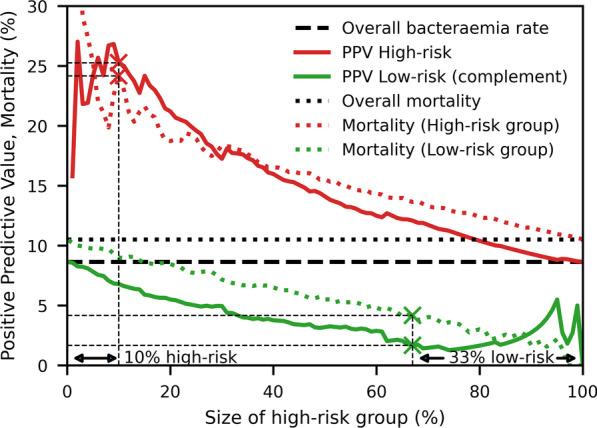
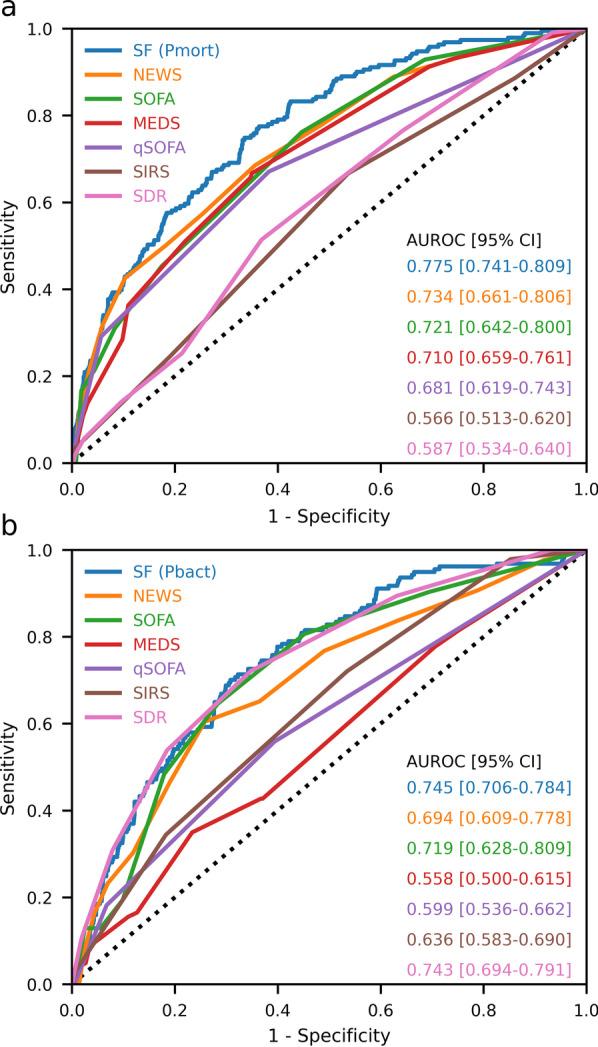
SF had higher Area Under the Receiver Operating curve than the clinical scores for prediction of mortality and bacteraemia, significantly so for MEDS, qSOFA and SIRS. For mortality predictions SF also had significantly higher area under the curve than SDR. In a low risk group identified by SF, consisting of 33% of the patients only 1.7% had bacteraemia and mortality was 4.2%, giving a cost of € 1976 for one positive result by blood culture. This was higher than the cost of € 502 of one positive dfbPCR from a high risk group consisting of 10% of the patients, where 25.3% had bacteraemia and mortality was 24.2%.
CONCLUSION
This may motivate a health economic study of whether resources spent on low risk blood cultures might be better spent on high risk dfbPCR.
背景
对疑似感染的患者进行临床评分分层可用于支持治疗决策和诊断性检查。本研究评估了七种临床评分,即 SepsisFinder(SF)、National Early Warning Score(NEWS)、Sequential Orgen Failure Assessment(SOFA)、Mortality in Emergency Department Sepsis(MEDS)、quick SOFA(qSOFA)、Shapiro Decision Rule(SDR)和 Systemic Inflammatory Response Syndrome(SIRS),以评估其预测 30 天死亡率和菌血症的能力,并评估其识别低危人群的能力,在该人群中血培养可能不具有成本效益,以及识别高危人群的能力,在该人群中直接从血液进行 PCR(dfbPCR)可能具有成本效益。
方法
使用来自丹麦两家医院和一家以色列医院的回顾性数据计算了这七种评分。
结果
SF 的Receiver Operating 曲线下面积(AUC)高于用于预测死亡率和菌血症的临床评分,对于 MEDS、qSOFA 和 SIRS 尤其如此。在 SF 确定的低危人群中,仅占患者总数 33%的人群中,有 1.7%发生菌血症,死亡率为 4.2%,这意味着血培养阳性的成本为每例 1976 欧元。这高于高危人群(占患者总数 10%)的直接从血液进行 PCR 的成本(每例 502 欧元),因为该人群中 25.3%发生菌血症,死亡率为 24.2%。
结论
这可能促使进行卫生经济学研究,以评估是否可以将用于低危血培养的资源更好地用于高危 dfbPCR。
 Zotero 插件