
体内微环境中的外在相互作用激活 CLL 中的抗凋亡多药耐药表型。
Extrinsic interactions in the microenvironment in vivo activate an antiapoptotic multidrug-resistant phenotype in CLL.
机构信息
Department of Microbiology, Immunology, and Cancer Biology, University of Virginia School of Medicine, Charlottesville, VA.
Beirne B. Carter Center for Immunology Research, Charlottesville, VA.
出版信息
Blood Adv. 2021 Sep 14;5(17):3497-3510. doi: 10.1182/bloodadvances.2020003944.
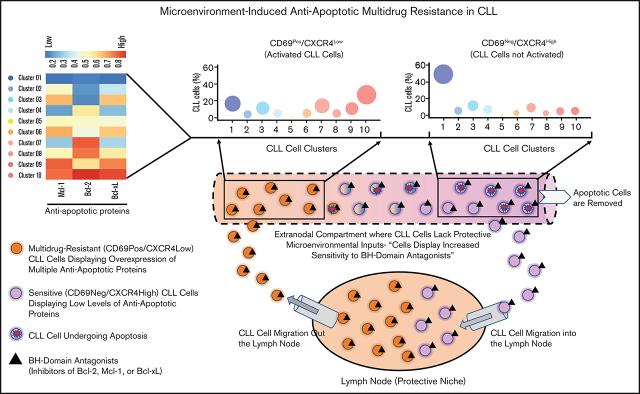
The Bcl-2 inhibitor venetoclax has yielded exceptional clinical responses in chronic lymphocytic leukemia (CLL). However, de novo resistance can result in failure to achieve negative minimal residual disease and predicts poor treatment outcomes. Consequently, additional proapoptotic drugs, such as inhibitors of Mcl-1 and Bcl-xL, are in development. By profiling antiapoptotic proteins using flow cytometry, we find that leukemic B cells that recently emigrated from the lymph node (CD69+/CXCR4Low) in vivo are enriched for cell clusters simultaneously overexpressing multiple antiapoptotic proteins (Mcl-1High/Bcl-xLHigh/Bcl-2High) in both treated and treatment-naive CLL patients. These cells exhibited antiapoptotic resistance to multiple BH-domain antagonists, including inhibitors of Bcl-2, Mcl-1, and Bcl-xL, when tested as single agents in a flow cytometry-based functional assay. Antiapoptotic multidrug resistance declines ex vivo, consistent with resistance being generated in vivo by extrinsic microenvironmental interactions. Surviving "persister" cells in patients undergoing venetoclax treatment are enriched for CLL cells displaying the functional and molecular properties of microenvironmentally induced multidrug resistance. Overcoming this resistance required simultaneous inhibition of multiple antiapoptotic proteins, with potential for unwanted toxicities. Using a drug screen performed using patient peripheral blood mononuclear cells cultured in an ex vivo microenvironment model, we identify novel venetoclax drug combinations that induce selective cytotoxicity in multidrug-resistant CLL cells. Thus, we demonstrate that antiapoptotic multidrug-resistant CLL cells exist in patients de novo and show that these cells persist during proapoptotic treatment, such as venetoclax. We validate clinically actionable approaches to selectively deplete this reservoir in patients.
Bcl-2 抑制剂 venetoclax 在慢性淋巴细胞白血病 (CLL) 中产生了出色的临床反应。然而,新出现的耐药性可能导致无法实现阴性微小残留病,并预示着治疗结局不佳。因此,正在开发其他促凋亡药物,如 Mcl-1 和 Bcl-xL 的抑制剂。通过使用流式细胞术对凋亡蛋白进行分析,我们发现体内新近从淋巴结迁移出来的白血病 B 细胞(CD69+/CXCR4Low)中同时过表达多种抗凋亡蛋白(Mcl-1High/Bcl-xLHigh/Bcl-2High)的细胞簇丰富,无论是在治疗的还是未经治疗的 CLL 患者中。当在基于流式细胞术的功能测定中作为单一药物进行测试时,这些细胞表现出对多种 BH 结构域拮抗剂的抗凋亡耐药性,包括 Bcl-2、Mcl-1 和 Bcl-xL 的抑制剂。抗凋亡多药耐药性在体外下降,与体内通过外在微环境相互作用产生的耐药性一致。在接受 venetoclax 治疗的患者中,“持久性”存活的细胞中富含显示微环境诱导的多药耐药性的功能和分子特性的 CLL 细胞。克服这种耐药性需要同时抑制多种抗凋亡蛋白,可能会产生不必要的毒性。使用在体外微环境模型中培养的患者外周血单核细胞进行药物筛选,我们确定了新型 venetoclax 药物组合,可在多药耐药性 CLL 细胞中诱导选择性细胞毒性。因此,我们证明了新出现的抗凋亡多药耐药性 CLL 细胞存在于患者中,并表明这些细胞在促凋亡治疗(如 venetoclax)期间持续存在。我们验证了临床上可行的方法来选择性地耗尽患者中的这种储库。
 Zotero 插件