
RE-MIND:比较复发或难治性弥漫性大 B 细胞淋巴瘤中塔法西他单抗+来那度胺(L-MIND)与真实世界中来那度胺单药治疗队列。
RE-MIND: Comparing Tafasitamab + Lenalidomide (L-MIND) with a Real-world Lenalidomide Monotherapy Cohort in Relapsed or Refractory Diffuse Large B-cell Lymphoma.
机构信息
IRCCS Azienda Ospedaliero-Universitaria di Bologna, Istituto di Ematologia "Seràgnoli", Bologna, Italy; Dipartimento di Medicina Specialistica, Diagnostica e Sperimentale, Università di Bologna, Bologna, Italy.
University of Rochester Medical Center, Rochester, New York.
出版信息
Clin Cancer Res. 2021 Nov 15;27(22):6124-6134. doi: 10.1158/1078-0432.CCR-21-1471. Epub 2021 Aug 25.
PURPOSE
Tafasitamab, an Fc-modified, humanized, anti-CD19 monoclonal antibody, in combination with lenalidomide, demonstrated efficacy in transplant-ineligible patients with relapsed/refractory (R/R) diffuse large B-cell lymphoma (DLBCL), in the single-arm, phase II L-MIND study (NCT02399085). RE-MIND, a retrospective observational study, generated a historic control for L-MIND to delineate the contribution of tafasitamab to the efficacy of the combination.
PATIENTS AND METHODS
Data were retrospectively collected from patients with R/R DLBCL treated with lenalidomide monotherapy for comparison with tafasitamab + lenalidomide-treated patients (L-MIND). Key eligibility criteria were aligned with L-MIND. Estimated propensity score-based Nearest Neighbor 1:1 Matching methodology balanced the cohorts for nine prespecified prognostic baseline covariates. The primary endpoint was investigator-assessed best overall response rate (ORR). Secondary endpoints included complete response (CR) rate, progression-free survival (PFS), and overall survival (OS).
RESULTS
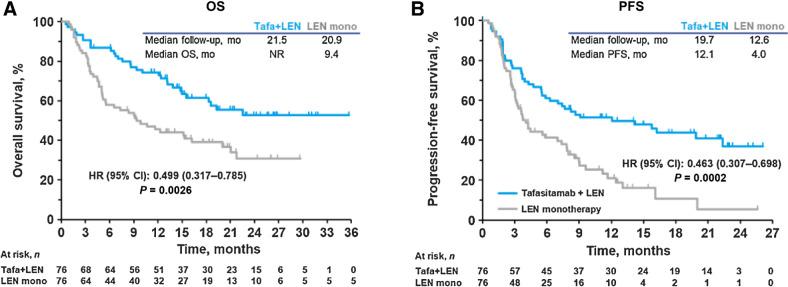
Data from 490 patients going through lenalidomide monotherapy were collected; 140 qualified for matching with the L-MIND cohort. The primary analysis included 76 patients from each cohort who received a lenalidomide starting dose of 25 mg/day. Cohort baseline covariates were comparable. A significantly better ORR of 67.1% (95% confidence interval, 55.4-77.5) was observed for the combination therapy versus 34.2% (23.7-46.0) for lenalidomide monotherapy [odds ratio, 3.89 (1.90-8.14); < 0.0001]. Higher CR rates were achieved with combination therapy compared with lenalidomide monotherapy [39.5% (28.4-51.4) vs. 13.2% (6.5-22.9)]. Survival endpoints favored combination therapy. Lenalidomide monotherapy outcomes were similar to previously published data.
CONCLUSIONS
RE-MIND enabled the estimation of the additional treatment effect achieved by combining tafasitamab with lenalidomide in patients with R/R DLBCL.
目的
Tafasitamab 是一种 Fc 修饰的、人源化的抗 CD19 单克隆抗体,与来那度胺联合用于不适合移植的复发/难治性(R/R)弥漫性大 B 细胞淋巴瘤(DLBCL)患者,在单臂、2 期 L-MIND 研究(NCT02399085)中显示出疗效。RE-MIND 是一项回顾性观察性研究,为 L-MIND 生成了一个历史对照,以描绘 tafasitamab 对联合治疗疗效的贡献。
方法
从接受来那度胺单药治疗的 R/R DLBCL 患者中回顾性收集数据,与接受 tafasitamab+lenalidomide 治疗的患者(L-MIND)进行比较。关键入组标准与 L-MIND 一致。采用估计倾向评分的最近邻 1:1 匹配方法,对 9 个预设的预后基线协变量进行了队列平衡。主要终点是研究者评估的最佳总缓解率(ORR)。次要终点包括完全缓解(CR)率、无进展生存期(PFS)和总生存期(OS)。
结果
共收集了 490 例接受来那度胺单药治疗的患者数据;其中 140 例符合与 L-MIND 队列匹配的条件。主要分析包括每个队列各 76 例接受 25mg/天起始剂量来那度胺的患者。队列基线协变量具有可比性。联合治疗的 ORR 显著更高,为 67.1%(95%置信区间,55.4-77.5),而来那度胺单药治疗为 34.2%(23.7-46.0)[比值比,3.89(1.90-8.14);<0.0001]。与来那度胺单药治疗相比,联合治疗的 CR 率更高[39.5%(28.4-51.4)vs. 13.2%(6.5-22.9)]。生存终点有利于联合治疗。来那度胺单药治疗的结果与之前发表的数据相似。
结论
RE-MIND 使我们能够估计在 R/R DLBCL 患者中,将 tafasitamab 与来那度胺联合使用所带来的额外治疗效果。


 Zotero 插件