
光动力疗法联合Bcl-2/Bcl-xL抑制可增加Noxa/Mcl-1比值,该比值独立于Usp9X,且能协同增强胶质母细胞瘤的细胞凋亡。
Photodynamic Therapy Combined with Bcl-2/Bcl-xL Inhibition Increases the Noxa/Mcl-1 Ratio Independent of Usp9X and Synergistically Enhances Apoptosis in Glioblastoma.
作者信息
Golla Carolin, Bilal Mayas, Dwucet Annika, Bader Nicolas, Anthonymuthu Jenson, Heiland Tim, Pruss Maximilian, Westhoff Mike-Andrew, Siegelin Markus David, Capanni Felix, Wirtz Christian Rainer, Kast Richard Eric, Halatsch Marc-Eric, Karpel-Massler Georg
机构信息
Department of Neurological Surgery, Ulm University Medical Center, 89081 Ulm, Germany.
Department of Mechatronics and Medical Engineering, Ulm University of Applied Sciences, 89081 Ulm, Germany.
出版信息
Cancers (Basel). 2021 Aug 17;13(16):4123. doi: 10.3390/cancers13164123.
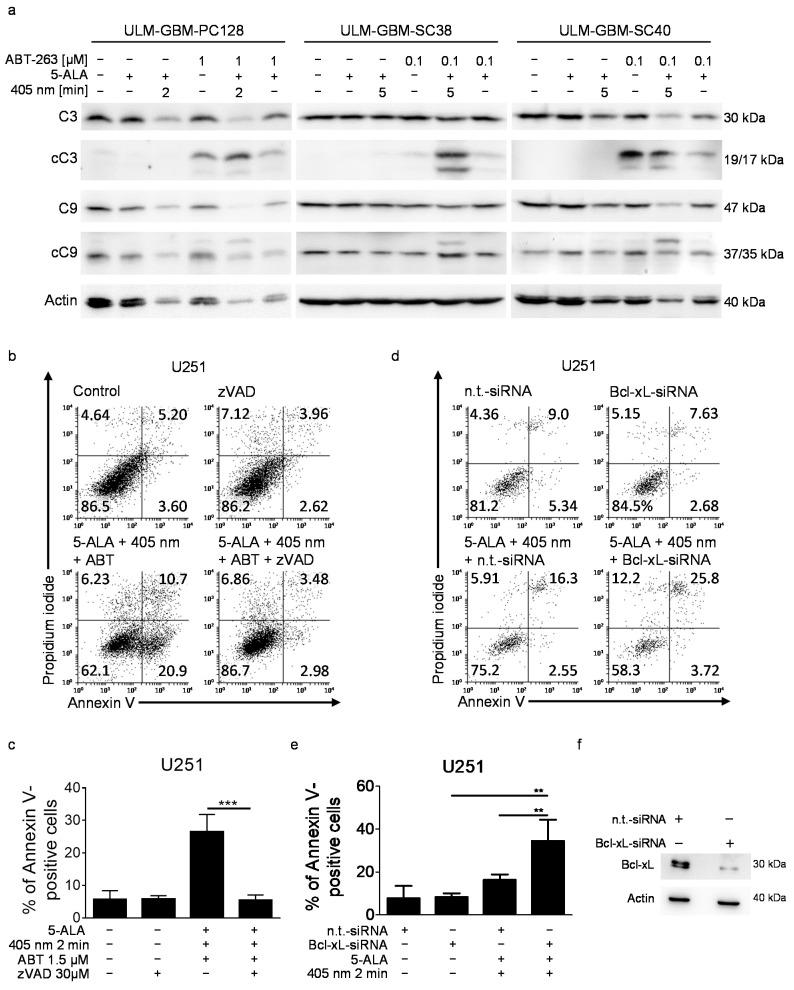
The purpose of this study was to assess in vitro whether the biological effects of 5-aminolevulinic acid (5-ALA)-based photodynamic therapy are enhanced by inhibition of the anti-apoptotic Bcl-2 family proteins Bcl-2 and Bcl-xL in different glioblastoma models. Pre-clinical testing of a microcontroller-based device emitting light of 405 nm wavelength in combination with exposure to 5-ALA (PDT) and the Bcl-2/Bcl-xL inhibitor ABT-263 (navitoclax) was performed in human established and primary cultured glioblastoma cells as well as glioma stem-like cells. We applied cell count analyses to assess cellular proliferation and Annexin V/PI staining to examine pro-apoptotic effects. Western blot analyses and specific knockdown experiments using siRNA were used to examine molecular mechanisms of action. Bcl-2/Bcl-xL inhibition synergistically enhanced apoptosis in combination with PDT. This effect was caspase-dependent. On the molecular level, PDT caused an increased Noxa/Mcl-1 ratio, which was even more pronounced when combined with ABT-263 in a Usp9X-independent manner. Our data showed that Bcl-2/Bcl-xL inhibition increases the response of glioblastoma cells toward photodynamic therapy. This effect can be partly attributed to cytotoxicity and is likely related to a pro-apoptotic shift because of an increased Noxa/Mcl-1 ratio. The results of this study warrant further investigation.
本研究的目的是在体外评估,在不同的胶质母细胞瘤模型中,抑制抗凋亡Bcl-2家族蛋白Bcl-2和Bcl-xL是否会增强基于5-氨基乙酰丙酸(5-ALA)的光动力疗法的生物学效应。在人源已建立的和原代培养的胶质母细胞瘤细胞以及胶质瘤干细胞样细胞中,对一种发射405nm波长光的基于微控制器的设备,结合5-ALA(光动力疗法)和Bcl-2/Bcl-xL抑制剂ABT-263(纳维托克司)进行临床前测试。我们应用细胞计数分析来评估细胞增殖,并使用膜联蛋白V/碘化丙啶染色来检测促凋亡效应。采用蛋白质免疫印迹分析和使用小干扰RNA的特异性敲低实验来研究作用的分子机制。Bcl-2/Bcl-xL抑制与光动力疗法联合使用时可协同增强细胞凋亡。这种效应依赖于半胱天冬酶。在分子水平上,光动力疗法导致Noxa/Mcl-1比值增加,当与ABT-263联合使用时,这种增加以一种不依赖于泛素特异性蛋白酶9X的方式更加明显。我们的数据表明,Bcl-2/Bcl-xL抑制可增加胶质母细胞瘤细胞对光动力疗法的反应。这种效应部分可归因于细胞毒性,并且可能与由于Noxa/Mcl-1比值增加导致的促凋亡转变有关。本研究结果值得进一步研究。



 Zotero 插件