
翻译后修饰在STAT3生物学活性和功能中的作用
The Roles of Post-Translational Modifications in STAT3 Biological Activities and Functions.
作者信息
Tesoriere Annachiara, Dinarello Alberto, Argenton Francesco
机构信息
Dipartimento di Biologia, Università degli Studi di Padova, 35131 Padova, Italy.
出版信息
Biomedicines. 2021 Aug 4;9(8):956. doi: 10.3390/biomedicines9080956.
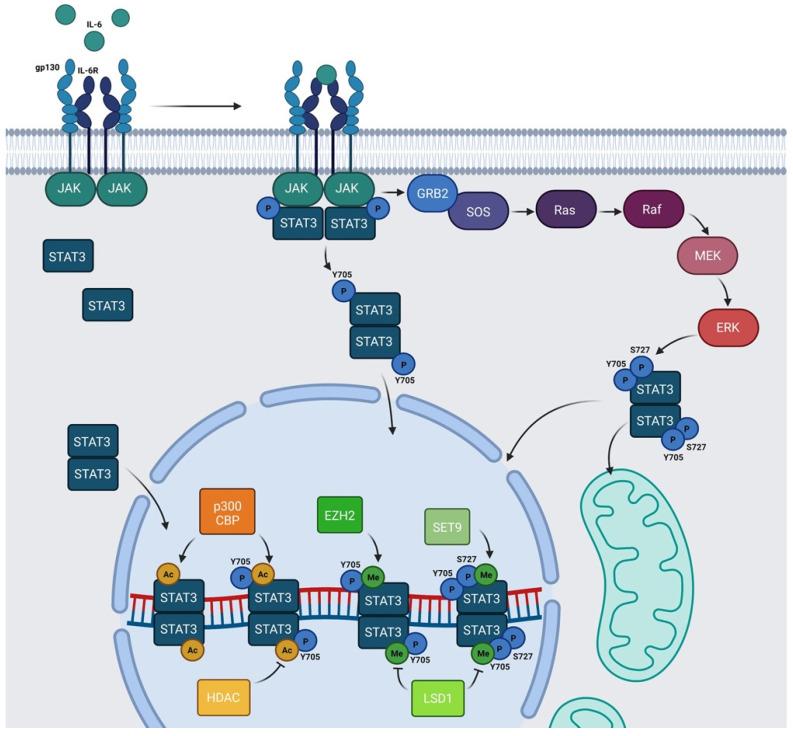
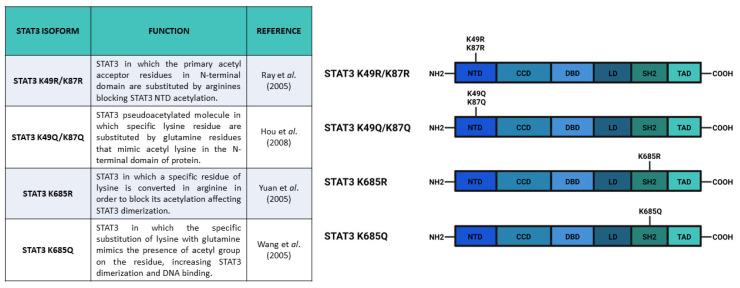
STAT3 is an important transcription factor that regulates cell growth and proliferation by regulating gene transcription of a plethora of genes. This protein also has many roles in cancer progression and several tumors such as prostate, lung, breast, and intestine cancers that are characterized by strong STAT3-dependent transcriptional activity. This protein is post-translationally modified in different ways according to cellular context and stimulus, and the same post-translational modification can have opposite effects in different cellular models. In this review, we describe the studies performed on the main modifications affecting the activity of STAT3: phosphorylation of tyrosine 705 and serine 727; acetylation of lysine 49, 87, 601, 615, 631, 685, 707, and 709; and methylation of lysine 49, 140, and 180. The extensive results obtained by different studies demonstrate that post-translational modifications drastically change STAT3 activities and that we need further analysis to properly elucidate all the functions of this multifaceted transcription factor.
信号转导和转录激活因子3(STAT3)是一种重要的转录因子,它通过调控众多基因的转录来调节细胞生长和增殖。该蛋白在癌症进展中也发挥着多种作用,在前列腺癌、肺癌、乳腺癌和肠癌等几种肿瘤中具有很强的依赖STAT3的转录活性。根据细胞环境和刺激因素,该蛋白会发生不同方式的翻译后修饰,并且相同的翻译后修饰在不同的细胞模型中可能产生相反的作用。在本综述中,我们描述了针对影响STAT3活性的主要修饰所开展的研究:酪氨酸705和丝氨酸727的磷酸化;赖氨酸49、87、601、615、631、685、707和709的乙酰化;以及赖氨酸49、140和180的甲基化。不同研究获得的大量结果表明,翻译后修饰会极大地改变STAT3的活性,我们需要进一步分析以全面阐明这种多面转录因子的所有功能。



 Zotero 插件