
根治性膀胱切除术治疗肌层浸润性膀胱癌患者微小残留病灶的尿液肿瘤 DNA 检测:一项队列研究。
Urine tumor DNA detection of minimal residual disease in muscle-invasive bladder cancer treated with curative-intent radical cystectomy: A cohort study.
机构信息
Division of Cancer Biology, Department of Radiation Oncology, Washington University School of Medicine, St. Louis, Missouri, United States of America.
Division of Medical Oncology, Department of Medicine, Washington University School of Medicine, St. Louis, Missouri, United States of America.
出版信息
PLoS Med. 2021 Aug 31;18(8):e1003732. doi: 10.1371/journal.pmed.1003732. eCollection 2021 Aug.
BACKGROUND
The standard of care treatment for muscle-invasive bladder cancer (MIBC) is radical cystectomy, which is typically preceded by neoadjuvant chemotherapy. However, the inability to assess minimal residual disease (MRD) noninvasively limits our ability to offer bladder-sparing treatment. Here, we sought to develop a liquid biopsy solution via urine tumor DNA (utDNA) analysis.
METHODS AND FINDINGS
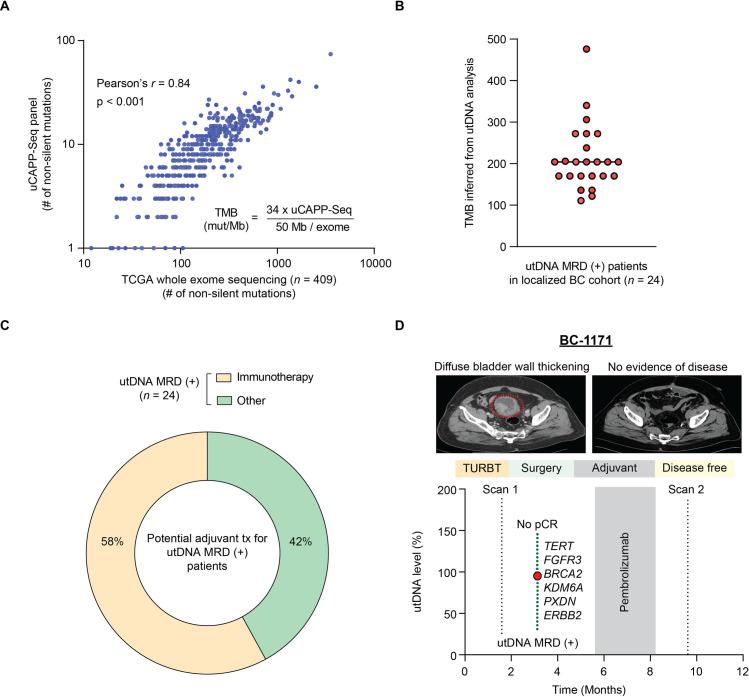
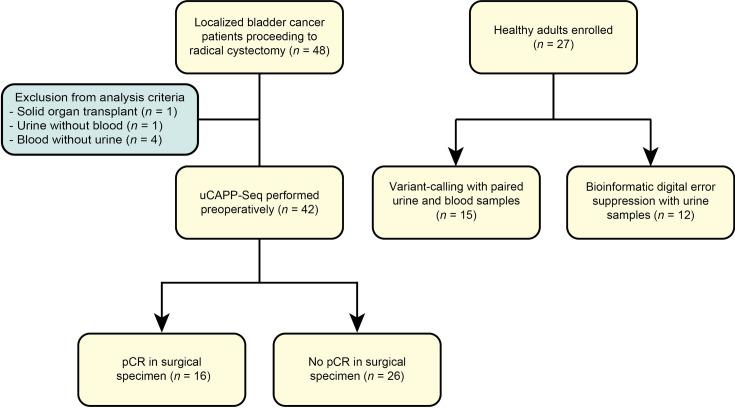
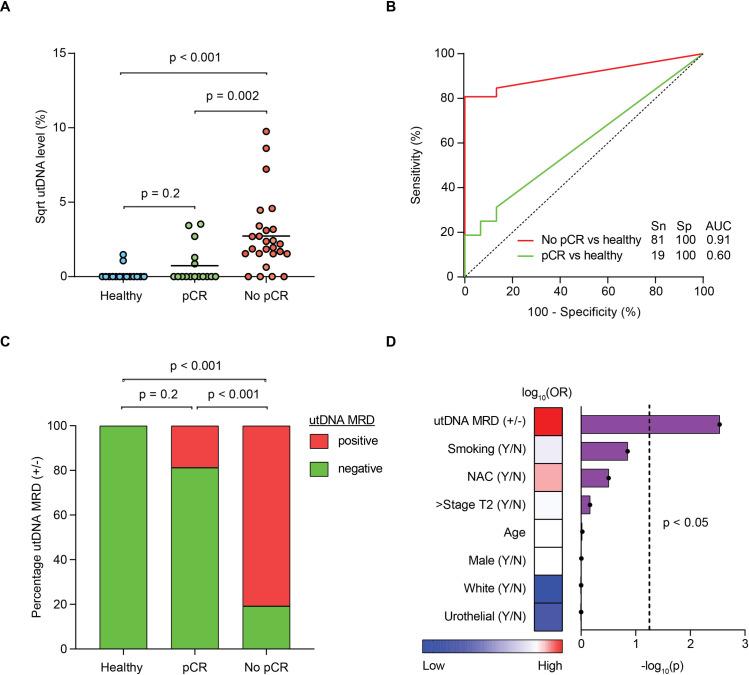
We applied urine Cancer Personalized Profiling by Deep Sequencing (uCAPP-Seq), a targeted next-generation sequencing (NGS) method for detecting utDNA, to urine cell-free DNA (cfDNA) samples acquired between April 2019 and November 2020 on the day of curative-intent radical cystectomy from 42 patients with localized bladder cancer. The average age of patients was 69 years (range: 50 to 86), of whom 76% (32/42) were male, 64% (27/42) were smokers, and 76% (32/42) had a confirmed diagnosis of MIBC. Among MIBC patients, 59% (19/32) received neoadjuvant chemotherapy. utDNA variant calling was performed noninvasively without prior sequencing of tumor tissue. The overall utDNA level for each patient was represented by the non-silent mutation with the highest variant allele fraction after removing germline variants. Urine was similarly analyzed from 15 healthy adults. utDNA analysis revealed a median utDNA level of 0% in healthy adults and 2.4% in bladder cancer patients. When patients were classified as those who had residual disease detected in their surgical sample (n = 16) compared to those who achieved a pathologic complete response (pCR; n = 26), median utDNA levels were 4.3% vs. 0%, respectively (p = 0.002). Using an optimal utDNA threshold to define MRD detection, positive utDNA MRD detection was highly correlated with the absence of pCR (p < 0.001) with a sensitivity of 81% and specificity of 81%. Leave-one-out cross-validation applied to the prediction of pathologic response based on utDNA MRD detection in our cohort yielded a highly significant accuracy of 81% (p = 0.007). Moreover, utDNA MRD-positive patients exhibited significantly worse progression-free survival (PFS; HR = 7.4; 95% CI: 1.4-38.9; p = 0.02) compared to utDNA MRD-negative patients. Concordance between urine- and tumor-derived mutations, determined in 5 MIBC patients, was 85%. Tumor mutational burden (TMB) in utDNA MRD-positive patients was inferred from the number of non-silent mutations detected in urine cfDNA by applying a linear relationship derived from The Cancer Genome Atlas (TCGA) whole exome sequencing of 409 MIBC tumors. We suggest that about 58% of these patients with high inferred TMB might have been candidates for treatment with early immune checkpoint blockade. Study limitations included an analysis restricted only to single-nucleotide variants (SNVs), survival differences diminished by surgery, and a low number of DNA damage response (DRR) mutations detected after neoadjuvant chemotherapy at the MRD time point.
CONCLUSIONS
utDNA MRD detection prior to curative-intent radical cystectomy for bladder cancer correlated significantly with pathologic response, which may help select patients for bladder-sparing treatment. utDNA MRD detection also correlated significantly with PFS. Furthermore, utDNA can be used to noninvasively infer TMB, which could facilitate personalized immunotherapy for bladder cancer in the future.
背景
肌层浸润性膀胱癌(MIBC)的标准治疗方法是根治性膀胱切除术,通常在该手术前进行新辅助化疗。然而,由于无法非侵入性地评估微小残留疾病(MRD),我们无法提供保膀胱治疗。在这里,我们试图通过尿液肿瘤 DNA(utDNA)分析开发一种液体活检解决方案。
方法和发现
我们应用了尿癌症个体化测序(uCAPP-Seq),这是一种用于检测 utDNA 的靶向下一代测序(NGS)方法,对 2019 年 4 月至 2020 年 11 月期间 42 名局部膀胱癌患者根治性膀胱切除术前一天采集的尿液细胞游离 DNA(cfDNA)样本进行了分析。患者的平均年龄为 69 岁(范围:50-86 岁),其中 76%(32/42)为男性,64%(27/42)为吸烟者,76%(32/42)被确诊为 MIBC。在 MIBC 患者中,59%(19/32)接受了新辅助化疗。utDNA 变异调用是在不预先对肿瘤组织进行测序的情况下进行的非侵入性检测。每位患者的总体 utDNA 水平由去除种系变异后具有最高变异等位基因分数的非沉默突变来表示。同样对 15 名健康成年人的尿液进行了分析。utDNA 分析显示,健康成年人的 utDNA 水平中位数为 0%,膀胱癌患者的 utDNA 水平中位数为 2.4%。当将患者分为手术样本中检测到残留疾病的患者(n=16)与实现病理完全缓解(pCR;n=26)的患者相比时,中位数 utDNA 水平分别为 4.3%和 0%(p=0.002)。使用最优 utDNA 阈值来定义 MRD 检测,阳性 utDNA MRD 检测与缺乏 pCR 高度相关(p<0.001),其敏感性为 81%,特异性为 81%。基于 utDNA MRD 检测在本队列中的预测病理反应的留一法交叉验证产生了非常显著的准确性(81%;p=0.007)。此外,utDNA MRD 阳性患者的无进展生存期(PFS;HR=7.4;95%CI:1.4-38.9;p=0.02)明显差于 utDNA MRD 阴性患者。在 5 名 MIBC 患者中,尿液和肿瘤衍生突变之间的一致性为 85%。utDNA MRD 阳性患者的肿瘤突变负担(TMB)是通过应用从 409 例 MIBC 肿瘤的癌症基因组图谱(TCGA)全外显子测序中得出的线性关系,从尿液 cfDNA 中检测到的非沉默突变数推断出来的。我们建议,大约 58%的这些高推断 TMB 患者可能是早期免疫检查点阻断治疗的候选者。研究的局限性包括仅分析单核苷酸变异(SNV)、手术差异减小的生存差异以及新辅助化疗后在 MRD 时间点检测到的 DNA 损伤反应(DRR)突变数量较少。
结论
在根治性膀胱切除术治疗膀胱癌之前进行 utDNA MRD 检测与病理反应显著相关,这可能有助于为保膀胱治疗选择患者。utDNA MRD 检测也与 PFS 显著相关。此外,utDNA 可用于非侵入性地推断 TMB,这可能有助于未来膀胱癌的个性化免疫治疗。


 Zotero 插件