
在脑膜炎和脑炎患者中增强病毒检测和宏基因组测序。
Enhanced Virus Detection and Metagenomic Sequencing in Patients with Meningitis and Encephalitis.
机构信息
Broad Institutegrid.66859.34 of MIT and Harvard, Cambridge, Massachusetts, USA.
Division of Infectious Diseases, Massachusetts General Hospitalgrid.32224.35, Boston, Massachusetts, USA.
出版信息
mBio. 2021 Aug 31;12(4):e0114321. doi: 10.1128/mBio.01143-21.
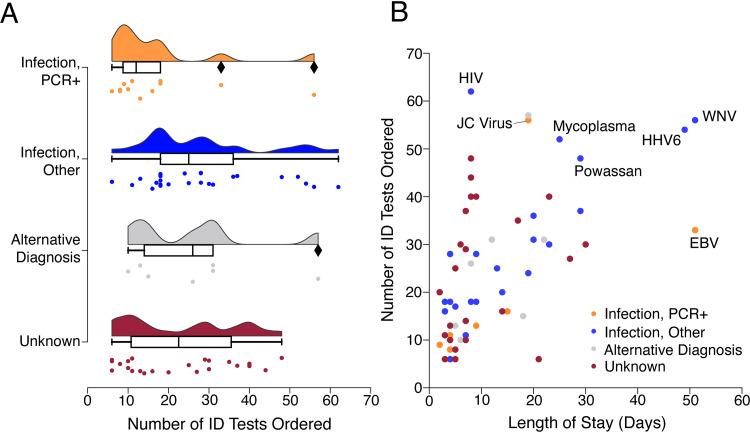
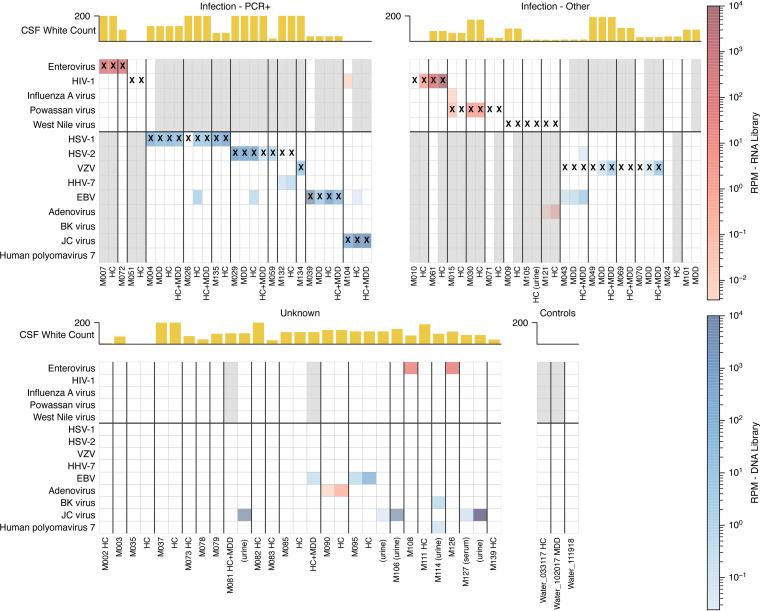
Meningitis and encephalitis are leading causes of central nervous system (CNS) disease and often result in severe neurological compromise or death. Traditional diagnostic workflows largely rely on pathogen-specific tests, sometimes over days to weeks, whereas metagenomic next-generation sequencing (mNGS) profiles all nucleic acid in a sample. In this single-center, prospective study, 68 hospitalized patients with known ( = 44) or suspected ( = 24) CNS infections underwent mNGS from RNA and DNA to identify potential pathogens and also targeted sequencing of viruses using hybrid capture. Using a computational metagenomic classification pipeline based on KrakenUniq and BLAST, we detected pathogen nucleic acid in cerebrospinal fluid (CSF) from 22 subjects, 3 of whom had no clinical diagnosis by routine workup. Among subjects diagnosed with infection by serology and/or peripheral samples, we demonstrated the utility of mNGS to detect pathogen nucleic acid in CSF, importantly for the Ixodes scapularis tick-borne pathogens Powassan virus, Borrelia burgdorferi, and Anaplasma phagocytophilum. We also evaluated two methods to enhance the detection of viral nucleic acid, hybrid capture and methylated DNA depletion. Hybrid capture nearly universally increased viral read recovery. Although results for methylated DNA depletion were mixed, it allowed the detection of varicella-zoster virus DNA in two samples that were negative by standard mNGS. Overall, mNGS is a promising approach that can test for multiple pathogens simultaneously, with efficacy similar to that of pathogen-specific tests, and can uncover geographically relevant infectious CNS disease, such as tick-borne infections in New England. With further laboratory and computational enhancements, mNGS may become a mainstay of workup for encephalitis and meningitis. Meningitis and encephalitis are leading global causes of central nervous system (CNS) disability and mortality. Current diagnostic workflows remain inefficient, requiring costly pathogen-specific assays and sometimes invasive surgical procedures. Despite intensive diagnostic efforts, 40 to 60% of people with meningitis or encephalitis have no clear cause of CNS disease identified. As diagnostic uncertainty often leads to costly inappropriate therapies, the need for novel pathogen detection methods is paramount. Metagenomic next-generation sequencing (mNGS) offers the unique opportunity to circumvent these challenges using unbiased laboratory and computational methods. Here, we performed comprehensive mNGS from 68 prospectively enrolled patients with known ( = 44) or suspected ( = 24) CNS viral infection from a single center in New England and evaluated enhanced methods to improve the detection of CNS pathogens, including those not traditionally identified in the CNS by nucleic acid detection. Overall, our work helps elucidate how mNGS can become integrated into the diagnostic toolkit for CNS infections.
脑膜炎和脑炎是中枢神经系统(CNS)疾病的主要原因,常导致严重的神经功能障碍或死亡。传统的诊断工作流程主要依赖于针对病原体的检测,有时需要数天到数周的时间,而宏基因组下一代测序(mNGS)则可以对样本中的所有核酸进行分析。在这项单中心前瞻性研究中,68 名患有已知( = 44 名)或疑似( = 24 名)中枢神经系统感染的住院患者接受了 RNA 和 DNA 的 mNGS,以确定潜在的病原体,并使用杂交捕获对病毒进行靶向测序。我们使用基于 KrakenUniq 和 BLAST 的计算宏基因组分类管道,在 22 名受试者的脑脊液(CSF)中检测到病原体核酸,其中 3 名受试者的常规检查没有临床诊断。在通过血清学和/或外周样本诊断为感染的受试者中,我们证明了 mNGS 可用于检测 CSF 中的病原体核酸,这对于伊蚊传播的病原体波瓦桑病毒、伯氏疏螺旋体和嗜吞噬细胞无形体尤为重要。我们还评估了两种增强病毒核酸检测的方法,即杂交捕获和甲基化 DNA 耗尽。杂交捕获几乎普遍增加了病毒的读取恢复。尽管甲基化 DNA 耗尽的结果参差不齐,但它允许在两个标准 mNGS 阴性的样本中检测到水痘带状疱疹病毒 DNA。总体而言,mNGS 是一种很有前途的方法,可以同时检测多种病原体,其功效与针对病原体的检测相似,并且可以发现与地理位置相关的中枢神经系统感染,例如新英格兰的蜱传感染。随着实验室和计算方法的进一步改进,mNGS 可能成为脑炎和脑膜炎检查的主要方法。
脑膜炎和脑炎是全球导致中枢神经系统(CNS)残疾和死亡的主要原因。目前的诊断工作流程仍然效率低下,需要昂贵的针对病原体的检测,有时还需要进行有创的手术。尽管进行了深入的诊断,但仍有 40%至 60%的脑膜炎或脑炎患者没有明确的中枢神经系统疾病原因。由于诊断不确定性通常导致昂贵的不适当治疗,因此需要新的病原体检测方法。宏基因组下一代测序(mNGS)提供了使用无偏实验室和计算方法克服这些挑战的独特机会。在这里,我们对来自新英格兰一家单中心的 68 名患有已知( = 44 名)或疑似( = 24 名)中枢神经系统病毒感染的患者进行了全面的 mNGS,并评估了增强方法以提高中枢神经系统病原体的检测,包括那些传统上通过核酸检测未在中枢神经系统中检测到的病原体。总的来说,我们的工作有助于阐明 mNGS 如何成为中枢神经系统感染诊断工具包的一部分。


 Zotero 插件