
游离 DNA 全基因组测序可检测组织活检不可行的癌症患者的拷贝数改变。
Genome-wide Sequencing of Cell-free DNA Enables Detection of Copy-number Alterations in Patients with Cancer Where Tissue Biopsy is Not Feasible.
机构信息
Sequenom, Inc, a wholly owned subsidiary of Laboratory Corporation of America Holdings, San Diego, California.
Laboratory Corporation of America, Durham, North Carolina.
出版信息
Mol Cancer Ther. 2021 Nov;20(11):2274-2279. doi: 10.1158/1535-7163.MCT-20-1066. Epub 2021 Aug 31.
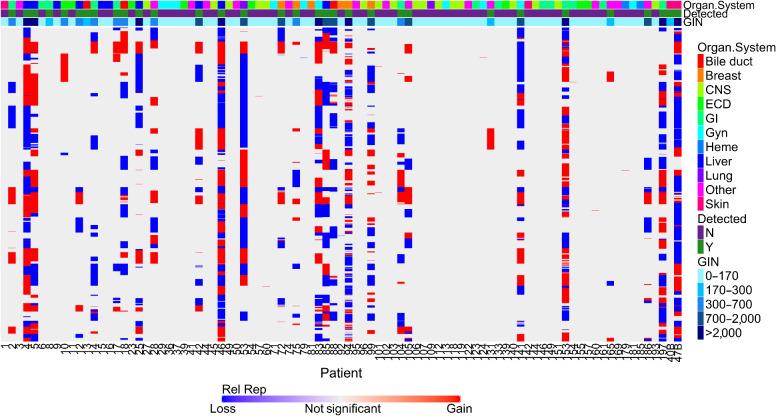
When tissue biopsy is not medically prudent or tissue is insufficient for molecular testing, alternative methods are needed. Because cell-free DNA (cfDNA) has been shown to provide a representative surrogate for tumor tissue, we sought to evaluate its utility in this clinical scenario. cfDNA was isolated from the plasma of patients and assayed with low-coverage (∼0.3×), genome-wide sequencing. Copy-number alterations (CNA) were identified and characterized using analytic methods originally developed for noninvasive prenatal testing (NIPT) and quantified using the genomic instability number (GIN), a metric that reflects the quantity and magnitude of CNAs across the genome. The technical variability of the GIN was first evaluated in an independent cohort comprising genome-wide sequencing results from 27,754 women who consented to have their samples used for research and whose NIPT results yielded no detected CNAs to establish a detection threshold. Subsequently, cfDNA sequencing data from 96 patients with known cancers but for whom a tissue biopsy could not be obtained are presented. An elevated GIN was detected in 35% of patients and detection rates varied by tumor origin. Collectively, CNAs covered 96.6% of all autosomes. Survival was significantly reduced in patients with an elevated GIN relative to those without. Overall, these data provide a proof of concept for the use of low-coverage, genome-wide sequencing of cfDNA from patients with cancer to obtain relevant molecular information in instances where tissue is difficult to access. These data may ultimately serve as an informative complement to other molecular tests.
当组织活检在医学上不可行或组织不足以进行分子检测时,就需要替代方法。由于游离细胞 DNA (cfDNA) 已被证明可作为肿瘤组织的代表性替代物,我们试图评估其在这种临床情况下的效用。从患者的血浆中分离 cfDNA,并进行低覆盖率(约 0.3×)、全基因组测序分析。使用最初为非侵入性产前检测 (NIPT) 开发的分析方法识别和表征拷贝数改变 (CNA),并使用基因组不稳定性数 (GIN) 进行定量,该指标反映了基因组中 CNA 的数量和幅度。首先在一个独立的队列中评估 GIN 的技术变异性,该队列包括 27754 名同意将其样本用于研究且其 NIPT 结果未检测到 CNA 的女性的全基因组测序结果,以建立检测阈值。随后,报告了 96 名已知患有癌症但无法进行组织活检的患者的 cfDNA 测序数据。在 35%的患者中检测到 GIN 升高,并且检测率因肿瘤起源而异。总的来说,CNA 覆盖了所有常染色体的 96.6%。与没有升高的 GIN 的患者相比,GIN 升高的患者的生存率显著降低。总的来说,这些数据为使用癌症患者 cfDNA 的低覆盖率、全基因组测序来获取难以获得组织时的相关分子信息提供了一个概念验证。这些数据最终可能成为其他分子测试的有益补充。

 Zotero 插件