
基于血凝的即时检测用于 SARS-CoV-2 抗体水平的床边半定量检测。
A Hemagglutination-Based Semiquantitative Test for Point-of-Care Determination of SARS-CoV-2 Antibody Levels.
机构信息
Department of Pathology, Johns Hopkins University School of Medicine, Baltimore, Maryland, USA.
Department of Medicine, University of Maryland Medical Center Midtown Campus, Baltimore, Maryland, USA.
出版信息
J Clin Microbiol. 2021 Nov 18;59(12):e0118621. doi: 10.1128/JCM.01186-21. Epub 2021 Sep 1.
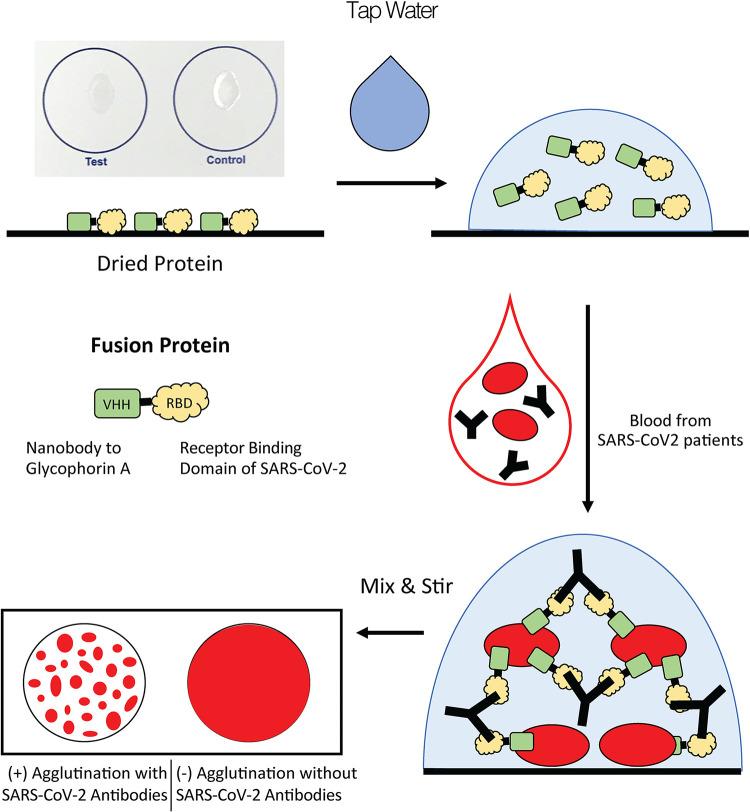
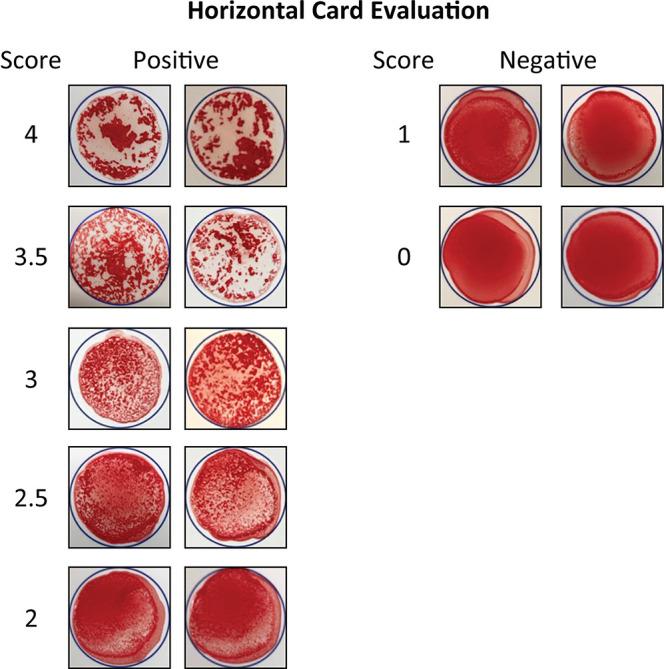
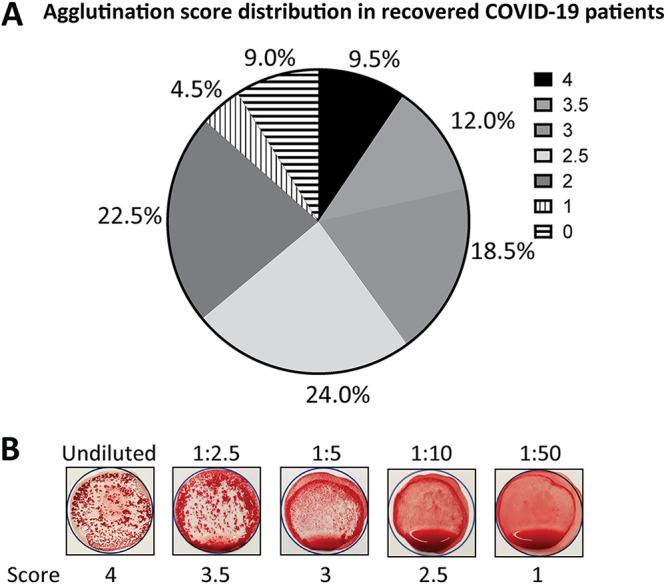
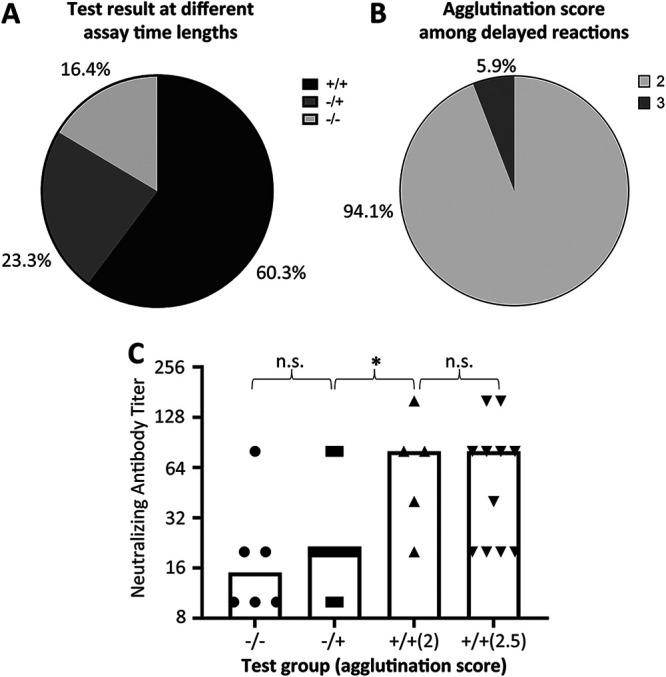
Serologic point-of-care tests to detect antibodies against severe acute respiratory syndrome coronavirus 2 (SARS-CoV-2) are an important tool in the COVID-19 pandemic. The majority of current point-of-care antibody tests developed for SARS-CoV-2 rely on lateral flow assays, but these do not offer quantitative information. To address this, we developed a novel antibody test leveraging hemagglutination, employing a dry card format currently used for typing ABO blood groups. Two hundred COVID-19 patient and 200 control plasma samples were reconstituted with O-negative red blood cells (RBCs) to form whole blood and added to dried viral-antibody fusion protein, followed by a stirring step and a tilting step, 3-min incubation, and a second tilting step. The sensitivities of the hemagglutination test, Euroimmun IgG enzyme-linked immunosorbent assay (ELISA), and receptor binding domain (RBD)-based CoronaChek lateral flow assay were 87.0%, 86.5%, and 84.5%, respectively, using samples obtained from recovered COVID-19 individuals. Testing prepandemic samples, the hemagglutination test had a specificity of 95.5%, compared to 97.3% and 98.9% for the ELISA and CoronaChek, respectively. A distribution of agglutination strengths was observed in COVID-19 convalescent-phase plasma samples, with the highest agglutination score (4) exhibiting significantly higher neutralizing antibody titers than weak positives (2) ( < 0.0001). Strong agglutinations were observed within 1 min of testing, and this shorter assay time also increased specificity to 98.5%. In conclusion, we developed a novel rapid, point-of-care RBC agglutination test for the detection of SARS-CoV-2 antibodies that can yield semiquantitative information on neutralizing antibody titer in patients. The 5-min test may find use in determination of serostatus prior to vaccination, postvaccination surveillance, and travel screening.
用于检测针对严重急性呼吸综合征冠状病毒 2 (SARS-CoV-2) 的抗体的即时血清学检测是 COVID-19 大流行中的重要工具。目前开发的大多数用于 SARS-CoV-2 的即时检测点抗体检测依赖于侧向流动检测,但这些检测不能提供定量信息。为了解决这个问题,我们开发了一种新型抗体检测方法,利用血凝作用,采用目前用于血型分型的干卡格式。将 200 例 COVID-19 患者和 200 例对照血浆样本与 O 型阴性红细胞 (RBC) 重构成全血,并加入干燥的病毒抗体融合蛋白,然后进行搅拌和倾斜步骤、3 分钟孵育和第二次倾斜步骤。使用从康复的 COVID-19 个体中获得的样本,血凝检测、Euroimmun IgG 酶联免疫吸附试验 (ELISA) 和基于受体结合域 (RBD) 的 CoronaChek 侧向流动检测的灵敏度分别为 87.0%、86.5%和 84.5%。使用来自大流行前样本的测试,血凝检测的特异性为 95.5%,而 ELISA 和 CoronaChek 的特异性分别为 97.3%和 98.9%。在 COVID-19 恢复期血浆样本中观察到凝集强度的分布,最高的凝集评分 (4) 显示出比弱阳性 (2) 更高的中和抗体滴度(<0.0001)。在测试后 1 分钟内观察到强烈的凝集,这种较短的检测时间还将特异性提高到 98.5%。总之,我们开发了一种新型的快速即时护理 RBC 凝集检测用于检测 SARS-CoV-2 抗体,可提供患者中和抗体滴度的半定量信息。5 分钟的测试可能在疫苗接种前确定血清状态、疫苗接种后监测和旅行筛查中找到用途。


 Zotero 插件