
2014-2019 年向世界卫生组织协调的侵袭性细菌疫苗可预防疾病监测网络报告的儿童细菌性脑膜炎全球数据报告
The Global Landscape of Pediatric Bacterial Meningitis Data Reported to the World Health Organization-Coordinated Invasive Bacterial Vaccine-Preventable Disease Surveillance Network, 2014-2019.
机构信息
Department of Immunization, Vaccines and Biologicals, World Health Organization, Geneva, Switzerland.
Division of Bacterial Diseases, US Centers for Disease Control and Prevention, Global Reference Laboratory for the WHO-coordinated Invasive Bacterial Vaccine Preventable Disease Surveillance Network, National Center for Immunization and Respiratory Disease, Atlanta, Georgia, USA.
出版信息
J Infect Dis. 2021 Sep 1;224(12 Suppl 2):S161-S173. doi: 10.1093/infdis/jiab217.
BACKGROUND
The World Health Organization (WHO) coordinates the Global Invasive Bacterial Vaccine-Preventable Diseases (IB-VPD) Surveillance Network to support vaccine introduction decisions and use. The network was established to strengthen surveillance and laboratory confirmation of meningitis caused by Streptococcus pneumoniae, Haemophilus influenzae, and Neisseria meningitidis.
METHODS
Sentinel hospitals report cases of children <5 years of age hospitalized for suspected meningitis. Laboratories report confirmatory testing results and strain characterization tested by polymerase chain reaction. In 2019, the network included 123 laboratories that follow validated, standardized testing and reporting strategies.
RESULTS
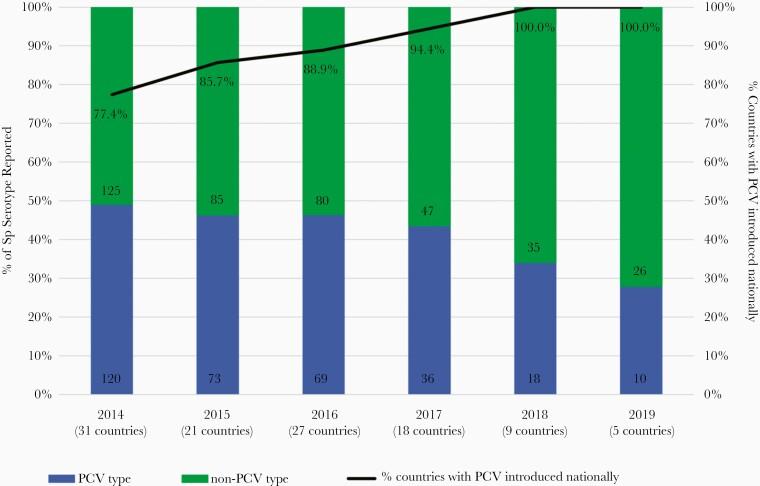
From 2014 through 2019, >137 000 suspected meningitis cases were reported by 58 participating countries, with 44.6% (n = 61 386) reported from countries in the WHO African Region. More than half (56.6%, n = 77 873) were among children <1 year of age, and 4.0% (n = 4010) died among those with reported disease outcome. Among suspected meningitis cases, 8.6% (n = 11 798) were classified as probable bacterial meningitis. One of 3 bacterial pathogens was identified in 30.3% (n = 3576) of these cases, namely S. pneumoniae (n = 2177 [60.9%]), H. influenzae (n = 633 [17.7%]), and N. meningitidis (n = 766 [21.4%]). Among confirmed bacterial meningitis cases with outcome reported, 11.0% died; case fatality ratio varied by pathogen (S. pneumoniae, 12.2%; H. influenzae, 6.1%; N. meningitidis, 11.0%). Among the 277 children who died with confirmed bacterial meningitis, 189 (68.2%) had confirmed S. pneumoniae. The proportion of pneumococcal cases with pneumococcal conjugate vaccine (PCV) serotypes decreased as the number of countries implementing PCV increased, from 77.8% (n = 273) to 47.5% (n = 248). Of 397 H. influenzae specimens serotyped, 49.1% (n = 195) were type b. Predominant N. meningitidis serogroups varied by region.
CONCLUSIONS
This multitier, global surveillance network has supported countries in detecting and serotyping the 3 principal invasive bacterial pathogens that cause pediatric meningitis. Streptococcus pneumoniae was the most common bacterial pathogen detected globally despite the growing number of countries that have nationally introduced PCV. The large proportions of deaths due to S. pneumoniae reflect the high proportion of meningitis cases caused by this pathogen. This global network demonstrated a strong correlation between PCV introduction status and reduction in the proportion of pneumococcal meningitis infections caused by vaccine serotypes. Maintaining case-based, active surveillance with laboratory confirmation for prioritized vaccine-preventable diseases remains a critical component of the global agenda in public health.The World Health Organization (WHO)-coordinated Invasive Bacterial Vaccine-Preventable Disease (IB-VPD) Surveillance Network reported data from 2014 to 2019, contributing to the estimates of the disease burden and serotypes of pediatric meningitis caused by Streptococcus pneumoniae, Haemophilus influenzae and Neisseria meningitidis.
背景
世界卫生组织(WHO)协调全球侵袭性细菌性疫苗可预防疾病(IB-VPD)监测网络,以支持疫苗引入决策和使用。该网络旨在加强对肺炎链球菌、流感嗜血杆菌和脑膜炎奈瑟菌引起的脑膜炎的监测和实验室确认。
方法
哨点医院报告<5 岁因疑似脑膜炎住院的儿童病例。实验室报告聚合酶链反应(PCR)确认检测结果和菌株特征。2019 年,该网络包括 123 个遵循经过验证、标准化检测和报告策略的实验室。
结果
2014 年至 2019 年,来自 58 个参与国家的 137000 多例疑似脑膜炎病例被报告,其中来自世卫组织非洲区域的国家报告了 44.6%(n=61386)。超过一半(56.6%,n=77873)发生在<1 岁的儿童中,报告疾病结局的病例中有 4.0%(n=4010)死亡。在疑似脑膜炎病例中,8.6%(n=11798)被归类为可能的细菌性脑膜炎。在这些病例中,有 30.3%(n=3576)确定了一种细菌病原体,即肺炎链球菌(n=2177 [60.9%])、流感嗜血杆菌(n=633 [17.7%])和脑膜炎奈瑟菌(n=766 [21.4%])。在报告结局的确诊细菌性脑膜炎病例中,有 11.0%死亡;病例死亡率因病原体而异(肺炎链球菌,12.2%;流感嗜血杆菌,6.1%;脑膜炎奈瑟菌,11.0%)。在 277 名死于确诊细菌性脑膜炎的儿童中,189 名(68.2%)患有确诊肺炎链球菌。随着实施 PCV 的国家数量增加,PCV 血清型的肺炎球菌病例比例从 77.8%(n=273)下降到 47.5%(n=248)。在 397 份流感嗜血杆菌标本中,49.1%(n=195)为 b 型。不同地区优势脑膜炎奈瑟菌血清群不同。
结论
该多层、全球监测网络支持各国检测和血清分型导致小儿脑膜炎的 3 种主要侵袭性细菌性病原体。尽管越来越多的国家在全国范围内引入了 PCV,但肺炎链球菌仍然是全球最常见的细菌病原体。由于这种病原体引起的脑膜炎病例比例较高,导致的死亡比例也较高。该全球网络表明 PCV 引入状况与疫苗血清型引起的肺炎球菌脑膜炎感染比例下降之间存在很强的相关性。针对优先疫苗可预防疾病,保持基于病例的、有实验室确认的主动监测仍然是全球公共卫生议程的重要组成部分。
世界卫生组织(WHO)协调的侵袭性细菌性疫苗可预防疾病(IB-VPD)监测网络报告了 2014 年至 2019 年的数据,有助于估计由肺炎链球菌、流感嗜血杆菌和脑膜炎奈瑟菌引起的小儿脑膜炎的疾病负担和血清型。


 Zotero 插件