
度洛西汀治疗膝骨关节炎疼痛的更新系统评价和荟萃分析。
An Updated Systematic Review and Meta-analysis of Duloxetine for Knee Osteoarthritis Pain.
机构信息
Research Institute of Orthopaedics and Traumatology, Shuguang Hospital affiliated to Shanghai University of Traditional Chinese Medicine, Shanghai, China.
出版信息
Clin J Pain. 2021 Nov 1;37(11):852-862. doi: 10.1097/AJP.0000000000000975.
OBJECTIVE
We conducted the updated systematic review and meta-analysis of the best available quantitative and qualitative evidence to evaluate the effects and safety of duloxetine for the treatment of knee osteoarthritis (OA) pain.
METHODS
A comprehensive literature search used 3 English and 4 Chinese biomedical databases from inception through July 10, 2020. We included randomized controlled trials of duloxetine with intervention duration of 2 weeks or longer for knee OA. The primary outcome was pain intensity measured by Brief Pain Inventory and the Western Ontario and McMaster Universities Osteoarthritis Index (WOMAC) pain subscale. Secondary outcome measurements included 36-Item Short Form Health Survey, Patient's Global Impression of Improvement, Clinical Global Impressions of Severity, and adverse events (AEs). The quality of all included studies was evaluated using the Cochrane risk-of-bias criteria. The review was registered in the PROSPERO (CRD 42020194072).
RESULTS
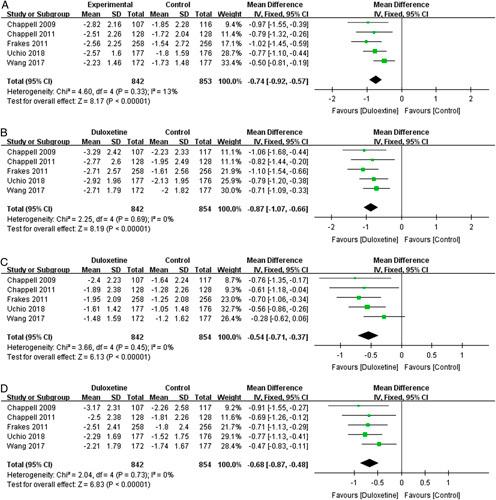
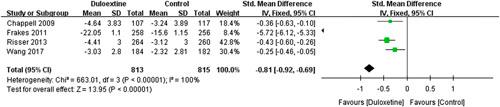
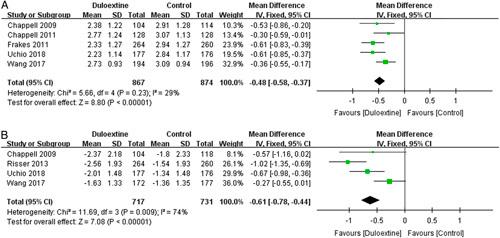
Six studies totaling 2059 patients met the eligibility criteria. Duloxetine had significant reductions in Brief Pain Inventory 24 hours average pain (mean difference [MD]=-0.74; 95% confidence interval [CI], -0.92 to -0.57; P<0.00001; I2=13%; 5 trials; 1695 patients); patient general activity (MD=-0.76; 95% CI, -0.96 to -0.56; P<0.00001; I2=0%; 5 trials; 1694 patients) WOMAC physical function subscale (MD=-4.22; 95% CI, -5.14 to -3.30; P<0.00001; I2=26%; 5 trials; 1986 patients); Patient's Global Impression of Improvement (MD=-0.48; 95% CI, -0.58 to -0.37; P<0.00001; I2=29%; 5 trials; 1741 patients); and Clinical Global Impressions of Severity (MD=-0.34; 95% CI, -0.44 to -0.24; P<0.00001; I2=0%; 4 trials; 1178 patients) compared with placebo control. However, no difference on WOMAC pain subscale (standard mean difference=-1.68; 95% CI, -3.45 to 0.08; P=0.06; I2=100%; 3 trials; 1104 patients) and in serious AEs (risk ratio=0.92; 95% CI, 0.40-2.11; P=0.84; I2=0%; 5 trials; 1762 patients) between duloxetine and placebo. Furthermore, duloxetine failed to show superior effects for improving the life quality and demonstrated more treatment-emergent AEs.
CONCLUSION
Duloxetine may be an effective treatment option for knee OA patients but further rigorously designed and well-controlled randomized trials are warranted.
目的
我们对最佳现有定量和定性证据进行了更新的系统评价和荟萃分析,以评估度洛西汀治疗膝骨关节炎(OA)疼痛的效果和安全性。
方法
使用 3 个英文和 4 个中文生物医学数据库,从创建到 2020 年 7 月 10 日进行全面文献检索。我们纳入了度洛西汀干预时间为 2 周或更长时间的膝 OA 的随机对照试验。主要结局指标为 Brief Pain Inventory 和 Western Ontario and McMaster Universities Osteoarthritis Index(WOMAC)疼痛子量表测量的疼痛强度。次要结局测量包括 36-Item Short Form Health Survey、患者总体改善印象、临床总体印象严重程度和不良事件(AE)。使用 Cochrane 偏倚风险标准评估所有纳入研究的质量。该综述已在 PROSPERO(CRD42020194072)中注册。
结果
符合入选标准的 6 项研究共纳入 2059 例患者。度洛西汀在 24 小时平均疼痛的 Brief Pain Inventory 中具有显著降低作用(平均差值[MD]=-0.74;95%置信区间[CI],-0.92 至-0.57;P<0.00001;I2=13%;5 项试验;1695 例患者);患者一般活动(MD=-0.76;95%CI,-0.96 至-0.56;P<0.00001;I2=0%;5 项试验;1694 例患者)WOMAC 躯体功能子量表(MD=-4.22;95%CI,-5.14 至-3.30;P<0.00001;I2=26%;5 项试验;1986 例患者);患者总体改善印象(MD=-0.48;95%CI,-0.58 至-0.37;P<0.00001;I2=29%;5 项试验;1741 例患者)和临床总体印象严重程度(MD=-0.34;95%CI,-0.44 至-0.24;P<0.00001;I2=0%;4 项试验;1178 例患者)均优于安慰剂对照。然而,在 WOMAC 疼痛子量表(标准均数差=-1.68;95%CI,-3.45 至 0.08;P=0.06;I2=100%;3 项试验;1104 例患者)和严重不良事件(风险比=0.92;95%CI,0.40-2.11;P=0.84;I2=0%;5 项试验;1762 例患者)方面,度洛西汀与安慰剂之间无差异。此外,度洛西汀在改善生活质量方面并未显示出优越的效果,并且表现出更多的治疗相关不良事件。
结论
度洛西汀可能是膝骨关节炎患者的有效治疗选择,但需要进一步进行设计严谨且对照良好的随机试验。




 Zotero 插件