
训练有素的固有免疫对 T 细胞反应的影响;临床意义和未来研究的知识空白。
The Effects of Trained Innate Immunity on T Cell Responses; Clinical Implications and Knowledge Gaps for Future Research.
机构信息
Human and Translational Immunology Group, Department of Clinical Medicine, Trinity Translational Medicine Institute, St James's Hospital, Trinity College Dublin, The University of Dublin, Dublin, Ireland.
Immune Regulation Research Group, School of Biochemistry and Immunology, Trinity Biomedical Sciences Institute, Trinity College Dublin, The University of Dublin, Dublin, Ireland.
出版信息
Front Immunol. 2021 Aug 19;12:706583. doi: 10.3389/fimmu.2021.706583. eCollection 2021.
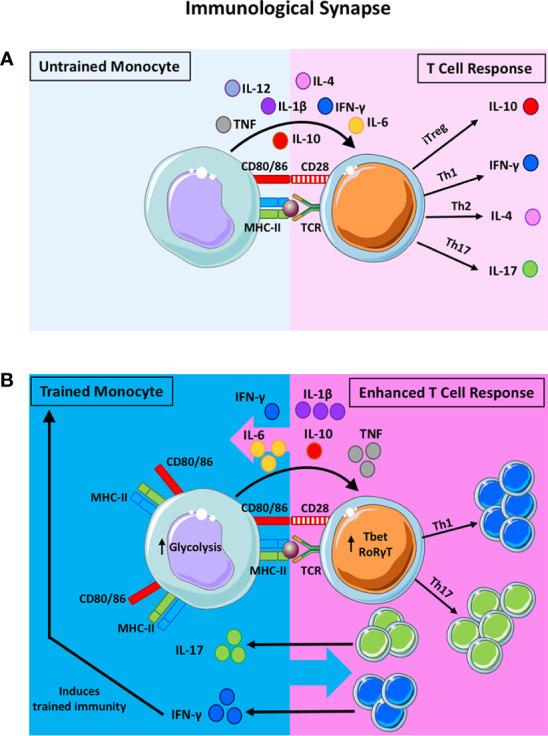
The burgeoning field of innate immune training, also called trained immunity, has given immunologists new insights into the role of innate responses in protection against infection and in modulating inflammation. Moreover, it has led to a paradigm shift in the way we think about immune memory and the interplay between innate and adaptive immune systems in conferring immunity against pathogens. Trained immunity is the term used to describe the medium-term epigenetic and metabolic reprogramming of innate immune cells in peripheral tissues or in the bone marrow stem cell niche. It is elicited by an initial challenge, followed by a significant period of rest that results in an altered response to a subsequent, unrelated challenge. Trained immunity can be associated with increased production of proinflammatory mediators, such as IL-1β, TNF and IL-6, and increased expression of markers on innate immune cells associated with antigen presentation to T cells. The microenvironment created by trained innate immune cells during the secondary challenge may have profound effects on T cell responses, such as altering the differentiation, polarisation and function of T cell subtypes, including Th17 cells. In addition, the Th1 cytokine IFN-γ plays a critical role in establishing trained immunity. In this review, we discuss the evidence that trained immunity impacts on or can be impacted by T cells. Understanding the interplay between innate immune training and how it effects adaptive immunity will give insights into how this phenomenon may affect the development or progression of disease and how it could be exploited for therapeutic interventions or to enhance vaccine efficacy.
先天免疫训练领域(也称为训练免疫)的兴起,使免疫学家对先天免疫反应在抗感染和调节炎症中的作用有了新的认识。此外,它还导致了我们对免疫记忆以及先天免疫系统和适应性免疫系统在赋予针对病原体的免疫方面相互作用的思维方式发生了范式转变。训练免疫是指在外周组织或骨髓干细胞龛中,先天免疫细胞的中期表观遗传和代谢重编程。它是由最初的挑战引发的,随后是一个显著的休息期,导致对随后的、不相关的挑战产生改变的反应。训练免疫可与促炎介质(如 IL-1β、TNF 和 IL-6)的产生增加以及与抗原呈递给 T 细胞相关的先天免疫细胞标志物的表达增加相关。在二次挑战期间,经过训练的先天免疫细胞所产生的微环境可能对 T 细胞反应产生深远影响,例如改变 T 细胞亚型(包括 Th17 细胞)的分化、极化和功能。此外,Th1 细胞因子 IFN-γ 在建立训练免疫方面发挥着关键作用。在这篇综述中,我们讨论了训练免疫对 T 细胞的影响或可能受到 T 细胞影响的证据。了解先天免疫训练的相互作用及其对适应性免疫的影响,将深入了解这一现象可能如何影响疾病的发展或进展,以及如何利用它进行治疗干预或增强疫苗效力。

 Zotero 插件