
游离 DNA 中的多层次拷贝数变异用于预测 HCC 根治性治疗的预后。
Multiple-level copy number variations in cell-free DNA for prognostic prediction of HCC with radical treatments.
机构信息
Department of Hepatobiliary Surgery, Xijing Hospital, Fourth Military Medical University, Xi'an, China.
Department of Physiology and Pathophysiology, State Key Laboratory of Cancer Biology, Fourth Military Medical University, Xi'an, China.
出版信息
Cancer Sci. 2021 Nov;112(11):4772-4784. doi: 10.1111/cas.15128. Epub 2021 Sep 14.
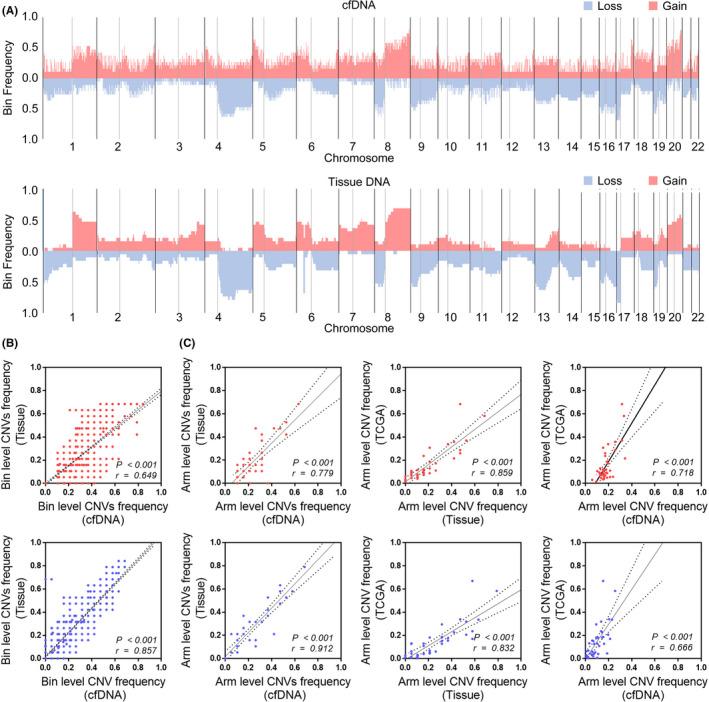
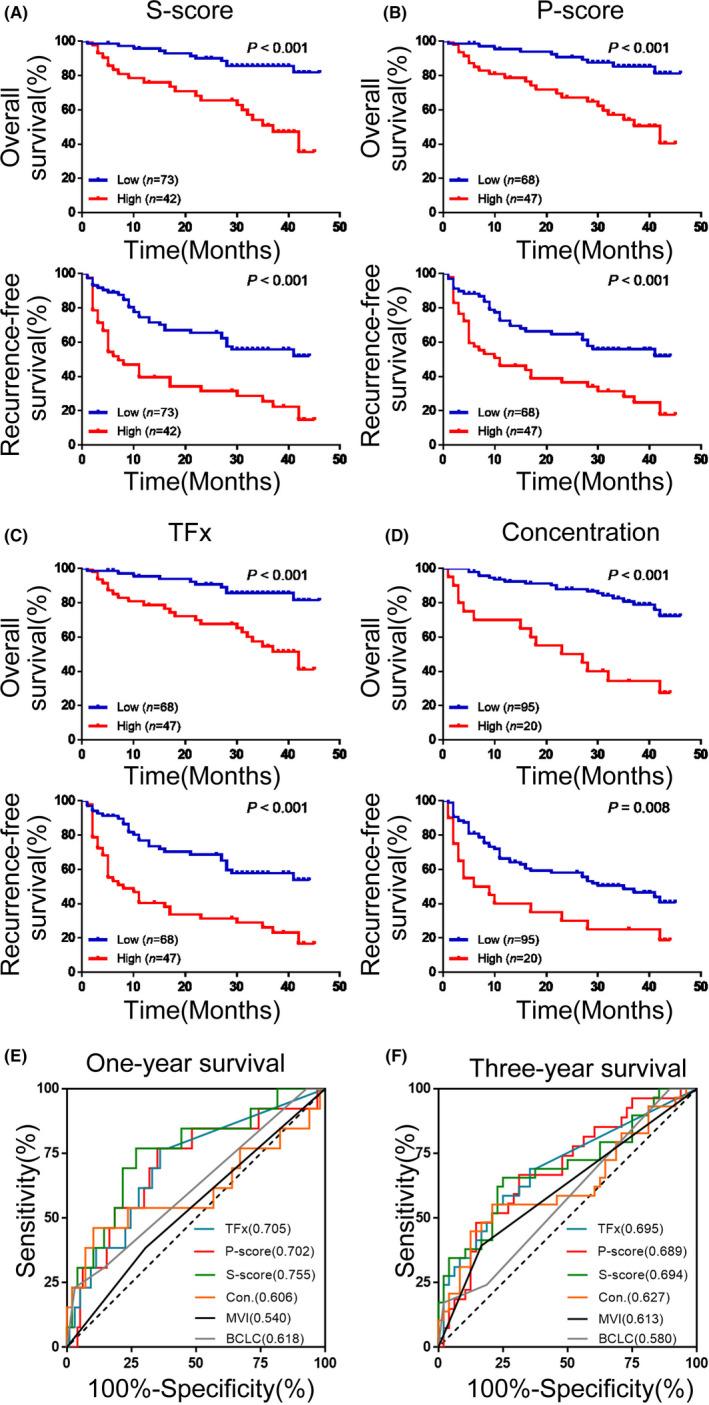
Copy number variations (CNVs) in cell-free DNA (cfDNA) are emerging as noninvasive biomarkers for various cancers. However, multiple-level analysis of cfDNA CNVs for hepatocellular carcinoma (HCC) patients with radical treatments remains uninvestigated. Here, CNVs at genome-wide, chromosomal-arm, and bin levels were analyzed in cfDNA from 117 HCC patients receiving radical treatments. Then, the relationship between cfDNA CNVs and clinical outcomes was explored. Our results showed that a concordant profile of CNVs was observed between cfDNA and tumor tissue DNA. Three genome-wide CNV indicators including tumor fraction (TFx), prediction score (P-score), and stability score (S-score) were calculated and demonstrated to exhibit significant correlation with poorer overall survival (OS) and recurrence-free survival (RFS). Furthermore, the high-frequency cfDNA CNVs at chromosomal-arm level including the loss of 4q, 17p, and 19p and the gain of 8q and 1q clearly predicted HCC prognosis. Finally, a bin-level risk score was constructed to improve the ability of CNVs in predicting prognosis. Altogether, our study indicates that the multiple-level cfDNA CNVs are significantly associated with OS and RFS in HCC patients with radical treatments, suggesting that cfDNA CNVs detected by low-coverage whole-genome sequencing (WGS) may be used as potential prognostic biomarkers of HCC patients.
游离 DNA(cfDNA)中的拷贝数变异(CNVs)正在成为各种癌症的非侵入性生物标志物。然而,对于接受根治性治疗的肝细胞癌(HCC)患者的 cfDNA 进行多层次的 CNV 分析尚未得到研究。在这里,对 117 名接受根治性治疗的 HCC 患者的 cfDNA 进行了全基因组、染色体臂和 bin 水平的 CNV 分析。然后,探讨了 cfDNA CNVs 与临床结局的关系。我们的研究结果表明,cfDNA 和肿瘤组织 DNA 之间观察到一致的 CNV 谱。计算了三个全基因组 CNV 指标,包括肿瘤分数(TFx)、预测评分(P-score)和稳定性评分(S-score),结果表明它们与较差的总生存期(OS)和无复发生存期(RFS)显著相关。此外,染色体臂水平上高频的 cfDNA CNVs,包括 4q、17p 和 19p 的缺失以及 8q 和 1q 的获得,清楚地预测了 HCC 的预后。最后,构建了 bin 级风险评分,以提高 CNVs 预测预后的能力。总之,我们的研究表明,根治性治疗的 HCC 患者的多层次 cfDNA CNVs 与 OS 和 RFS 显著相关,提示低覆盖全基因组测序(WGS)检测到的 cfDNA CNVs 可能作为 HCC 患者的潜在预后生物标志物。


 Zotero 插件