
普瑞巴林和加巴喷丁治疗脊髓损伤相关性神经病理性疼痛患者:一项网状Meta分析
Pregabalin and Gabapentin in Patients with Spinal Cord Injury-Related Neuropathic Pain: A Network Meta-Analysis.
作者信息
Tong Chen, Zhengyao Zuo, Mei Li, Dongpo Su, Qian Han, Fengqun Mu
机构信息
Department of Neurosurgery, North China University of Science and Technology Affiliated Hospital, Tangshan, 063000, Hebei, China.
Department of Neurology, Gongren Hospital, Tangshan, 063000, Hebei, China.
出版信息
Pain Ther. 2021 Dec;10(2):1497-1509. doi: 10.1007/s40122-021-00302-8. Epub 2021 Sep 7.
INTRODUCTION
This study was performed to explore the efficacy and safety of pregabalin and gabapentin in patients with spinal cord injury (SCI)-induced neuropathic pain to determine which treatment is most suitable for such patients.
METHODS
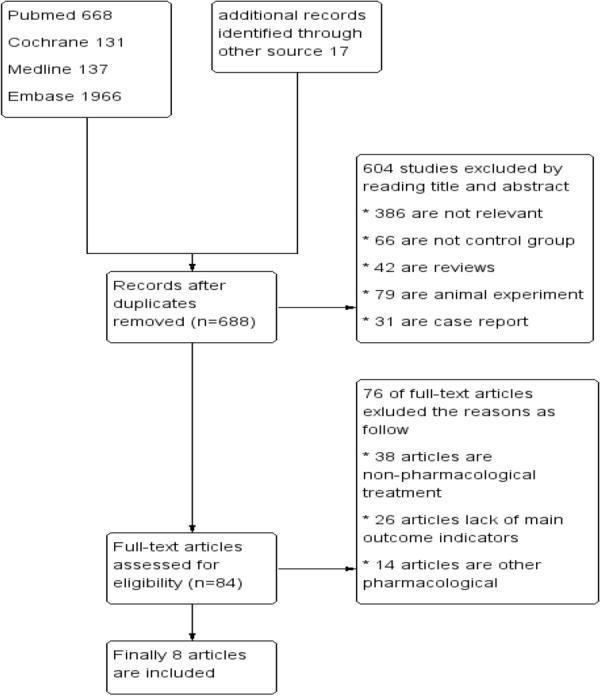
We searched the PubMed, MEDLINE, Embase, and Cochrane Library databases from database inception to August 31, 2020. The quality of the included studies was assessed. We selected the average pain intensity after treatment and the proportion of patients who discontinued treatment because of adverse effects as the outcome indicators for efficacy and safety, respectively. Statistical analyses were performed using Stata, v16.0, and RevMan, v5.3, software.
RESULTS
We included eight randomized controlled trials that examined four interventions (pregabalin, gabapentin, carbamazepine, and amitriptyline). Based on the average pain intensity after treatment, the efficacy order from highest to lowest was pregabalin, gabapentin, amitriptyline, carbamazepine, and placebo. Based on the proportion of patients who discontinued treatment because of adverse effects, the order from highest to lowest was pregabalin, amitriptyline, carbamazepine, gabapentin, and placebo. In addition, five studies reported the overall incidence of treatment-related adverse effects for two interventions (pregabalin and gabapentin). According to the pooled analysis of these studies, the order for the overall incidence of treatment-related adverse effects from highest to lowest was pregabalin, gabapentin, and placebo.
CONCLUSIONS
This study revealed that for patients with SCI-related neuropathic pain, pregabalin was the most effective for relieving pain, whereas gabapentin performed better in aspects associated with drug therapy-related safety.
引言
本研究旨在探讨普瑞巴林和加巴喷丁对脊髓损伤(SCI)所致神经性疼痛患者的疗效和安全性,以确定哪种治疗方法最适合此类患者。
方法
我们检索了从数据库建立至2020年8月31日的PubMed、MEDLINE、Embase和Cochrane图书馆数据库。对纳入研究的质量进行评估。我们分别选择治疗后的平均疼痛强度以及因不良反应而停药的患者比例作为疗效和安全性的结局指标。使用Stata v16.0和RevMan v5.3软件进行统计分析。
结果
我们纳入了八项随机对照试验,这些试验考察了四种干预措施(普瑞巴林、加巴喷丁、卡马西平和阿米替林)。基于治疗后的平均疼痛强度,疗效从高到低依次为普瑞巴林、加巴喷丁、阿米替林、卡马西平和安慰剂。基于因不良反应而停药的患者比例,从高到低依次为普瑞巴林、阿米替林、卡马西平、加巴喷丁和安慰剂。此外,五项研究报告了两种干预措施(普瑞巴林和加巴喷丁)与治疗相关不良反应的总体发生率。根据这些研究的汇总分析,与治疗相关不良反应的总体发生率从高到低依次为普瑞巴林、加巴喷丁和安慰剂。
结论
本研究表明,对于SCI相关神经性疼痛患者,普瑞巴林在缓解疼痛方面最有效,而加巴喷丁在与药物治疗相关安全性方面表现更好。



 Zotero 插件