
使用全基因组测序方法描述印度人群中疫苗前进化流行病学的基因组数据集。
genomic datasets from an Indian population describing pre-vaccine evolutionary epidemiology using a whole genome sequencing approach.
机构信息
Central Research Laboratory, Kempegowda Institute of Medical Sciences, Bangalore, India.
Hubert Department of Global Health, Rollins School of Public Health, Emory University, Atlanta, GA, USA.
出版信息
Microb Genom. 2021 Sep;7(9). doi: 10.1099/mgen.0.000645.
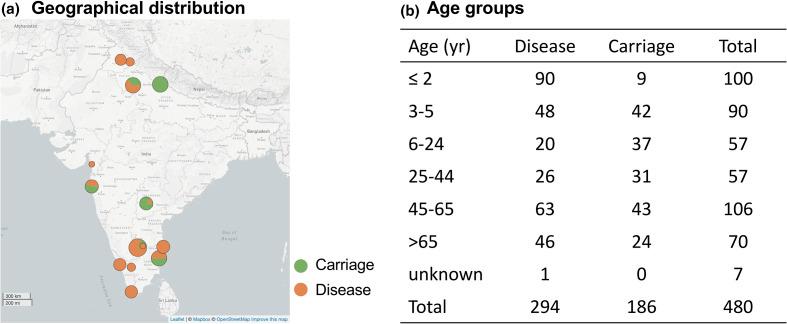
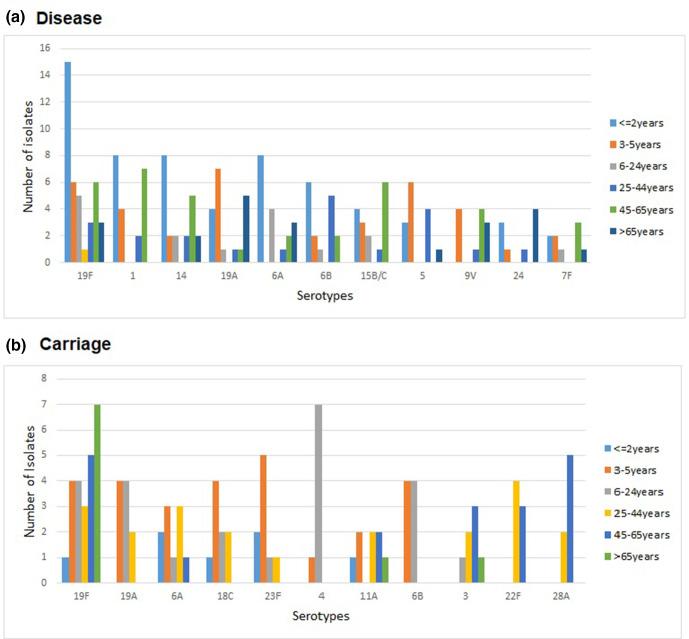
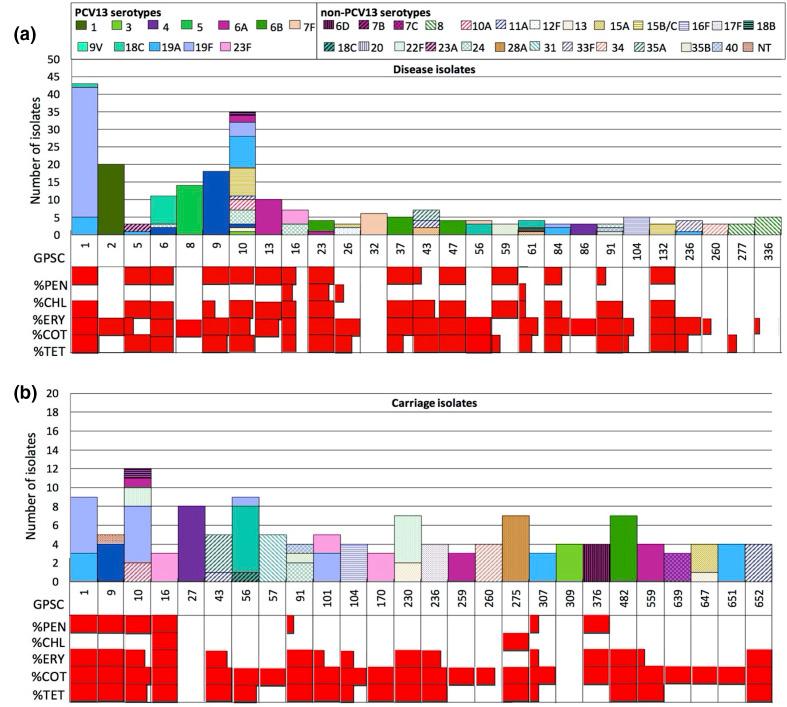
Globally, India has a high burden of pneumococcal disease, and pneumococcal conjugate vaccine (PCV) has been rolled out in different phases across the country since May 2017 in the national infant immunization programme (NIP). To provide a baseline for assessing the impact of the vaccine on circulating pneumococci in India, genetic characterization of pneumococcal isolates detected prior to introduction of PCV would be helpful. Here we present a population genomic study of 480 isolates collected across India and from all age groups before vaccine introduction (2009-2017), including 294 isolates from pneumococcal disease and 186 collected through nasopharyngeal surveys. Population genetic structure, serotype and antimicrobial susceptibility profile were characterized and predicted from whole-genome sequencing data. Our findings revealed high levels of genetic diversity represented by 110 Global Pneumococcal Sequence Clusters (GPSCs) and 54 serotypes. Serotype 19F and GPSC1 (CC320) was the most common serotype and pneumococcal lineage, respectively. Coverage of PCV13 (Pfizer) and 10-valent Pneumosil (Serum Institute of India) serotypes in age groups of ≤2 and 3-5 years were 63-75 % and 60-69 %, respectively. Coverage of PPV23 (Merck) serotypes in age groups of ≥50 years was 62 % (98/158). Among the top five lineages causing disease, GPSC10 (CC230), which ranked second, is the only lineage that expressed both PCV13 (serotypes 3, 6A, 14, 19A and 19F) and non-PCV13 (7B, 13, 10A, 11A, 13, 15B/C, 22F, 24F) serotypes. It exhibited multidrug resistance and was the largest contributor (17 %, 18/103) of NVTs in the disease-causing population. Overall, 42 % (202/480) of isolates were penicillin-resistant (minimum inhibitory concentration ≥0.12 µg ml) and 45 % (217/480) were multidrug-resistant. Nine GPSCs (GPSC1, 6, 9, 10, 13, 16, 43, 91, 376) were penicillin-resistant and among them six were multidrug-resistant. Pneumococci expressing PCV13 serotypes had a higher prevalence of antibiotic resistance. Sequencing of pneumococcal genomes has significantly improved our understanding of the biology of these bacteria. This study, describing the pneumococcal disease and carriage epidemiology pre-PCV introduction, demonstrates that 60-75 % of pneumococcal serotypes in children ≤5 years are covered by PCV13 and Pneumosil. Vaccination against pneumococci is very likely to reduce antibiotic resistance. A multidrug-resistant pneumococcal lineage, GPSC10 (CC230), is a high-risk clone that could mediate serotype replacement.
全球范围内,印度的肺炎球菌疾病负担很高,自 2017 年 5 月以来,肺炎球菌结合疫苗(PCV)已在全国儿童免疫规划(NIP)中分阶段推出。为了为评估疫苗对印度流行肺炎球菌的影响提供基线,在引入 PCV 之前检测到的肺炎球菌分离株的遗传特征将很有帮助。在这里,我们对 480 株在疫苗引入前(2009-2017 年)从印度各地和所有年龄组收集的分离株进行了人群基因组研究,包括 294 株来自肺炎球菌病的分离株和 186 株通过鼻咽调查收集的分离株。我们对人群遗传结构、血清型和抗生素耐药性特征进行了表征,并从全基因组测序数据中进行了预测。我们的研究结果表明,存在高度的遗传多样性,由 110 个全球肺炎球菌序列群(GPSC)和 54 个血清型组成。血清型 19F 和 GPSC1(CC320)分别是最常见的血清型和肺炎球菌谱系。≤2 岁和 3-5 岁年龄组中,PCV13(辉瑞)和 10 价肺炎球菌多糖疫苗(印度血清研究所)的血清型覆盖率分别为 63-75%和 60-69%。≥50 岁年龄组中,PPV23(默克)血清型的覆盖率为 62%(98/158)。在引起疾病的前 5 个谱系中,排名第二的 GPSC10(CC230)是唯一表达 PCV13(血清型 3、6A、14、19A 和 19F)和非 PCV13(7B、13、10A、11A、13、15B/C、22F、24F)血清型的谱系。它表现出多药耐药性,是引起疾病人群中 NVT 的最大贡献者(17%,18/103)。总体而言,480 株分离株中有 42%(202/480)对青霉素耐药(最低抑菌浓度≥0.12µg/ml),45%(217/480)为多药耐药。9 个 GPSC(GPSC1、6、9、10、13、16、43、91、376)对青霉素耐药,其中 6 个为多药耐药。表达 PCV13 血清型的肺炎球菌具有更高的抗生素耐药性。肺炎球菌基因组测序大大提高了我们对这些细菌生物学的理解。本研究描述了 PCV 引入前肺炎球菌病和带菌者的流行病学情况,表明≤5 岁儿童中 60-75%的肺炎球菌血清型可由 PCV13 和 Pneumosil 覆盖。接种肺炎球菌疫苗极有可能降低抗生素耐药性。一种具有多重耐药性的肺炎球菌谱系,GPSC10(CC230),是一种高危克隆,可能介导血清型替换。

 Zotero 插件