
脂质组学分析揭示了新型 LSD1 抑制剂治疗的脂质调节作用。
Lipidomic profiling reveals lipid regulation by a novel LSD1 inhibitor treatment.
机构信息
Department of Pharmacology, Shanxi Medical University, Taiyuan, Shanxi 030001, P.R. China.
State Key Laboratory of Biotherapy and Cancer Center, West China Hospital, West China Medical School, and Collaborative Innovation Center for Biotherapy, Sichuan University, Chengdu, Sichuan 610041, P.R. China.
出版信息
Oncol Rep. 2021 Nov;46(5). doi: 10.3892/or.2021.8184. Epub 2021 Sep 9.
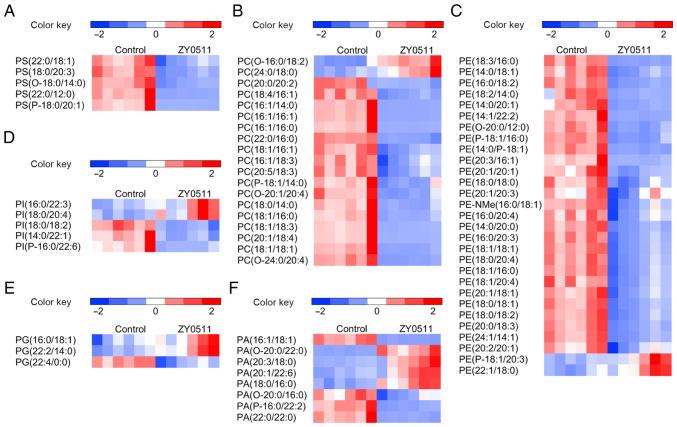
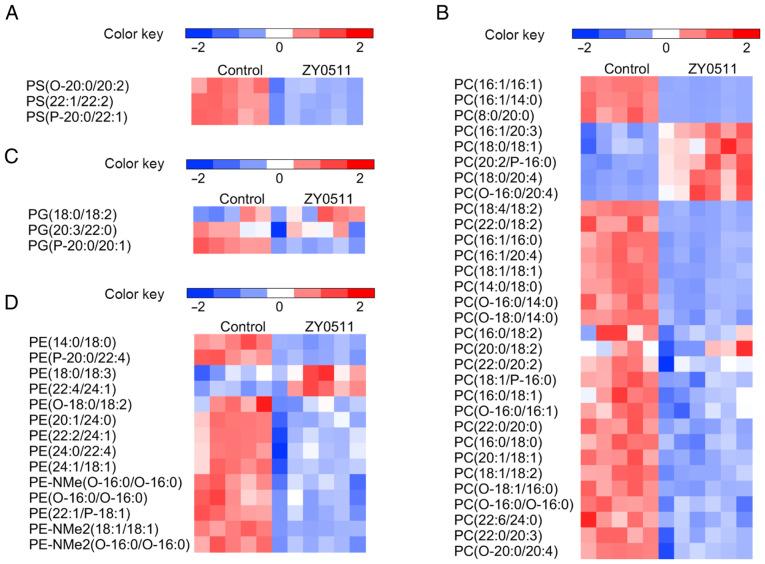
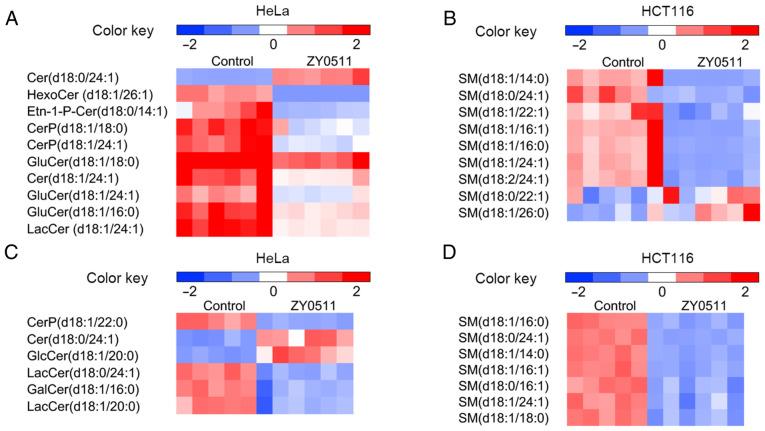
Lipid metabolic alterations are associated with cancer progression. Lysine‑specific demethylase 1 (LSD1) plays a crucial role in cancer and has become a promising target for cancer therapy. However, the effect of LSD1 on lipid metabolism remains unclear. In the present study, we used a LC‑MS/MS‑based lipidomics approach to investigate the impact of LSD1 on cancer cell lipid metabolism using ZY0511, a specific LSD1 inhibitor developed by our group as a specific probe. ZY0511 profoundly modified the human colorectal and cervical cancer cell lipid metabolism. A total of 256 differential metabolites were identified in HeLa cells, and 218 differential metabolites were identified in HCT116 cells, respectively. Among these lipid metabolites, phosphatidylserine, phosphatidylethanolamine, phosphatidylcholine and sphingomyelin (SM) were downregulated by ZY0511. In contrast, ceramide (Cer) and a small portion of glycerophospholipids such as phosphatidylinositol and phosphatidylethanolamine were upregulated by ZY0511. These results revealed a disturbance in sphingolipids (SPs) and glycerophospholipids, which may be correlated with the progression of cancer. Furthermore, a marked increase in Cer and prominent decrease in SM were consistent with the upregulated expression of key enzymes in the Cer synthesis process including synthesis, hydrolysis of SM and the salvage pathway after ZY0511 exposure. In conclusion, our research reveals a link between LSD1 and lipid metabolism in cancer cells, offering more comprehensive evidence for the application of LSD1 inhibitors for cancer therapy. The underlying mechanisms of how the LSD1 inhibitor regulates lipid metabolism warrant further investigation.
脂质代谢改变与癌症进展有关。赖氨酸特异性脱甲基酶 1(LSD1)在癌症中发挥着关键作用,已成为癌症治疗的有前途的靶点。然而,LSD1 对脂质代谢的影响尚不清楚。在本研究中,我们使用基于 LC-MS/MS 的脂质组学方法,使用我们小组开发的特异性 LSD1 抑制剂 ZY0511 作为特异性探针,研究 LSD1 对癌症细胞脂质代谢的影响。ZY0511 深刻改变了人结肠癌细胞和宫颈癌细胞的脂质代谢。在 HeLa 细胞中鉴定出 256 种差异代谢物,在 HCT116 细胞中鉴定出 218 种差异代谢物。在这些脂质代谢物中,磷脂酰丝氨酸、磷脂酰乙醇胺、磷脂酰胆碱和鞘磷脂(SM)被 ZY0511 下调。相反,神经酰胺(Cer)和一小部分甘油磷脂如磷脂酰肌醇和磷脂酰乙醇胺被 ZY0511 上调。这些结果揭示了鞘脂(SPs)和甘油磷脂的紊乱,这可能与癌症的进展有关。此外,Cer 的显著增加和 SM 的明显减少与 Cer 合成过程中关键酶的上调表达一致,包括 SM 的合成、水解和 ZY0511 暴露后的补救途径。总之,我们的研究揭示了 LSD1 与癌细胞中脂质代谢之间的联系,为 LSD1 抑制剂在癌症治疗中的应用提供了更全面的证据。LSD1 抑制剂如何调节脂质代谢的潜在机制值得进一步研究。




 Zotero 插件