
了解安大略省多伦多市未经宫颈癌筛查或筛查不足的女性对 HPV 自我采样的可接受性和采用情况:一项干预研究方案。
Understanding the Acceptability and Uptake of HPV Self-Sampling Amongst Women Under- or Never-Screened for Cervical Cancer in Toronto (Ontario, Canada): An Intervention Study Protocol.
机构信息
Peter Gilgan Centre for Women's Cancers, Women's College Hospital, Toronto, ON M5S 1B2, Canada.
MAP Centre for Urban Health Solutions, St. Michael's Hospital, Toronto, ON M5B 1T8, Canada.
出版信息
Int J Environ Res Public Health. 2021 Aug 29;18(17):9114. doi: 10.3390/ijerph18179114.
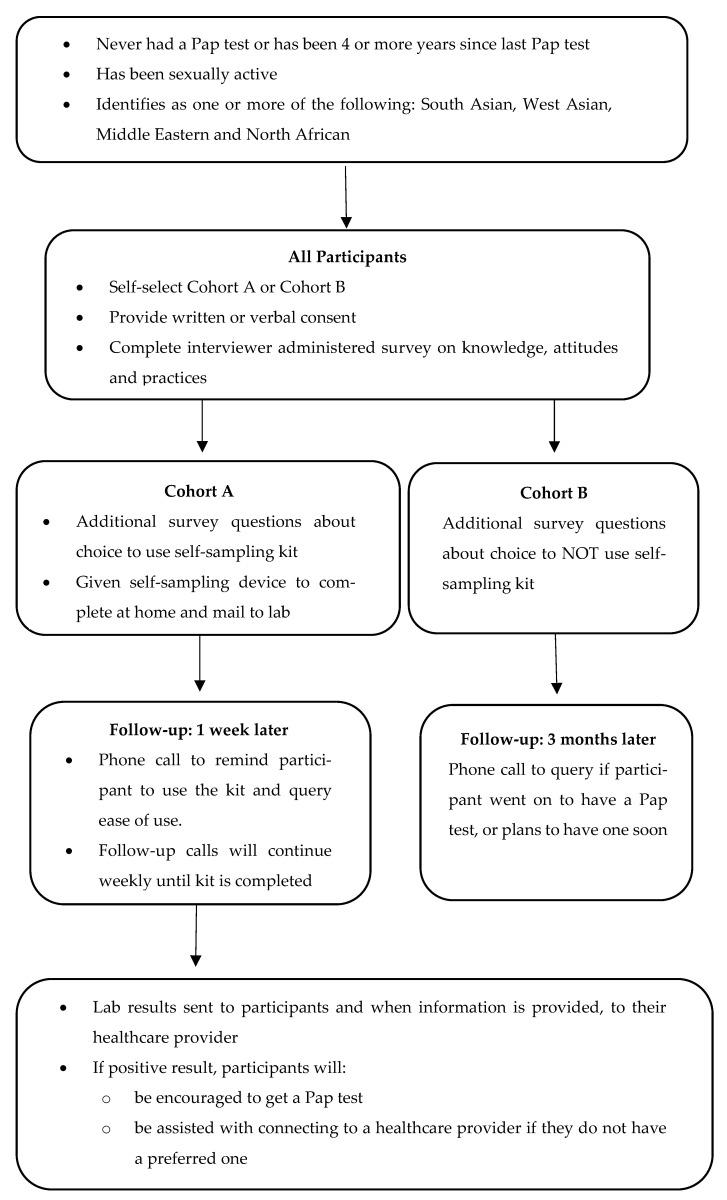
Cervical cancer remains a global public health concern, even though scientific advancements have made the disease almost entirely preventable. With the link between human papillomavirus (HPV) and cervical cancer, and the subsequent improvement in screening technology, there is potential to improve access and coverage of cervical screening with the introduction of HPV self-sampling. In Ontario, Canada, a province with a cytology-based screening program (i.e., Pap test), women who identify as South Asian, West Asian, Middle Eastern and North African have some of the lowest rates of screening, and research suggests they have a higher burden of cervical cancer. In this study, we will use both quantitative and qualitative methods to understand the acceptability and uptake of a take-home HPV self-sampling kit. Working with community champions-people with pre-existing connections with local groups-we will recruit women from these groups who are under- or never-screened for cervical cancer. Women will self-select whether they are in the group that tries HPV self-sampling or in the group that does not. We will aim for 100 women in each group. All participants will provide feedback on the feasibility, acceptability and preferences for cervical screening through a survey and phone follow-up. Women who self-select the HPV self-sampling group, will be followed up to find out if they followed through with self-sampling and to understand their experience using the device. Women who do not want to try self-sampling will be followed up to see if they went on to get a Pap test. The qualitative phase of this study consists of five focus groups with participants and semi-structured interviews with key informants in the community.
宫颈癌仍然是一个全球公共卫生关注点,尽管科学的进步已经使这种疾病几乎完全可以预防。由于人乳头瘤病毒(HPV)与宫颈癌之间的关联,以及随后筛查技术的改进,通过引入 HPV 自我采样,有可能改善宫颈癌筛查的可及性和覆盖率。在加拿大安大略省,该省实行基于细胞学的筛查计划(即巴氏涂片检查),南亚、西亚、中东和北非裔的女性筛查率最低,研究表明她们患有宫颈癌的负担更高。在这项研究中,我们将使用定量和定性方法来了解家庭 HPV 自我采样试剂盒的可接受性和采用情况。通过与具有与当地团体预先建立联系的社区拥护者合作,我们将招募从未接受过或未接受过宫颈癌筛查的这些群体中的女性。女性将自行选择是否参加 HPV 自我采样组或不参加该组。每组我们将招募 100 名女性。所有参与者将通过调查和电话随访,就宫颈癌筛查的可行性、可接受性和偏好提供反馈。自行选择 HPV 自我采样组的女性将被跟踪,以了解她们是否完成了自我采样,并了解她们使用该设备的体验。不想尝试自我采样的女性将被跟踪,以了解她们是否进行了巴氏涂片检查。这项研究的定性阶段包括与参与者进行五次焦点小组讨论,并对社区中的主要知情人进行半结构化访谈。
 Zotero 插件