
使用GeoMx数字空间剖析仪进行乳腺癌研究的空间剖析最佳实践。
Best Practices for Spatial Profiling for Breast Cancer Research with the GeoMx Digital Spatial Profiler.
作者信息
Bergholtz Helga, Carter Jodi M, Cesano Alessandra, Cheang Maggie Chon U, Church Sarah E, Divakar Prajan, Fuhrman Christopher A, Goel Shom, Gong Jingjing, Guerriero Jennifer L, Hoang Margaret L, Hwang E Shelley, Kuasne Hellen, Lee Jinho, Liang Yan, Mittendorf Elizabeth A, Perez Jessica, Prat Aleix, Pusztai Lajos, Reeves Jason W, Riazalhosseini Yasser, Richer Jennifer K, Sahin Özgür, Sato Hiromi, Schlam Ilana, Sørlie Therese, Stover Daniel G, Swain Sandra M, Swarbrick Alexander, Thompson E Aubrey, Tolaney Sara M, Warren Sarah E
机构信息
Department of Cancer Genetics, Institute for Cancer Research, Oslo University Hospital, 0450 Oslo, Norway.
Department of Laboratory Medicine and Pathology, Mayo Clinic, Rochester, MN 55905, USA.
出版信息
Cancers (Basel). 2021 Sep 4;13(17):4456. doi: 10.3390/cancers13174456.
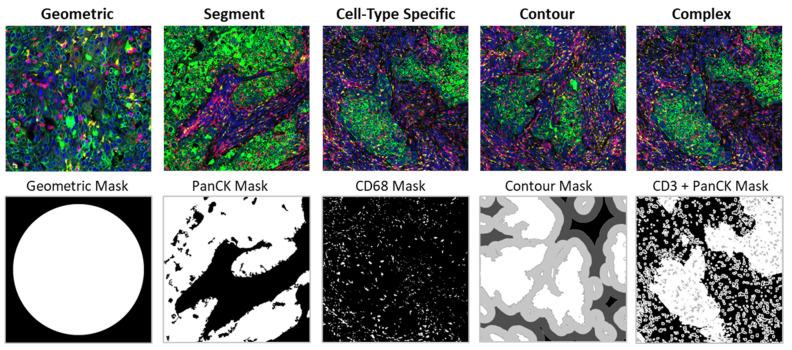
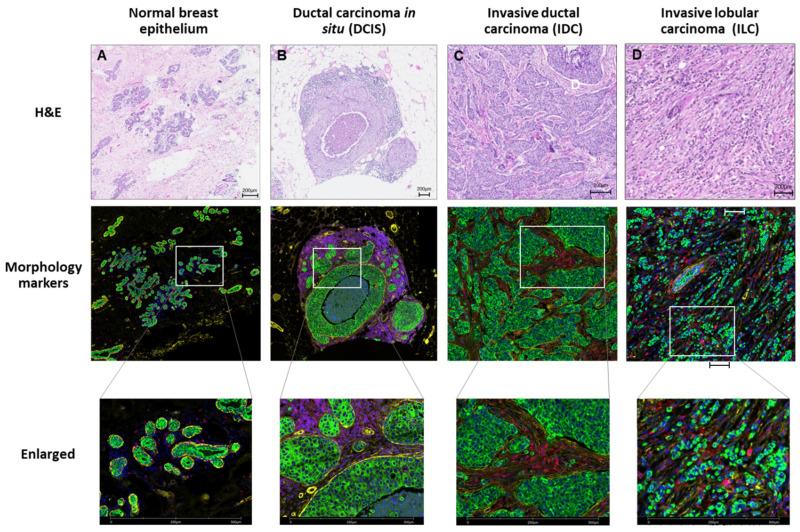
Breast cancer is a heterogenous disease with variability in tumor cells and in the surrounding tumor microenvironment (TME). Understanding the molecular diversity in breast cancer is critical for improving prediction of therapeutic response and prognostication. High-plex spatial profiling of tumors enables characterization of heterogeneity in the breast TME, which can holistically illuminate the biology of tumor growth, dissemination and, ultimately, response to therapy. The GeoMx Digital Spatial Profiler (DSP) enables researchers to spatially resolve and quantify proteins and RNA transcripts from tissue sections. The platform is compatible with both formalin-fixed paraffin-embedded and frozen tissues. RNA profiling was developed at the whole transcriptome level for human and mouse samples and protein profiling of 100-plex for human samples. Tissue can be optically segmented for analysis of regions of interest or cell populations to study biology-directed tissue characterization. The GeoMx Breast Cancer Consortium (GBCC) is composed of breast cancer researchers who are developing innovative approaches for spatial profiling to accelerate biomarker discovery. Here, the GBCC presents best practices for GeoMx profiling to promote the collection of high-quality data, optimization of data analysis and integration of datasets to advance collaboration and meta-analyses. Although the capabilities of the platform are presented in the context of breast cancer research, they can be generalized to a variety of other tumor types that are characterized by high heterogeneity.
乳腺癌是一种异质性疾病,肿瘤细胞及周围肿瘤微环境(TME)存在变异性。了解乳腺癌的分子多样性对于改善治疗反应预测和预后判断至关重要。肿瘤的高多重空间分析能够表征乳腺TME中的异质性,从而全面阐明肿瘤生长、扩散以及最终对治疗反应的生物学机制。GeoMx数字空间分析平台使研究人员能够从组织切片中在空间上解析和定量蛋白质及RNA转录本。该平台与福尔马林固定石蜡包埋组织和冷冻组织均兼容。已针对人和小鼠样本在全转录组水平开展了RNA分析,并针对人样本开展了100重蛋白质分析。组织可进行光学分割,以分析感兴趣区域或细胞群体,从而研究生物学导向的组织特征。GeoMx乳腺癌联盟(GBCC)由乳腺癌研究人员组成,他们正在开发用于空间分析的创新方法,以加速生物标志物的发现。在此,GBCC介绍了GeoMx分析的最佳实践,以促进高质量数据的收集、数据分析的优化以及数据集的整合,从而推动合作和荟萃分析。尽管该平台的功能是在乳腺癌研究背景下介绍的,但它们可推广至以高度异质性为特征的多种其他肿瘤类型。

 Zotero 插件