
常染色体显性遗传性肾小管间质性肾病的临床与遗传学特征
Clinical and genetic spectra of autosomal dominant tubulointerstitial kidney disease.
机构信息
Faculty of Medical Sciences, Translational and Clinical Research Institute, Newcastle University, Newcastle upon Tyne, UK.
Renal Services, Newcastle Upon Tyne Hospitals NHS Foundation Trust, Newcastle upon Tyne, UK.
出版信息
Nephrol Dial Transplant. 2023 Feb 13;38(2):271-282. doi: 10.1093/ndt/gfab268.
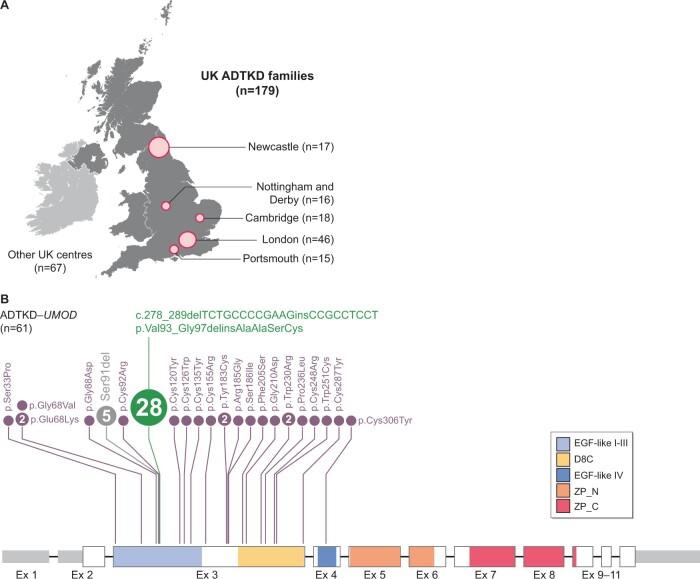
Autosomal dominant tubulointerstitial kidney disease (ADTKD) is a clinical entity defined by interstitial fibrosis with tubular damage, bland urinalysis and progressive kidney disease. Mutations in UMOD and MUC1 are the most common causes of ADTKD but other rarer (REN, SEC61A1), atypical (DNAJB11) or heterogeneous (HNF1B) subtypes have been described. Raised awareness, as well as the implementation of next-generation sequencing approaches, have led to a sharp increase in reported cases. ADTKD is now believed to be one of the most common monogenic forms of kidney disease and overall it probably accounts for ∼5% of all monogenic causes of chronic kidney disease. Through international efforts and systematic analyses of patient cohorts, critical insights into clinical and genetic spectra of ADTKD, genotype-phenotype correlations as well as innovative diagnostic approaches have been amassed during recent years. In addition, intense research efforts are addressed towards deciphering and rescuing the cellular pathways activated in ADTKD. A better understanding of these diseases and of possible commonalities with more common causes of kidney disease may be relevant to understand and target mechanisms leading to fibrotic kidney disease in general. Here we highlight recent advances in our understanding of the different subtypes of ADTKD with an emphasis on the molecular underpinnings and its clinical presentations.
常染色体显性遗传性肾小管间质性肾病 (ADTKD) 是一种临床实体,其特征为间质纤维化伴肾小管损伤、尿液分析正常和进行性肾脏疾病。UMOD 和 MUC1 的突变是 ADTKD 最常见的原因,但也有其他罕见的 (REN、SEC61A1)、非典型 (DNAJB11) 或异质性 (HNF1B) 亚型已被描述。随着人们认识的提高,以及下一代测序方法的实施,报告的病例数量急剧增加。ADTKD 现在被认为是最常见的单基因肾脏疾病之一,总体而言,它可能占所有单基因慢性肾脏病病因的 5%左右。通过国际合作和对患者队列的系统分析,近年来在 ADTKD 的临床和遗传谱、基因型-表型相关性以及创新诊断方法方面积累了重要的见解。此外,人们还在努力深入研究导致 ADTKD 的细胞途径,并试图加以破译和挽救。更好地了解这些疾病及其与更常见肾脏疾病病因的共同之处,可能有助于我们理解和针对导致纤维性肾脏疾病的一般机制。在这里,我们重点介绍了对 ADTKD 不同亚型的理解方面的最新进展,强调了其分子基础及其临床表现。


 Zotero 插件