
已知结直肠癌易感性 SNPs 预测结直肠癌风险的能力:英国生物库内的队列研究。
Ability of known colorectal cancer susceptibility SNPs to predict colorectal cancer risk: A cohort study within the UK Biobank.
机构信息
Genetic Technologies Ltd., Fitzroy, Victoria, Australia.
Phenogen Sciences Inc, Charlotte, North Carolina, United States of America.
出版信息
PLoS One. 2021 Sep 15;16(9):e0251469. doi: 10.1371/journal.pone.0251469. eCollection 2021.
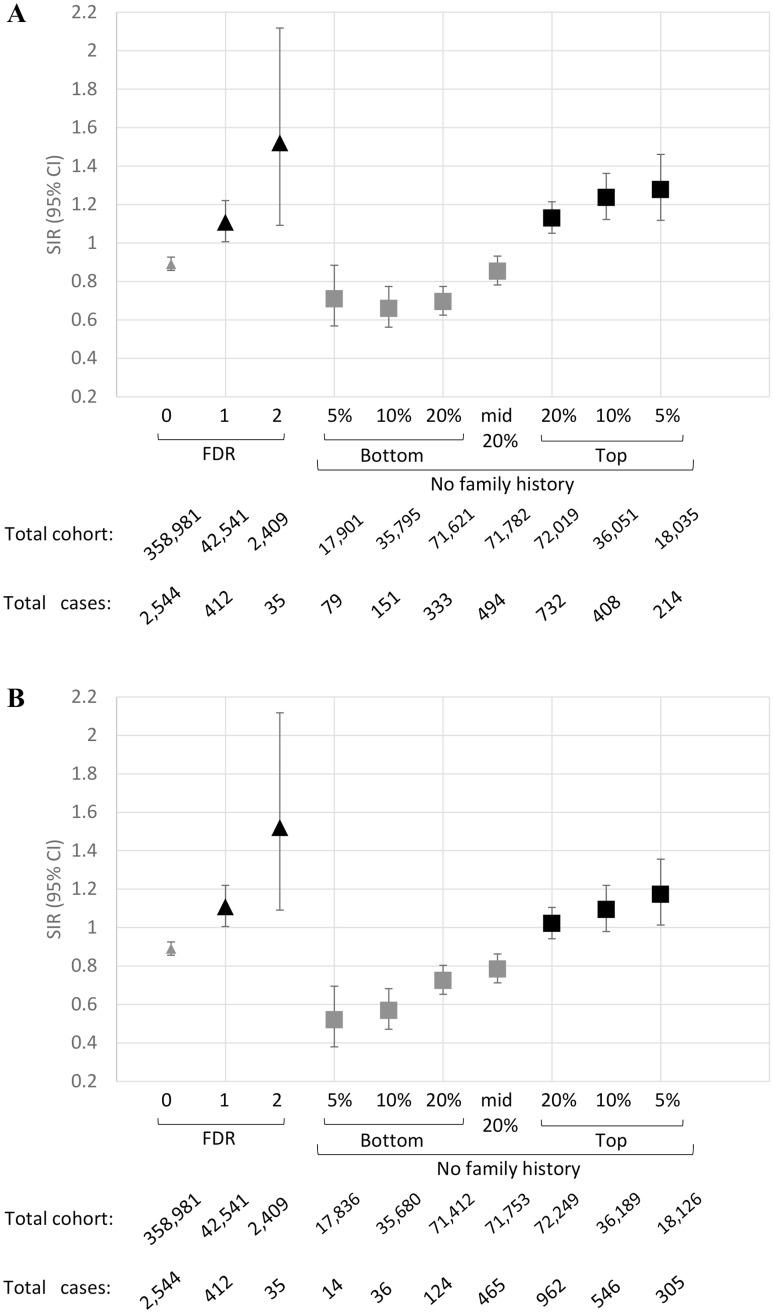
Colorectal cancer risk stratification is crucial to improve screening and risk-reducing recommendations, and consequently do better than a one-size-fits-all screening regimen. Current screening guidelines in the UK, USA and Australia focus solely on family history and age for risk prediction, even though the vast majority of the population do not have any family history. We investigated adding a polygenic risk score based on 45 single-nucleotide polymorphisms to a family history model (combined model) to quantify how it improves the stratification and discriminatory performance of 10-year risk and full lifetime risk using a prospective population-based cohort within the UK Biobank. For both 10-year and full lifetime risk, the combined model had a wider risk distribution compared with family history alone, resulting in improved risk stratification of nearly 2-fold between the top and bottom risk quintiles of the full lifetime risk model. Importantly, the combined model can identify people (n = 72,019) who do not have family history of colorectal cancer but have a predicted risk that is equivalent to having at least one affected first-degree relative (n = 44,950). We also confirmed previous findings by showing that the combined full lifetime risk model significantly improves discriminatory accuracy compared with a simple family history model 0.673 (95% CI 0.664-0.682) versus 0.666 (95% CI 0.657-0.675), p = 0.0065. Therefore, a combined polygenic risk score and first-degree family history model could be used to improve risk stratified population screening programs.
结直肠癌风险分层对于改善筛查和降低风险的建议至关重要,从而可以避免一刀切的筛查方案。目前,英国、美国和澳大利亚的现行筛查指南仅关注家族史和年龄来进行风险预测,尽管绝大多数人没有家族史。我们研究了在家族史模型中添加基于 45 个单核苷酸多态性的多基因风险评分(综合模型),以量化其如何使用英国生物银行中的前瞻性基于人群队列来改善 10 年风险和全生命周期风险的分层和判别性能。对于 10 年风险和全生命周期风险,综合模型的风险分布范围比家族史单独使用时更广,导致全生命周期风险模型的最高和最低五分位之间的风险分层改善了近两倍。重要的是,综合模型可以识别出没有结直肠癌家族史但预测风险相当于至少有一个一级亲属受影响的人(n=72019)。我们还通过显示综合全生命周期风险模型与简单家族史模型相比显著提高了判别准确性来证实了之前的发现,0.673(95%CI 0.664-0.682)对 0.666(95%CI 0.657-0.675),p=0.0065。因此,综合多基因风险评分和一级亲属家族史模型可用于改善风险分层人群筛查计划。

 Zotero 插件