
辉瑞-BioNTech 疫苗加强针在以色列预防新冠病毒。
Protection of BNT162b2 Vaccine Booster against Covid-19 in Israel.
机构信息
From the Department of Plant and Environmental Sciences, Weizmann Institute of Science, Rehovot (Y.M.B.-O., R.M.), Technion-Israel Institute of Technology, Haifa (Y.G.), Hebrew University of Jerusalem (M.M.) and Israel Ministry of Health (O.B., S.A.-P., N.A.), Jerusalem, the Biostatistical and Biomathematical Unit, Gertner Institute for Epidemiology and Health Policy Research, Sheba Medical Center, Ramat Gan (L.F., A.H.), KI Research Institute, Kfar Malal (N.K., B.M.), and the Sackler Faculty of Medicine, Tel Aviv University, Tel Aviv (A.H.) - all in Israel.
出版信息
N Engl J Med. 2021 Oct 7;385(15):1393-1400. doi: 10.1056/NEJMoa2114255. Epub 2021 Sep 15.
BACKGROUND
On July 30, 2021, the administration of a third (booster) dose of the BNT162b2 messenger RNA vaccine (Pfizer-BioNTech) was approved in Israel for persons who were 60 years of age or older and who had received a second dose of vaccine at least 5 months earlier. Data are needed regarding the effect of the booster dose on the rate of confirmed coronavirus 2019 disease (Covid-19) and the rate of severe illness.
METHODS
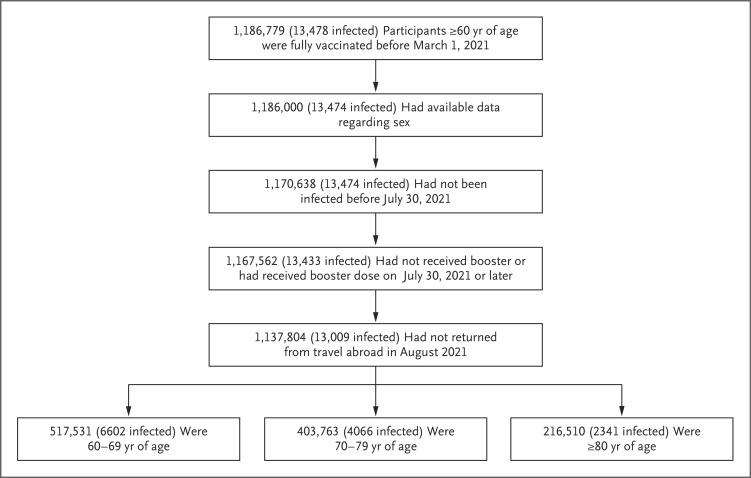
We extracted data for the period from July 30 through August 31, 2021, from the Israeli Ministry of Health database regarding 1,137,804 persons who were 60 years of age or older and had been fully vaccinated (i.e., had received two doses of BNT162b2) at least 5 months earlier. In the primary analysis, we compared the rate of confirmed Covid-19 and the rate of severe illness between those who had received a booster injection at least 12 days earlier (booster group) and those who had not received a booster injection (nonbooster group). In a secondary analysis, we evaluated the rate of infection 4 to 6 days after the booster dose as compared with the rate at least 12 days after the booster. In all the analyses, we used Poisson regression after adjusting for possible confounding factors.
RESULTS
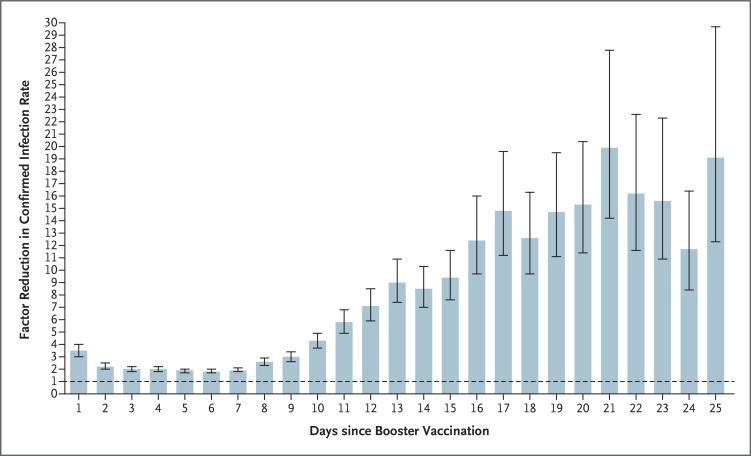
At least 12 days after the booster dose, the rate of confirmed infection was lower in the booster group than in the nonbooster group by a factor of 11.3 (95% confidence interval [CI], 10.4 to 12.3); the rate of severe illness was lower by a factor of 19.5 (95% CI, 12.9 to 29.5). In a secondary analysis, the rate of confirmed infection at least 12 days after vaccination was lower than the rate after 4 to 6 days by a factor of 5.4 (95% CI, 4.8 to 6.1).
CONCLUSIONS
In this study involving participants who were 60 years of age or older and had received two doses of the BNT162b2 vaccine at least 5 months earlier, we found that the rates of confirmed Covid-19 and severe illness were substantially lower among those who received a booster (third) dose of the BNT162b2 vaccine.
背景
2021 年 7 月 30 日,以色列批准为 60 岁及以上人群接种第三剂(加强针)BNT162b2 信使 RNA 疫苗(辉瑞-生物技术公司),这些人至少在 5 个月前已接种完两剂疫苗。需要了解加强针接种对 2019 年冠状病毒病(COVID-19)确诊病例发生率和重症发病率的影响。
方法
我们从以色列卫生部数据库中提取了 2021 年 7 月 30 日至 8 月 31 日期间年龄在 60 岁及以上且至少 5 个月前完成两剂 BNT162b2 疫苗接种(即已接种两剂)的 1137804 人的数据。在主要分析中,我们比较了至少 12 天前接受加强针注射(加强针组)和未接受加强针注射(非加强针组)的人群 COVID-19 确诊率和重症发病率。在二次分析中,我们评估了加强针接种后 4 至 6 天的感染率与加强针接种后至少 12 天的感染率。在所有分析中,我们使用泊松回归法,并调整了可能的混杂因素。
结果
加强针接种后至少 12 天,加强针组的确诊感染率比非加强针组低 11.3 倍(95%置信区间[CI],10.4 至 12.3);重症发病率低 19.5 倍(95%CI,12.9 至 29.5)。在二次分析中,加强针接种后至少 12 天的确诊感染率比接种后 4 至 6 天的感染率低 5.4 倍(95%CI,4.8 至 6.1)。
结论
在这项纳入年龄在 60 岁及以上且至少 5 个月前接种完两剂 BNT162b2 疫苗的参与者的研究中,我们发现接受 BNT162b2 疫苗加强(第三剂)接种的人群 COVID-19 和重症发病率显著降低。
 Zotero 插件