
深度学习确定治疗 COVID-19 的协同药物组合。
Deep learning identifies synergistic drug combinations for treating COVID-19.
机构信息
Computer Science and Artificial Intelligence Laboratory, Massachusetts Institute of Technology, Cambridge, MA 02139;
Department of Biological Engineering, Synthetic Biology Center, Institute for Medical Engineering and Science, Massachusetts Institute of Technology, Cambridge, MA 02139.
出版信息
Proc Natl Acad Sci U S A. 2021 Sep 28;118(39). doi: 10.1073/pnas.2105070118.
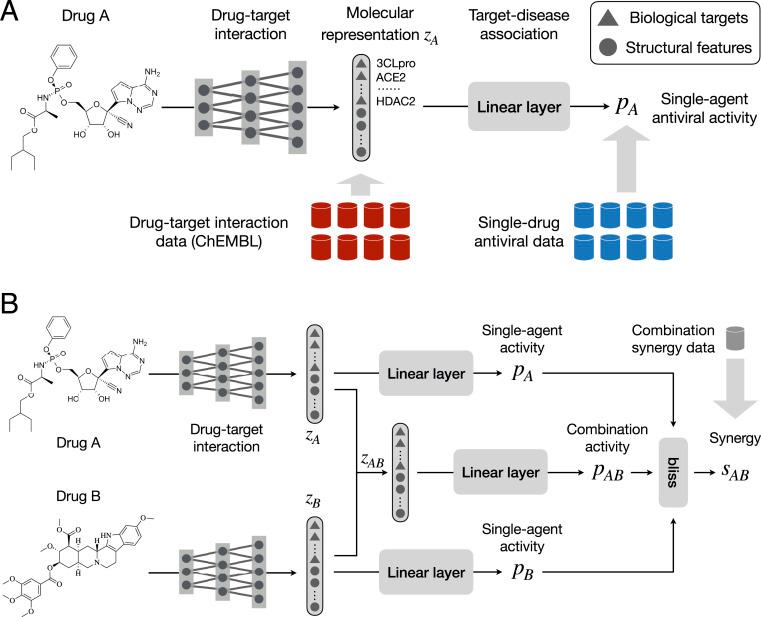
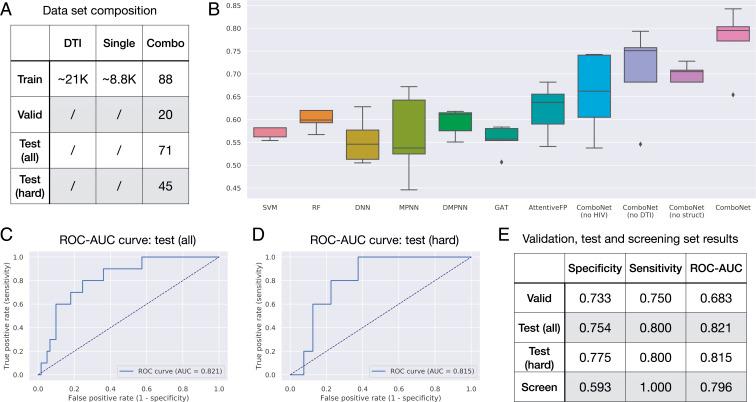
Effective treatments for COVID-19 are urgently needed. However, discovering single-agent therapies with activity against severe acute respiratory syndrome coronavirus 2 (SARS-CoV-2) has been challenging. Combination therapies play an important role in antiviral therapies, due to their improved efficacy and reduced toxicity. Recent approaches have applied deep learning to identify synergistic drug combinations for diseases with vast preexisting datasets, but these are not applicable to new diseases with limited combination data, such as COVID-19. Given that drug synergy often occurs through inhibition of discrete biological targets, here we propose a neural network architecture that jointly learns drug-target interaction and drug-drug synergy. The model consists of two parts: a drug-target interaction module and a target-disease association module. This design enables the model to utilize drug-target interaction data and single-agent antiviral activity data, in addition to available drug-drug combination datasets, which may be small in nature. By incorporating additional biological information, our model performs significantly better in synergy prediction accuracy than previous methods with limited drug combination training data. We empirically validated our model predictions and discovered two drug combinations, remdesivir and reserpine as well as remdesivir and IQ-1S, which display strong antiviral SARS-CoV-2 synergy in vitro. Our approach, which was applied here to address the urgent threat of COVID-19, can be readily extended to other diseases for which a dearth of chemical-chemical combination data exists.
目前急需针对 COVID-19 的有效疗法。然而,发现对严重急性呼吸综合征冠状病毒 2(SARS-CoV-2)具有活性的单一药物疗法极具挑战性。联合疗法在抗病毒治疗中发挥着重要作用,因为它们提高了疗效并降低了毒性。最近的方法应用深度学习来识别具有大量预先存在数据集的疾病的协同药物组合,但这些方法不适用于 COVID-19 等新出现的疾病,因为这些疾病的组合数据有限。鉴于药物协同作用通常通过抑制离散的生物靶标发生,在这里我们提出了一种神经网络架构,该架构联合学习药物-靶标相互作用和药物-药物协同作用。该模型由两部分组成:药物-靶标相互作用模块和靶标-疾病关联模块。这种设计使模型能够利用药物-靶标相互作用数据和单一药物抗病毒活性数据,以及可用的药物-药物组合数据集,尽管这些数据集可能性质较小。通过纳入额外的生物学信息,我们的模型在协同作用预测准确性方面的表现明显优于具有有限药物组合训练数据的先前方法。我们对模型预测进行了实证验证,并发现了两种药物组合,即瑞德西韦和利血平以及瑞德西韦和 IQ-1S,它们在体外对 SARS-CoV-2 表现出强烈的抗病毒协同作用。我们在这里应用的方法来应对 COVID-19 的紧迫威胁,可以很容易地扩展到其他化学-化学组合数据稀缺的疾病。

 Zotero 插件