
套细胞淋巴瘤中CD68+和CD163+巨噬细胞高计数与预后不良相关。
High Counts of CD68+ and CD163+ Macrophages in Mantle Cell Lymphoma Are Associated With Inferior Prognosis.
作者信息
Li Philippa, Yuan Ji, Ahmed Fahad Shabbir, McHenry Austin, Fu Kai, Yu Guohua, Cheng Hongxia, Xu Mina L, Rimm David L, Pan Zenggang
机构信息
Department of Pathology, Yale University School of Medicine, New Haven, CT, United States.
Department of Laboratory Medicine and Pathology, Mayo Clinic, Rochester, MN, United States.
出版信息
Front Oncol. 2021 Aug 30;11:701492. doi: 10.3389/fonc.2021.701492. eCollection 2021.
BACKGROUND
Lymphoma-associated macrophages (LAMs) are key components in the lymphoma microenvironment, which may impact disease progression and response to therapy. There are two major subtypes of LAMs, CD68+ M1 and CD163+ M2. M2 LAMs can be transformed from M1 LAMs, particularly in certain diffuse large B-cell lymphomas (DLBCL). While mantle cell lymphoma (MCL) is well-known to contain frequent epithelioid macrophages, LAM characterization within MCL has not been fully described. Herein we evaluate the immunophenotypic subclassification, the expression of immune checkpoint molecule PD-L1, and the prognostic impact of LAMs in MCL.
MATERIALS AND METHODS
A total of 82 MCL cases were collected and a tissue microarray block was constructed. Immunohistochemical staining was performed using CD68 and CD163, and the positive cells were recorded manually in four representative 400× fields for each case. Multiplexed quantitative immunofluorescence assays were carried out to determine PD-L1 expression on CD68+ M1 LAMs and CD163+ M2 LAMs. In addition, we assessed Ki67 proliferation rate of MCL by an automated method using the QuPath digital imaging analysis. The cut-off points of optimal separation of overall survival (OS) were analyzed using the X-Tile software, the SPSS version 26 was used to construct survival curves, and the log-rank test was performed to calculate the -values.
RESULTS
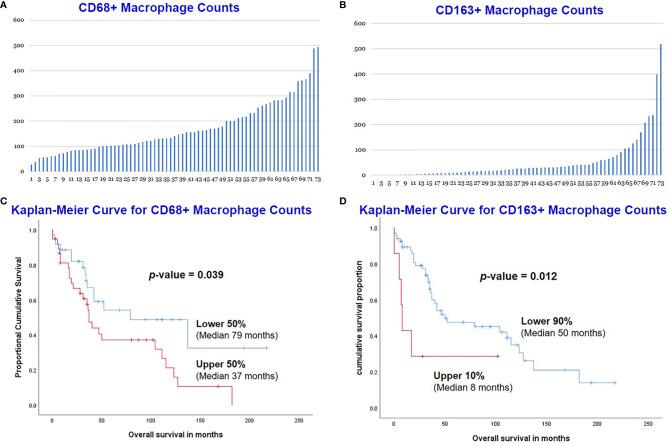
MCL had a much higher count of M1 LAMs than M2 LAMs with a CD68:CD163 ratio of 3:1. Both M1 and M2 LAMs were increased in MCL cases with high Ki67 proliferation rates (>30%), in contrast to those with low Ki67 (<30%). Increased number of M1 or M2 LAMs in MCL was associated with an inferior OS. Moreover, high expression of PD-L1 on M1 LAMs had a slightly better OS than the cases with low PD-L1 expression, whereas low expression of PD-L1 on M2 LAMs had a slightly improved OS, although both were not statistically significant.
CONCLUSIONS
In contrast to DLBCL, MCL had a significantly lower rate of M1 to M2 polarization, and the high levels of M1 and M2 LAMs were associated with poor OS. Furthermore, differential PD-L1 expressions on LAMs may partially explain the different functions of tumor-suppressing or tumor-promoting of M1 and M2 LAMs, respectively.
背景
淋巴瘤相关巨噬细胞(LAMs)是淋巴瘤微环境中的关键组成部分,可能影响疾病进展和对治疗的反应。LAMs主要有两种亚型,CD68+ M1和CD163+ M2。M2 LAMs可由M1 LAMs转化而来,特别是在某些弥漫性大B细胞淋巴瘤(DLBCL)中。虽然套细胞淋巴瘤(MCL)中常见上皮样巨噬细胞,但MCL内LAMs的特征尚未完全描述。在此,我们评估了MCL中LAMs的免疫表型亚分类、免疫检查点分子PD-L1的表达及其预后影响。
材料与方法
共收集82例MCL病例并构建组织芯片块。使用CD68和CD163进行免疫组织化学染色,对每个病例在四个代表性的400倍视野中手动记录阳性细胞。进行多重定量免疫荧光分析以确定CD68+ M1 LAMs和CD163+ M2 LAMs上PD-L1的表达。此外,我们使用QuPath数字成像分析的自动化方法评估MCL的Ki67增殖率。使用X-Tile软件分析总生存期(OS)最佳分离的截断点,使用SPSS 26版构建生存曲线,并进行对数秩检验以计算P值。
结果
MCL中M1 LAMs的数量远高于M2 LAMs,CD68:CD163比例为3:1。与Ki67低增殖率(<30%)的MCL病例相比,Ki67高增殖率(>30%)的MCL病例中M1和M2 LAMs均增加。MCL中M1或M2 LAMs数量增加与较差的OS相关。此外,M1 LAMs上PD-L1高表达的病例OS略优于PD-L1低表达的病例,而M2 LAMs上PD-L1低表达的病例OS略有改善,尽管两者均无统计学意义。
结论
与DLBCL相反,MCL中M1向M2极化的比率显著较低,高水平的M1和M2 LAMs与较差的OS相关。此外,LAMs上PD-L1的差异表达可能分别部分解释了M1和M2 LAMs的肿瘤抑制或肿瘤促进的不同功能。




 Zotero 插件