
自然获得的针对后续同型感染的人乳头瘤病毒抗体:一项大规模前瞻性队列研究。
Naturally acquired HPV antibodies against subsequent homotypic infection: A large-scale prospective cohort study.
作者信息
Yao Xingmei, Chen Wen, Zhao Chao, Wei Lihui, Hu Yuemei, Li Mingqiang, Lin Zhijie, Lin Bizhen, Liu Xiaohui, Hong Ying, Li Qing, Pan Qinjing, Zhang Xun, Li Mingzhu, Zhao Yuqian, Zhang Li, Xu Huifang, Hu Fangfang, Zhao Jun, Huang Yue, Sheng Wei, Zheng Ya, Hu Shangying, Su Yingying, Huang Shoujie, Pan Huirong, Zhao Fanghui, Qiao Youlin, Wu Ting, Zhang Jun, Xia Ningshao
机构信息
State Key Laboratory of Molecular Vaccinology and Molecular Diagnostics, National Institute of Diagnostics and Vaccine Development in Infectious Diseases, Strait Collaborative Innovation Center of Biomedicine and Pharmaceutics, School of Public Health, Xiamen University, Xiamen, Fujian, China.
National Cancer Center/National Clinical Research Center for Cancer/Cancer Hospital, Chinese Academy of Medical Sciences and Peking Union Medical College, Beijing, China.
出版信息
Lancet Reg Health West Pac. 2021 Jul 16;13:100196. doi: 10.1016/j.lanwpc.2021.100196. eCollection 2021 Aug.
BACKGROUND
Although recent studies have suggested that naturally acquired Human papillomavirus (HPV) antibodies are partly protective against subsequent homotypic infection, the extent of protection remains indecisive. Here, we evaluate the protective effect of neutralizing and IgG antibodies simultaneously.
METHODS
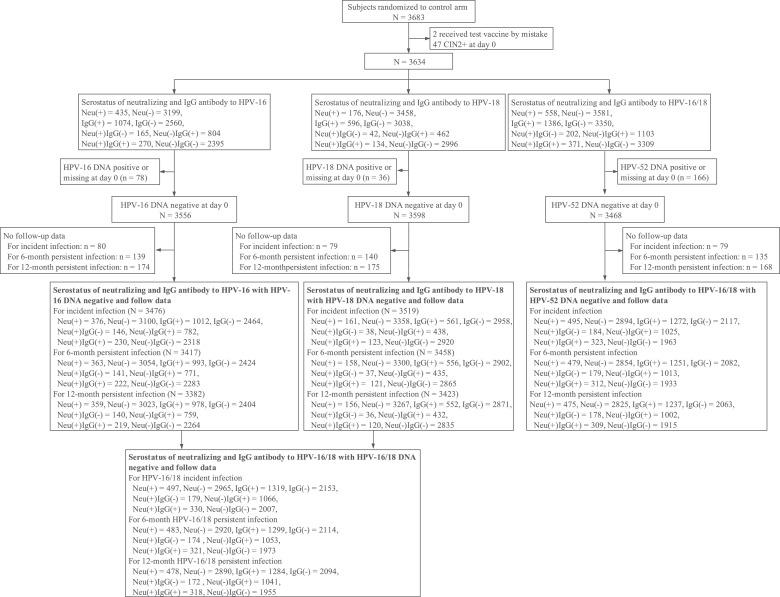
In a cohort of 3634 women aged 18-45 years from the control arm of a phase III trial of the HPV-16/18 bivalent vaccine, participants were tested for neutralizing antibodies by pseudovirion-based neutralization assay (PBNA) and IgG antibodies by enzyme-linked immunosorbent assay (ELISA) at baseline. HPV-16/18 incident and persistent infections were identified using cervical specimens periodically collected during the 5·5 years of follow-up. The protective effects of HPV-16/18 neutralizing and IgG antibodies against homotypic infection were assessed using a Cox proportional hazard model.
FINDINGS
For the persistent infection (PI) endpoints of HPV-16/18 lasting for over 6/12 months, a prevalence of type-specific neutralizing antibodies was highly protective (6-month PI: hazard ratio (HR) = 0·16, 95% confidence interval (CI): 0·04, 0·65; 12-month PI: HR = 0·23, 95% CI: 0·06, 0·94), whereas a prevalence of IgG antibodies was associated with minor and non-significant protection (6-month PI: HR = 0·66, 95% CI: 0·40, 1·09; 12-month PI: HR = 0·66, 95% CI: 0·36, 1·20). After increasing the cut-off value to the median IgG level, the risk of 6-month PI was significantly lower in seropositive vs seronegative women (HR = 0·38, 95% CI: 0·18, 0·83).
INTERPRETATION
Naturally acquired antibodies are associated with a substantially reduced risk of subsequent homotypic infection.
FUNDING
NSFC; The Fujian Province Health Education Joint Research Project; Xiamen Science and Technology Major Project; CIFMS; and Xiamen Innovax.
背景
尽管最近的研究表明,自然获得的人乳头瘤病毒(HPV)抗体对随后的同型感染有部分保护作用,但保护程度仍不明确。在此,我们同时评估中和抗体和IgG抗体的保护作用。
方法
在一项HPV-16/18二价疫苗III期试验对照组的3634名18至45岁女性队列中,在基线时通过基于假病毒颗粒的中和试验(PBNA)检测参与者的中和抗体,并通过酶联免疫吸附试验(ELISA)检测IgG抗体。在5.5年的随访期间,定期收集宫颈标本以确定HPV-16/18的新发感染和持续感染情况。使用Cox比例风险模型评估HPV-16/18中和抗体和IgG抗体对同型感染的保护作用。
研究结果
对于持续6/12个月以上的HPV-16/18持续感染(PI)终点,型特异性中和抗体的存在具有高度保护作用(6个月PI:风险比(HR)=0.16,95%置信区间(CI):0.04,0.65;12个月PI:HR=0.23,95%CI:0.06,0.94),而IgG抗体的存在与轻微且无统计学意义的保护作用相关(6个月PI:HR=0.66,95%CI:0.40,1.09;12个月PI:HR=0.66,95%CI:0.36,1.20)。将临界值提高到IgG水平中位数后,血清阳性女性与血清阴性女性相比,6个月PI的风险显著降低(HR=0.38,95%CI:0.18,0.83)。
解读
自然获得的抗体与随后同型感染风险的大幅降低相关。
资助
国家自然科学基金;福建省健康教育联合研究项目;厦门市科技重大项目;中国医学科学院医学与健康科技创新工程;以及厦门万泰沧海生物技术有限公司。

 Zotero 插件