
关于复杂结构对联吡啶配位的金(I)中心上芳基碘氧化加成影响的系统研究。
A Systematic Study of the Effects of Complex Structure on Aryl Iodide Oxidative Addition at Bipyridyl-Ligated Gold(I) Centers.
作者信息
Cadge Jamie A, Bower John F, Russell Christopher A
机构信息
School of Chemistry, University of Bristol, Cantock's Close, Bristol, BS8 1TS, United Kingdom.
Department of Chemistry, University of Liverpool, Crown Street, Liverpool, L69 7ZD, United Kingdom.
出版信息
Angew Chem Int Ed Engl. 2021 Nov 15;60(47):24976-24983. doi: 10.1002/anie.202108744. Epub 2021 Oct 18.
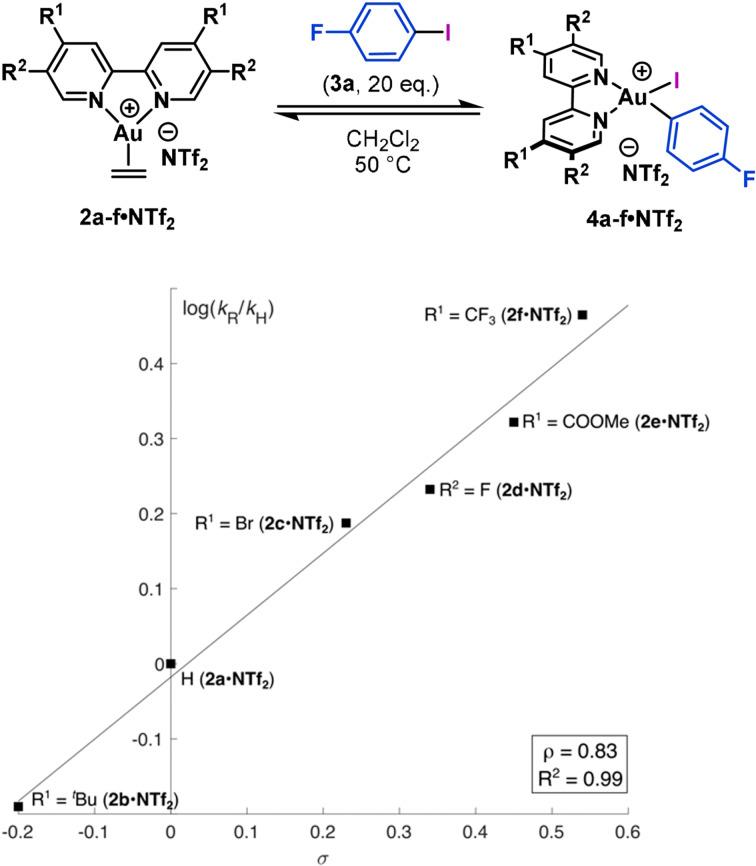
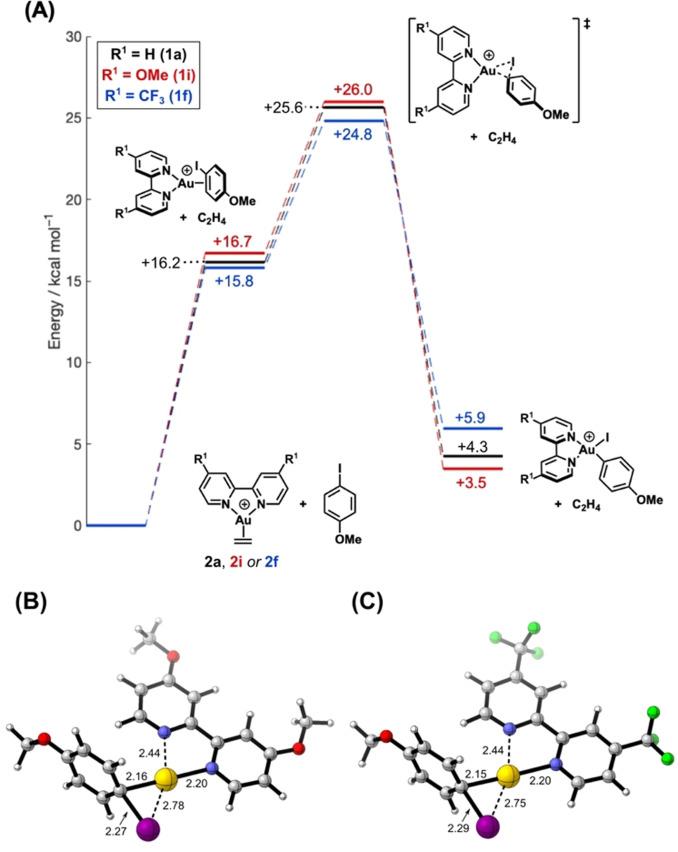
A combined theoretical and experimental approach has been used to study the unusual mechanism of oxidative addition of aryl iodides to [bipyAu(C H )] complexes. The modular nature of this system allowed a systematic assessment of the effects of complex structure. Computational comparisons between cationic gold and the isolobal (neutral) Pd and Pt complexes revealed similar mechanistic features, but with oxidative addition being significantly favored for the group 10 metals. Further differences between Au and Pd were seen in experimental studies: studying reaction rates as a function of electronic and steric properties showed that ligands bearing more electron-poor functionality increase the rate of oxidative addition; in a complementary way, electron-rich aryl iodides give faster rates. This divergence in mechanism compared to Pd suggests that Ar-X oxidative addition with Au can underpin a broad range of new or complementary transformations.
采用理论与实验相结合的方法研究了芳基碘化物与[bipyAu(C H )]配合物进行氧化加成的异常机理。该体系的模块化性质使得能够系统地评估配合物结构的影响。阳离子金与等瓣(中性)钯和铂配合物之间的计算比较揭示了相似的机理特征,但氧化加成对于第10族金属明显更有利。金和钯之间在实验研究中还存在进一步差异:研究反应速率作为电子和空间性质的函数表明,具有更多缺电子官能团的配体会提高氧化加成的速率;以互补的方式,富电子的芳基碘化物反应速率更快。与钯相比,这种机理上的差异表明金催化的Ar-X氧化加成可以支撑广泛的新的或互补的转化反应。




 Zotero 插件