
接种 BNT162b2 和 mRNA-1273 后 T 细胞和 B 细胞应答的时程变化。
The temporal course of T- and B-cell responses to vaccination with BNT162b2 and mRNA-1273.
机构信息
Institute of Clinical Chemistry, University Hospital of Schleswig-Holstein, Kiel, Germany.
Institute of Clinical Chemistry, University Hospital of Schleswig-Holstein, Kiel, Germany.
出版信息
Clin Microbiol Infect. 2022 May;28(5):701-709. doi: 10.1016/j.cmi.2021.09.006. Epub 2021 Sep 20.
OBJECTIVES
To investigate the response of the immune system (and its influencing factors) to vaccination with BNT162b2 or mRNA-1273.
METHODS
531 vaccinees, recruited from healthcare professionals, donated samples before, in between, and after the administration of the two doses of the vaccine. T- and B-cell responses were examined via interferon-γ (IFN-γ) release assay, and antibodies against different epitopes of severe acute respiratory syndrome coronavirus 2 (SARS-CoV-2) (S1 and NCP) were detected via ELISA and surrogate neutralization assay. Results were correlated with influencing factors such as age, sex, prior infection, vaccine received (BNT162b2 or mRNA-1273), and immunosuppression. Furthermore, antinuclear antibodies (ANAs) were measured to screen for autoimmune responses following vaccination with an mRNA vaccine.
RESULTS
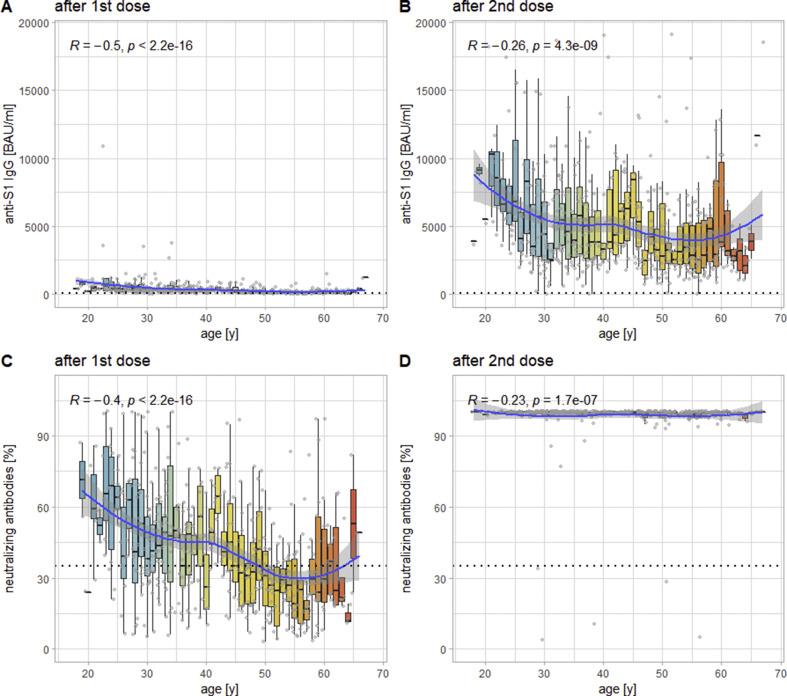
No markers of immunity against SARS-CoV-2 were found before the first vaccination. Two weeks after it, specific responses against SARS-CoV-2 were already measurable (median ± median absolute deviation (MAD): anti-S1 IgG 195.5 ± 172.7 BAU/mL; IgA 6.7 ± 4.9 OD; surrogate neutralization 39 ± 23.7%), and were significantly increased two weeks after the second dose (anti-S1 IgG 3744 ± 2571.4 BAU/mL; IgA 12 ± 0 OD; surrogate neutralization 100 ± 0%, IFN-γ 1897.2 ± 886.7 mIU/mL). Responses were stronger for younger participants (this difference decreasing after the second dose). Further influences were previous infection with SARS-CoV-2 (causing significantly stronger responses after the first dose compared to unexposed individuals (p ≤ 0.0001)) and the vaccine received (significantly stronger reactions for recipients of mRNA-1273 after both doses, p < 0.05-0.0001). Some forms of immunosuppression significantly impeded the immune response to the vaccination (with no observable immune response in three immunosuppressed participants). There was no significant induction of ANAs by the vaccination (no change in qualitative ANA results (p 0.2592) nor ANA titres (p 0.08) from pre-to post-vaccination.
CONCLUSIONS
Both vaccines elicit strong and specific immune responses against SARS-CoV-2 which become detectable one week (T-cell response) or two weeks (B-cell response) after the first dose.
目的
研究免疫系统(及其影响因素)对 BNT162b2 或 mRNA-1273 疫苗接种的反应。
方法
从医护人员中招募了 531 名疫苗接种者,在接种两剂疫苗之前、期间和之后采集样本。通过干扰素-γ(IFN-γ)释放试验检测 T 细胞和 B 细胞反应,通过 ELISA 和替代中和试验检测针对严重急性呼吸综合征冠状病毒 2(SARS-CoV-2)不同表位(S1 和 NCP)的抗体。结果与年龄、性别、既往感染、接种疫苗(BNT162b2 或 mRNA-1273)和免疫抑制等影响因素相关。此外,还测量了抗核抗体(ANA)以筛查 mRNA 疫苗接种后的自身免疫反应。
结果
在首次接种疫苗前未发现针对 SARS-CoV-2 的免疫标志物。两周后,已经可以测量到针对 SARS-CoV-2 的特异性反应(中位数±中位数绝对偏差(MAD):抗 S1 IgG 195.5±172.7 BAU/mL;IgA 6.7±4.9 OD;替代中和 39±23.7%),并且在第二次接种后两周内显著增加(抗 S1 IgG 3744±2571.4 BAU/mL;IgA 12±0 OD;替代中和 100±0%,IFN-γ 1897.2±886.7 mIU/mL)。年轻参与者的反应更强(这种差异在第二次接种后会减小)。进一步的影响因素是先前感染过 SARS-CoV-2(与未暴露个体相比,首次接种时会引起更强的反应(p≤0.0001))和接种的疫苗(两次接种后,接受 mRNA-1273 治疗的个体反应明显更强,p<0.05-0.0001)。某些形式的免疫抑制显著阻碍了疫苗接种的免疫反应(三名免疫抑制者未观察到免疫反应)。疫苗接种没有明显诱导自身抗体(定性 ANA 结果(p0.2592)或接种前后 ANA 滴度(p0.08)无变化。
结论
两种疫苗均可引发针对 SARS-CoV-2 的强烈且特异性的免疫反应,在首次接种后一周(T 细胞反应)或两周(B 细胞反应)即可检测到。


 Zotero 插件