
滤泡辅助性 CD4 T 细胞、滤泡调节性 CD4 T 细胞和诱导共刺激分子及其在多发性硬化症和实验性自身免疫性脑脊髓炎中的作用。
Follicular Helper CD4 T Cells, Follicular Regulatory CD4 T Cells, and Inducible Costimulator and Their Roles in Multiple Sclerosis and Experimental Autoimmune Encephalomyelitis.
机构信息
Department of Neurology, Binzhou Medical University Hospital, Binzhou, 256603 Shandong, China.
School of International Studies, Binzhou Medical University, Yantai, 264003 Shandong, China.
出版信息
Mediators Inflamm. 2021 Sep 12;2021:2058964. doi: 10.1155/2021/2058964. eCollection 2021.
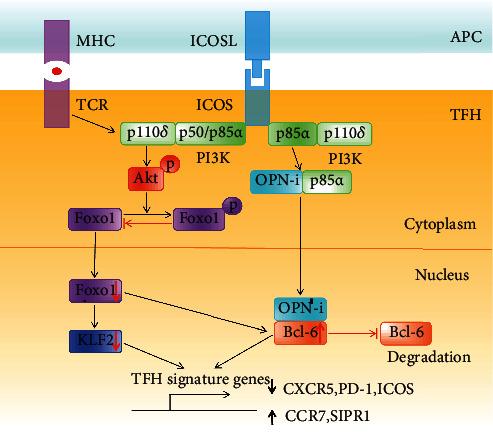
Follicular helper CD4 T (TFH) cells are a specialized subset of effector T cells that play a central role in orchestrating adaptive immunity. TFH cells mainly promote germinal center (GC) formation, provide help to B cells for immunoglobulin affinity maturation and class-switch recombination of B cells, and facilitate production of long-lived plasma cells and memory B cells. TFH cells express the nuclear transcriptional repressor B cell lymphoma 6 (Bcl-6), the chemokine (C-X-C motif) receptor 5 (CXCR5), the CD28 family members programmed cell death protein-1 (PD-1) and inducible costimulator (ICOS) and are also responsible for the secretion of interleukin-21 (IL-21) and IL-4. Follicular regulatory CD4+ T (TFR) cells, as a regulatory counterpart of TFH cells, participate in the regulation of GC reactions. TFR cells not only express markers of TFH cells but also express markers of regulatory T (Treg) cells containing FOXP3, glucocorticoid-induced tumor necrosis factor receptor (GITR), cytotoxic T lymphocyte antigen 4 (CTLA-4), and IL-10, hence owing to the dual characteristic of TFH cells and Treg cells. ICOS, expressed on activated CD4 effector T cells, participates in T cell activation, differentiation, and effector process. The expression of ICOS is highest on TFH and TFR cells, indicating it as a key regulator of humoral immunity. Multiple sclerosis (MS) is a severe autoimmune disease that affects the central nervous system and results in disability, mediated by autoreactive T cells with evolving evidence of a remarkable contribution from humoral responses. This review summarizes recent advances regarding TFH cells, TFR cells, and ICOS, as well as their functional characteristics in relation to MS.
滤泡辅助性 CD4 T(TFH)细胞是效应 T 细胞的一个特殊亚群,在调节适应性免疫中发挥核心作用。TFH 细胞主要促进生发中心(GC)的形成,为 B 细胞提供免疫球蛋白亲和力成熟和 B 细胞的类别转换重组的帮助,并促进长寿命浆细胞和记忆 B 细胞的产生。TFH 细胞表达核转录抑制因子 B 细胞淋巴瘤 6(Bcl-6)、趋化因子(C-X-C 基序)受体 5(CXCR5)、CD28 家族成员程序性细胞死亡蛋白 1(PD-1)和诱导共刺激因子(ICOS),并负责分泌白细胞介素-21(IL-21)和 IL-4。滤泡调节性 CD4+T(TFR)细胞作为 TFH 细胞的调节对应物,参与 GC 反应的调节。TFR 细胞不仅表达 TFH 细胞的标志物,还表达包含 FOXP3、糖皮质激素诱导的肿瘤坏死因子受体(GITR)、细胞毒性 T 淋巴细胞抗原 4(CTLA-4)和 IL-10 的调节性 T(Treg)细胞的标志物,因此由于 TFH 细胞和 Treg 细胞的双重特征。ICOS 在激活的 CD4 效应 T 细胞上表达,参与 T 细胞激活、分化和效应过程。ICOS 在 TFH 和 TFR 细胞上的表达最高,表明其是体液免疫的关键调节因子。多发性硬化症(MS)是一种严重的自身免疫性疾病,影响中枢神经系统并导致残疾,由自身反应性 T 细胞介导,有越来越多的证据表明体液反应有显著贡献。本综述总结了 TFH 细胞、TFR 细胞和 ICOS 的最新进展,以及它们在多发性硬化症中的功能特征。


 Zotero 插件