
特定吸气肌训练联合全身耐力训练方案对 COPD 患者平衡的影响:随机对照试验。
Effects of specific inspiratory muscle training combined with whole-body endurance training program on balance in COPD patients: Randomized controlled trial.
机构信息
Laboratory of Exercise Physiology and Rehabilitation (APERE, UR-EA 3300), Sport Sciences Department, Picardie Jules Verne University, Amiens, France.
Research Laboratory of Exercise Physiology and Pathophysiology: From Integral to Molecular Biology, Medicine and Health (LR19ES09), Faculty of Medicine of Sousse, University of Sousse, Sousse, Tunisia.
出版信息
PLoS One. 2021 Sep 23;16(9):e0257595. doi: 10.1371/journal.pone.0257595. eCollection 2021.
PURPOSE
This study aims to assess the effect of inspiratory muscle training (IMT) combined with endurance training (ET) on balance in patients with chronic obstructive pulmonary disease (COPD).
METHODS
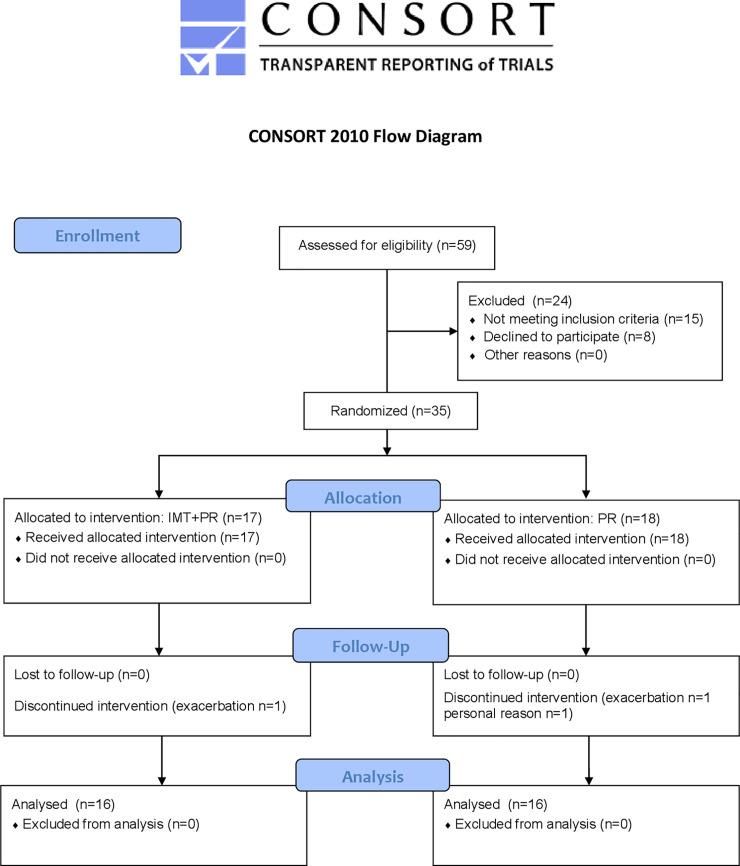
We studied 32 male patients (62 ± 6 years) with moderate to very severe COPD. They were randomly assigned to an experimental group (IMT+ET) n = 16 or a control group (ET) n = 16 with similar characteristics. The evaluations were carried out at inclusion and after eight weeks of the training period. Functional balance was assessed by the Berg Balance Scale (BBS), the Timed-up and Go (TUG), the Single Leg Stance test (SLS), and the Activities-specific Balance Confidence (ABC) scale. The strength of the inspiratory muscles (PImax) was assessed by maximal inspiratory mouth pressure. Functional exercise performance was assessed by the 6 minutes walking test (6MWT). IMT program consists in performing two daily sets of 30 inspirations with 50% of PImax increased by 10% every two weeks. ET program consists in performing 30 min treadmill exercise at 60% to 80% of the average speed achieved during the 6MWT three days per week.
RESULTS
After the training period, the experimental group demonstrated greater improvements in BBS (IMT+ET vs. ET; p = 0.019), and in ABC (IMT+ET vs. ET; p = 0.014). However, no significant differences between groups were observed for TUG, SLS, and 6MWT. There was a significant difference between groups in PImax (IMT+ET vs. ET; p = 0.030). Significant moderate correlations were obtained between ΔPImax and ΔBBS for both groups (IMT+ET: r = 0.624, p = 0.010; ET r = 0.550, p = 0.027) as well as for ΔABC but only in the experimental group (IMT+ET: r = 0.550, p = 0.027).
CONCLUSION
Compared to ET alone, the results suggest that IMT combined with ET enhances inspiratory muscle function and functional balance according to BBS and ABC in patients with COPD. We suggest that inspiratory muscle training might be introduced as additional training to pulmonary rehabilitation programs aimed at improving balance in COPD patients.
TRIAL REGISTRATION
The trial registry name: Clinical Trials; Registration number: NCT04084405; URL: https://clinicaltrials.gov/ct2/show/NCT04084405.
目的
本研究旨在评估吸气肌训练(IMT)联合耐力训练(ET)对慢性阻塞性肺疾病(COPD)患者平衡的影响。
方法
我们研究了 32 名男性患者(62±6 岁),他们患有中重度至非常严重的 COPD。他们被随机分为实验组(IMT+ET)n=16 或对照组(ET)n=16,两组具有相似特征。评估在纳入时和训练期八周后进行。功能平衡通过 Berg 平衡量表(BBS)、计时起立行走测试(TUG)、单腿站立测试(SLS)和活动特异性平衡信心量表(ABC)进行评估。吸气肌力量(PImax)通过最大吸气口腔压力评估。功能运动表现通过 6 分钟步行测试(6MWT)评估。IMT 方案包括每天进行两组 30 次呼吸,每次呼吸增加 50%的 PImax,每两周增加 10%。ET 方案包括每周 3 天在 6MWT 平均速度的 60%至 80%下进行 30 分钟的跑步机运动。
结果
经过训练期后,实验组在 BBS(IMT+ET 与 ET;p=0.019)和 ABC(IMT+ET 与 ET;p=0.014)方面的改善更为显著。然而,两组之间在 TUG、SLS 和 6MWT 方面无显著差异。两组之间的 PImax 存在显著差异(IMT+ET 与 ET;p=0.030)。两组的ΔPImax 与ΔBBS 之间均存在显著的中度相关性(IMT+ET:r=0.624,p=0.010;ET r=0.550,p=0.027),以及ΔABC 之间也存在相关性,但仅在实验组中存在(IMT+ET:r=0.550,p=0.027)。
结论
与单独 ET 相比,结果表明,在 COPD 患者中,IMT 联合 ET 可增强吸气肌功能和 BBS 和 ABC 依据的功能平衡。我们建议,吸气肌训练可以作为旨在改善 COPD 患者平衡的肺康复计划的附加训练引入。
试验注册
试验注册名称:临床试验;注册号:NCT04084405;网址:https://clinicaltrials.gov/ct2/show/NCT04084405。
 Zotero 插件