
移动医疗干预在冠心病生活方式和危险因素修正中的应用:随机对照试验。
mHealth Interventions for Lifestyle and Risk Factor Modification in Coronary Heart Disease: Randomized Controlled Trial.
机构信息
Division of Cardiology, Department of Internal Medicine, Chungbuk National University Hospital, Chungbuk National University College of Medicine, Cheongju, Republic of Korea.
Department of Cardiology, School of Medicine, Inha University Hospital, Inha University, Incheon, Republic of Korea.
出版信息
JMIR Mhealth Uhealth. 2021 Sep 24;9(9):e29928. doi: 10.2196/29928.
BACKGROUND
Self-management of lifestyle and cardiovascular disease risk factors is challenging in older patients with coronary heart disease (CHD). SMS text messaging could be a potential support tool for self-management and the most affordable and accessible method through a mobile phone. High-quality evidence had been lacking, and previous studies evaluated the effects of SMS text messaging on the subjective measures of short-term outcomes. Recently, a large-sized randomized controlled trial in Australia reported promising findings on the objective measures upon 6-month follow-up. However, an examination of the effectiveness of such interventions in an Asian population with unique demographic characteristics would be worthwhile.
OBJECTIVE
This study examined the effectiveness of a 1-way SMS text messaging program to modify the lifestyle and cardiovascular disease risk factors of patients who underwent the first percutaneous coronary intervention (PCI).
METHODS
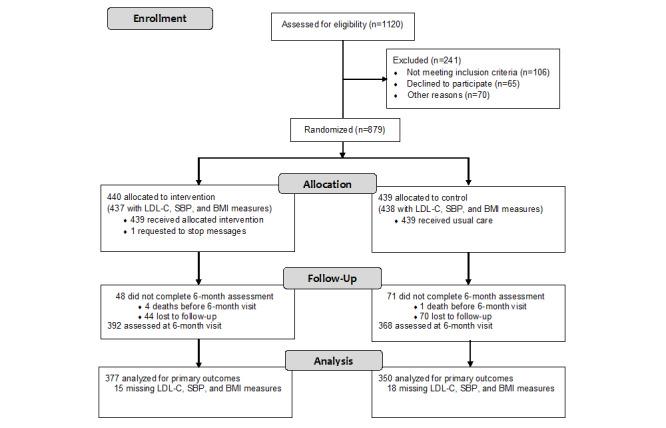
A parallel, single-blinded, 1:1 random allocation clinical trial was conducted with 879 patients treated through PCI. They were recruited during hospital admission from April 2017 to May 2020 at 2 university hospitals in the Republic of Korea. In addition to standard care, the intervention group received access to a supporting website and 4 SMS text messages per week for 6 months regarding a healthy diet, physical activity, smoking cessation, and cardiovascular health. Random allocation upon study enrollment and SMS text messaging after hospital discharge were performed automatically using a computer program. The coprimary outcomes were low-density-lipoprotein cholesterol (LDL-C), systolic blood pressure (SBP), and BMI. The secondary outcomes were change in lifestyle and adherence to the recommended health behaviors.
RESULTS
Of the eligible population, 440 and 439 patients who underwent PCI were assigned to the intervention and control groups, respectively. The 1-way SMS text messaging program significantly enhanced physical activity (P=.02), healthy diet (P<.01), and medication adherence (P<.04) among patients with CHD. Hence, more people were likely to control their cardiovascular disease risk factors per the recommendations. The intervention group was more likely to control all 5 risk factors by 62% (relative risk 1.62, 95% CI 1.05-2.50) per the recommendations. On the other hand, physiological measures of the primary outcomes, including LDL-C levels, SBP, and BMI, were not significant. Most participants found the SMS text messaging program useful and helpful in motivating lifestyle changes.
CONCLUSIONS
Lifestyle-focused SMS text messages were effective in the self-management of a healthy diet, exercise, and medication adherence, but their influence on the physiological measures was not significant. One-way SMS text messages can be used as an affordable adjuvant method for lifestyle modification to help prevent the recurrence of cardiovascular disease.
TRIAL REGISTRATION
Clinical Research Information Service (CRiS) KCT0005087; https://cris.nih.go.kr/cris/search/detailSearch.do/19282.
背景
对于患有冠心病(CHD)的老年患者来说,自我管理生活方式和心血管疾病风险因素具有挑战性。短信文本消息传递可能是自我管理的潜在支持工具,也是通过手机提供的最实惠和最便捷的方法。之前的研究评估了短信文本消息传递对短期结果的主观测量的影响,但缺乏高质量的证据。最近,澳大利亚的一项大型随机对照试验报告了在 6 个月随访时对客观测量的有希望的发现。然而,在具有独特人口统计学特征的亚洲人群中检查此类干预措施的效果将是值得的。
目的
本研究旨在检验一种单向短信文本消息传递方案对接受首次经皮冠状动脉介入治疗(PCI)的患者生活方式和心血管疾病风险因素的改变效果。
方法
对 879 名在韩国的 2 所大学医院接受 PCI 治疗的患者进行了平行、单盲、1:1 随机分组临床试验。他们于 2017 年 4 月至 2020 年 5 月在住院期间被招募。除了标准护理外,干预组还可以访问支持网站,并在 6 个月内每周接收 4 条有关健康饮食、身体活动、戒烟和心血管健康的短信文本消息。通过计算机程序自动进行研究入组时的随机分配和出院后的短信文本消息传递。主要结局指标是低密度脂蛋白胆固醇(LDL-C)、收缩压(SBP)和 BMI。次要结局指标是生活方式的改变和对推荐健康行为的依从性。
结果
在符合条件的人群中,440 名和 439 名接受 PCI 的患者分别被分配到干预组和对照组。单向短信文本消息传递方案显著增强了冠心病患者的身体活动(P=.02)、健康饮食(P<.01)和药物依从性(P<.04)。因此,更多的人可能会按照建议控制心血管疾病风险因素。按照建议,干预组更有可能控制所有 5 个风险因素,控制率为 62%(相对风险 1.62,95%CI 1.05-2.50)。另一方面,主要结局的生理指标,包括 LDL-C 水平、SBP 和 BMI,均无显著差异。大多数参与者认为短信文本消息传递方案有助于激励生活方式的改变。
结论
以生活方式为重点的短信文本消息传递在健康饮食、运动和药物依从性的自我管理方面是有效的,但对生理指标的影响并不显著。单向短信消息传递可作为一种经济实惠的辅助方法,用于生活方式的改变,以帮助预防心血管疾病的复发。
试验注册
临床研究信息服务(CRiS)KCT0005087;https://cris.nih.go.kr/cris/search/detailSearch.do/19282.


 Zotero 插件