
杨梅素可减缓 Tau 的液-液相分离,并激活 ATG5 依赖性自噬以抑制 Tau 毒性。
Myricetin slows liquid-liquid phase separation of Tau and activates ATG5-dependent autophagy to suppress Tau toxicity.
机构信息
Hubei Key Laboratory of Cell Homeostasis, College of Life Sciences, Wuhan University, Wuhan, China; Wuhan University Shenzhen Research Institute, Shenzhen, China.
Hubei Key Laboratory of Cell Homeostasis, College of Life Sciences, Wuhan University, Wuhan, China; Wuhan University Shenzhen Research Institute, Shenzhen, China.
出版信息
J Biol Chem. 2021 Oct;297(4):101222. doi: 10.1016/j.jbc.2021.101222. Epub 2021 Sep 22.
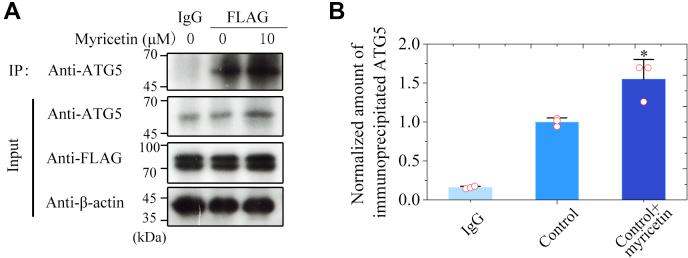
Intraneuronal neurofibrillary tangles composed of Tau aggregates have been widely accepted as an important pathological hallmark of Alzheimer's disease. A current therapeutic avenue for treating Alzheimer's disease is aimed at inhibiting Tau accumulation with small molecules such as natural flavonoids. Liquid-liquid phase separation (LLPS) of Tau can lead to its aggregation, and Tau aggregates can then be degraded by autophagy. However, it is unclear whether natural flavonoids modulate the formation of phase-separated Tau droplets or promote autophagy and Tau clearance. Here, using confocal microscopy and fluorescence recovery after photobleaching assays, we report that a natural antioxidant flavonoid compound myricetin slows LLPS of full-length human Tau, shifting the equilibrium phase boundary to a higher protein concentration. This natural flavonoid also significantly inhibits pathological phosphorylation and abnormal aggregation of Tau in neuronal cells and blocks mitochondrial damage and apoptosis induced by Tau aggregation. Importantly, using coimmunoprecipitation and Western blotting, we show that treatment of cells with myricetin stabilizes the interaction between Tau and autophagy-related protein 5 (ATG5) to promote clearance of phosphorylated Tau to indirectly limit its aggregation. Consistently, this natural flavonoid inhibits mTOR pathway, activates ATG5-dependent Tau autophagy, and almost completely suppresses Tau toxicity in neuronal cells. Collectively, these results demonstrate how LLPS and abnormal aggregation of Tau are inhibited by natural flavonoids, bridging the gap between Tau LLPS and aggregation in neuronal cells, and also establish that myricetin could act as an ATG5-dependent autophagic activator to ameliorate the pathogenesis of Alzheimer's disease.
神经细胞内神经原纤维缠结由 Tau 聚集物组成,已被广泛认为是阿尔茨海默病的重要病理标志。目前治疗阿尔茨海默病的一种治疗途径是用小分子如天然类黄酮来抑制 Tau 的积累。Tau 的液-液相分离 (LLPS) 可以导致其聚集,然后自噬可以降解 Tau 聚集物。然而,目前尚不清楚天然类黄酮是否调节相分离 Tau 液滴的形成,或者促进自噬和 Tau 清除。在这里,我们使用共聚焦显微镜和荧光恢复后光漂白实验报告称,一种天然抗氧化类黄酮化合物杨梅素减缓全长人 Tau 的液-液相分离,将平衡相界移至更高的蛋白质浓度。这种天然类黄酮还显著抑制神经元细胞中 Tau 的病理性磷酸化和异常聚集,并阻止 Tau 聚集诱导的线粒体损伤和细胞凋亡。重要的是,通过共免疫沉淀和 Western blot 实验,我们表明用杨梅素处理细胞可以稳定 Tau 与自噬相关蛋白 5 (ATG5) 之间的相互作用,促进磷酸化 Tau 的清除,从而间接限制其聚集。一致地,这种天然类黄酮抑制 mTOR 通路,激活 ATG5 依赖性 Tau 自噬,并几乎完全抑制神经元细胞中 Tau 的毒性。总之,这些结果表明天然类黄酮如何抑制 Tau 的液-液相分离和异常聚集,弥合 Tau 在神经元细胞中的液-液相分离和聚集之间的差距,并确立杨梅素可以作为 ATG5 依赖性自噬激活剂来改善阿尔茨海默病的发病机制。




 Zotero 插件