
循环经济中的咖啡生物废料资源化利用:一种用于评估咖啡渣在砂浆生产中潜力的方法。
Coffee biowaste valorization within circular economy: an evaluation method of spent coffee grounds potentials for mortar production.
作者信息
La Scalia Giada, Saeli Manfredi, Miglietta Pier Paolo, Micale Rosa
机构信息
Department of Engineering, University of Palermo, Viale delle Scienze, Bld 8, Palermo, Italy.
Department of Architecture, University of Palermo, Viale delle Scienze, Bld 8-14, Palermo, Italy.
出版信息
Int J Life Cycle Assess. 2021;26(9):1805-1815. doi: 10.1007/s11367-021-01968-0. Epub 2021 Sep 19.
PURPOSE
Spent coffee grounds (SCG) are biowastes extensively generated within the coffee supply chain. Nowadays, their disposal represents an increasing environmental concern due to its toxicity and organic nature. With the estimated increase of coffee production and consumption in the upcoming years, there is an imperative need to find a proper reverse option, along with a novel industrial application, which allows for the valorization of this coffee by-product within a circular economy perspective. This study aims at investigating a potential reuse of spent coffee grounds to produce novel construction materials to be used for sustainable buildings.
METHODS
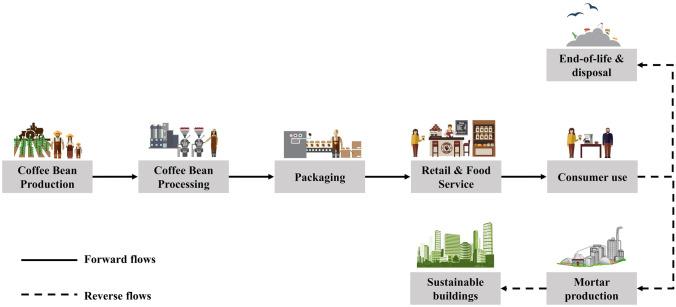
After having illustrated the forward flows within the coffee life cycle and the potential reverse flow options, an evaluation method based on multi-criteria analyses was elaborated to test not only the technical but also the environmental and economic performances of novel materials originating from the incorporation of SCG as an aggregate in natural hydraulic lime and geopolymer-based mortars. Moreover, we focus on the reuse of another waste streams- biomass fly ash-deriving from the paper-pulp industry, rarely investigated in both traditional construction applications and in geopolymer manufacture. The two (geopolymer- and lime-based) mortar typologies are here studied and compared as potential green material for applications in construction, with satisfying engineering performance and high insulation attitude, giving a new life to a common organic waste. Consequently, we compare eight formulations by means of multi-criteria approaches that are nowadays claimed as a useful and effective decision aiding support instrument to assess the development of new sustainable construction materials. They permit to consider simultaneously some controversial and often uncertain aspects like technological (as the usual scientific studies do), environmental, and economic (more difficult to easily approach and evaluate). For this purpose, in this paper, we have analyzed the performance of the novel bio-composite mortars using VIKOR and TOPSIS methods to rank a set of alternatives according to various evaluation criteria that often conflict one with each other.
RESULTS
Results show that adding spent coffee grounds can efficiently improve the technical and sustainable performances of the novel mortars for different applications in the building sector. The presence of SCG increases water absorption and improves the insulation performance along with an environmental impact reduction. The considered technological properties are highly promising-such as the improvement in thermal insulation. In particular, even the addition of only 5% SCG leads to a significant reduction of the thermal conductivity and consequently to a greater insulating performance.
CONCLUSIONS
To date, most of the available literature on recycling SCG in construction materials do not consider mortar-based applications and, moreover, nor multi-criteria approaches. Therefore, our study proposes itself as an innovative track solution to food waste management lowering the employment of non-renewable natural resources and the costs associated to construction material production. At the same time, a novel and innovative way of such waste disposal is suggested, pursuing the sustainability and substantially reducing the environmental impact of construction and building materials. This study is a fundamental step in assessing the applicability of our designed and produced materials and its potentials to be produced at an industrial scale.
目的
咖啡渣是咖啡供应链中大量产生的生物废弃物。如今,由于其毒性和有机性质,对其进行处理已引发越来越多的环境问题。预计在未来几年咖啡产量和消费量将会增加,因此迫切需要找到一种合适的逆向利用方案以及一种新的工业应用方式,以便从循环经济的角度对这种咖啡副产品进行增值利用。本研究旨在探究咖啡渣用于生产可持续建筑用新型建筑材料的潜在再利用价值。
方法
在阐述了咖啡生命周期中的正向流程以及潜在的逆向流程选项之后,精心设计了一种基于多标准分析的评估方法,以测试将咖啡渣作为骨料掺入天然水硬性石灰和地质聚合物基砂浆中所制得的新型材料的技术性能、环境性能和经济性能。此外,我们还关注另一种废物流——来自纸浆行业的生物质粉煤灰——在传统建筑应用和地质聚合物制造中均很少被研究。这里对两种(地质聚合物基和石灰基)砂浆类型进行了研究和比较,将其作为具有令人满意的工程性能和高保温性能的潜在绿色建筑材料,赋予一种常见有机废弃物新的用途。因此,我们通过多标准方法比较了八种配方,如今多标准方法被认为是一种有用且有效的决策辅助支持工具,可用于评估新型可持续建筑材料的开发。这些方法能够同时考虑一些有争议且往往不确定的方面,如技术方面(如同常规科学研究那样)、环境方面和经济方面(更难以轻易处理和评估)。为此,在本文中,我们使用VIKOR和TOPSIS方法分析了新型生物复合砂浆的性能,以便根据通常相互冲突的各种评估标准对一组备选方案进行排序。
结果
结果表明,添加咖啡渣能够有效改善新型砂浆在建筑领域不同应用中的技术性能和可持续性能。咖啡渣的存在增加了吸水率,改善了保温性能,同时减少了环境影响。所考虑的技术性能前景十分广阔,例如保温性能的提升。特别是,即使仅添加5%的咖啡渣也会导致热导率显著降低,从而具有更好的保温性能。
结论
迄今为止,关于在建筑材料中回收利用咖啡渣的现有文献大多未考虑基于砂浆的应用,而且也未涉及多标准方法。因此,我们的研究提出了一种创新的食品废弃物管理解决方案,减少了不可再生自然资源的使用以及与建筑材料生产相关的成本。同时,建议采用一种新颖且创新的此类废弃物处理方式,追求可持续性并大幅降低建筑和建筑材料对环境的影响。本研究是评估我们设计和生产的材料的适用性及其在工业规模生产潜力的重要一步。
 Zotero 插件