
[具体物种]的肠道细菌群落及其与宿主发育和饮食的关联
Gut Bacterial Communities of and Their Associations with Host Development and Diet.
作者信息
Ma Qiuyu, Cui Yonghong, Chu Xu, Li Guoqiang, Yang Meijiao, Wang Rong, Liang Guanghong, Wu Songqing, Tigabu Mulualem, Zhang Feiping, Hu Xia
机构信息
International Joint Laboratory of Forest Symbiology, College of Forestry, Fujian Agriculture and Forestry University, Fuzhou 350000, China.
Key Laboratory of Integrated, Pest Management in Ecological Forests, Fujian Agriculture and Forestry University, Fuzhou 350000, China.
出版信息
Microorganisms. 2021 Sep 1;9(9):1860. doi: 10.3390/microorganisms9091860.
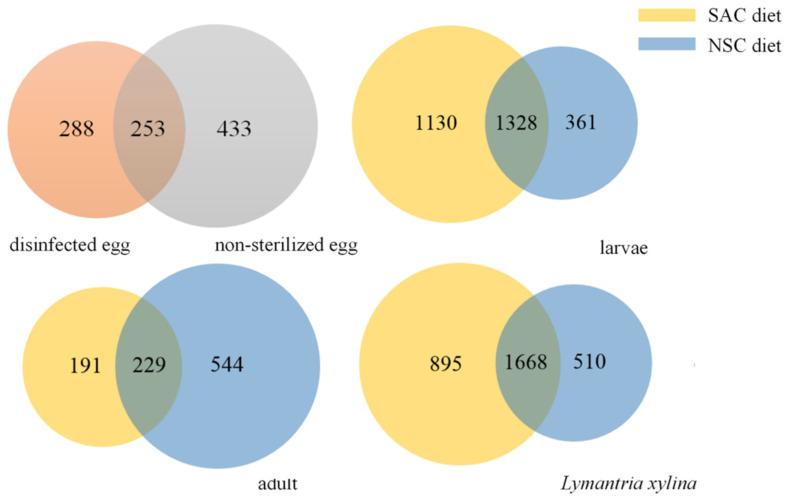
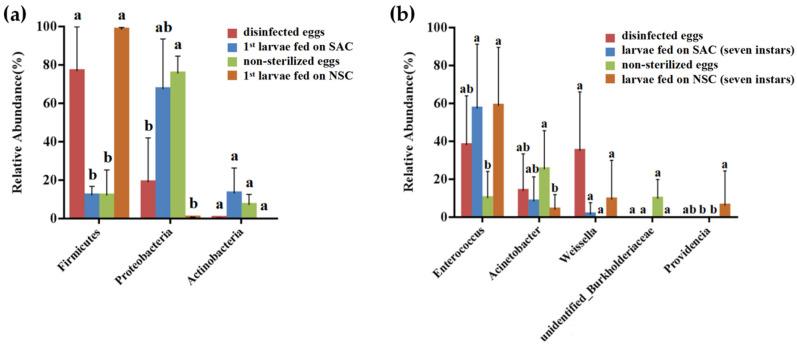
The gut microbiota of insects has a wide range of effects on host nutrition, physiology, and behavior. The structure of gut microbiota may also be shaped by their environment, causing them to adjust to their hosts; thus, the objective of this study was to examine variations in the morphological traits and gut microbiota of in response to natural and artificial diets using high-throughput sequencing. Regarding morphology, the head widths for larvae fed on a sterilized artificial diet were smaller than for larvae fed on a non-sterilized host-plant diet in the early instars. The gut microbiota diversity of fed on different diets varied significantly, but did not change during different development periods. This seemed to indicate that vertical inheritance occurred in mutualistic symbionts. and were dominant in/on eggs. In the first instar larvae, accounted for 33.52% of the sterilized artificial diet treatment, while (67.88%) was the predominant bacteria for the non-sterilized host-plant diet treatment. Gut microbe structures were adapted to both diets through vertical inheritance and self-regulation. This study clarified the impacts of microbial symbiosis on and might provide new possibilities for improving the control of these bacteria.
昆虫的肠道微生物群对宿主的营养、生理和行为有广泛影响。肠道微生物群的结构也可能受其环境影响,从而使其适应宿主;因此,本研究的目的是使用高通量测序技术,研究[昆虫名称未给出]在天然和人工饲料作用下形态特征和肠道微生物群的变化。在形态方面,取食无菌人工饲料的幼虫在低龄期的头宽比取食未灭菌寄主植物饲料的幼虫小。取食不同饲料的[昆虫名称未给出]的肠道微生物群多样性差异显著,但在不同发育阶段没有变化。这似乎表明互利共生菌在[昆虫名称未给出]中发生垂直遗传。[细菌名称未给出]和[细菌名称未给出]在卵内或卵上占主导地位。在一龄幼虫中,[细菌名称未给出]在无菌人工饲料处理中占33.52%,而在未灭菌寄主植物饲料处理中,[细菌名称未给出](67.88%)是优势菌。肠道微生物结构通过垂直遗传和自我调节适应两种饲料。本研究阐明了微生物共生对[昆虫名称未给出]的影响,并可能为改进对这些细菌的控制提供新的可能性。



 Zotero 插件