
多病症与心肌梗死后健康相关生活质量变化的关联:一项英国多中心纵向患者报告结局研究。
Association of multimorbidity and changes in health-related quality of life following myocardial infarction: a UK multicentre longitudinal patient-reported outcomes study.
机构信息
Leeds Institute of Cardiovascular and Metabolic Medicine, University of Leeds, Leeds, LS2 9JT, UK.
Leeds Institute for Data Analytics, University of Leeds, Leeds, UK.
出版信息
BMC Med. 2021 Sep 28;19(1):227. doi: 10.1186/s12916-021-02098-y.
BACKGROUND
Multimorbidity is prevalent for people with myocardial infarction (MI), yet previous studies investigated single-health conditions in isolation. We identified patterns of multimorbidity in MI survivors and their associations with changes in HRQoL.
METHODS
In this national longitudinal cohort study, we analysed data from 9566 admissions with MI from 77 National Health Service hospitals in England between 2011 and 2015. HRQoL was measured using EuroQol 5 dimension (EQ5D) instrument and visual analogue scale (EQVAS) at hospitalisation, 6, and 12 months following MI. Latent class analysis (LCA) of pre-existing long-term health conditions at baseline was used to identify clusters of multimorbidity and associations with changes in HRQoL quantified using mixed effects regression analysis.
RESULTS
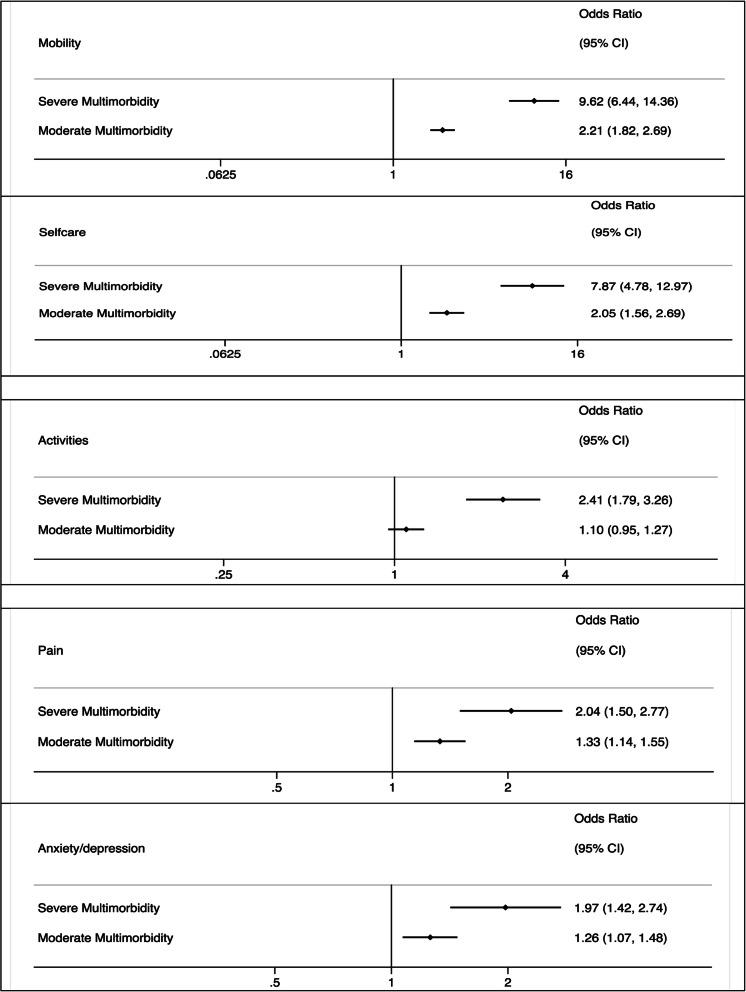
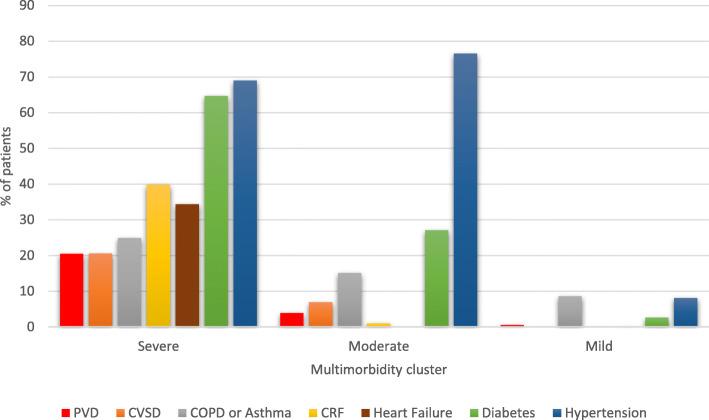
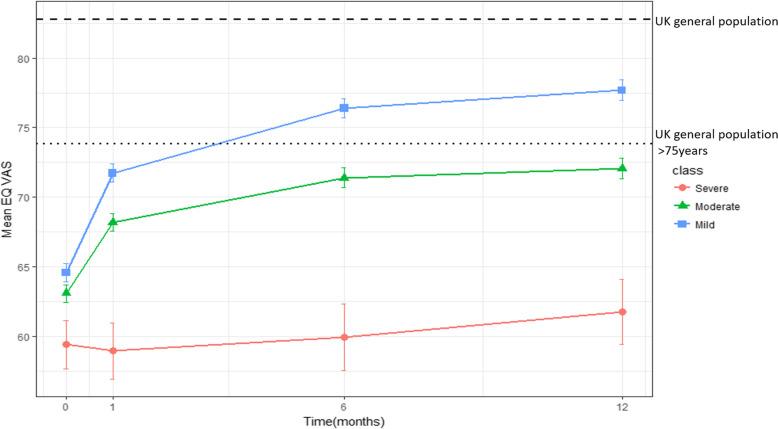
Of 9566 admissions with MI (mean age of 64.1 years [SD 11.9], 7154 [75%] men), over half (5119 [53.5%] had multimorbidities. LCA identified 3 multimorbidity clusters which were severe multimorbidity (591; 6.5%) with low HRQoL at baseline (EQVAS 59.39 and EQ5D 0.62) which did not improve significantly at 6 months (EQVAS 59.92, EQ5D 0.60); moderate multimorbidity (4301; 47.6%) with medium HRQoL at baseline (EQVAS 63.08, EQ5D 0.71) and who improved at 6 months (EQVAS 71.38, EQ5D 0.76); and mild multimorbidity (4147, 45.9%) at baseline (EQVAS 64.57, EQ5D 0.75) and improved at 6 months (EQVAS 76.39, EQ5D 0.82). Patients in the severe and moderate groups were more likely to be older, women, and presented with NSTEMI. Compared with the mild group, increased multimorbidity was associated with lower EQ-VAS scores (adjusted coefficient: -5.12 [95% CI -7.04 to -3.19] and -0.98 [-1.93 to -0.04] for severe and moderate multimorbidity, respectively. The severe class was more likely than the mild class to report problems in mobility, OR 9.62 (95% confidence interval: 6.44 to 14.36), self-care 7.87 (4.78 to 12.97), activities 2.41 (1.79 to 3.26), pain 2.04 (1.50 to 2.77), and anxiety/depression 1.97 (1.42 to 2.74).
CONCLUSIONS
Among MI survivors, multimorbidity clustered into three distinct patterns and was inversely associated with HRQoL. The identified multimorbidity patterns and HRQoL domains that are mostly affected may help to identify patients at risk of poor HRQoL for which clinical interventions could be beneficial to improve the HRQoL of MI survivors.
TRIAL REGISTRATION
ClinicalTrials.gov NCT01808027 and NCT01819103.
背景
心肌梗死(MI)患者普遍患有多种疾病,但以前的研究都是单独研究单一健康状况。我们确定了 MI 幸存者的多种疾病模式及其与 HRQoL 变化的关系。
方法
在这项全国性的纵向队列研究中,我们分析了 2011 年至 2015 年间英格兰 77 家国家卫生服务医院 9566 例 MI 住院患者的数据。在入院时、MI 后 6 个月和 12 个月使用 EQ5D 量表和视觉模拟量表(EQVAS)来测量 HRQoL。使用基线时预先存在的长期健康状况的潜在类别分析(LCA)来识别多种疾病的聚类,并使用混合效应回归分析来量化与 HRQoL 变化的关联。
结果
在 9566 例 MI 住院患者中(平均年龄 64.1 岁[SD 11.9],7154[75%]为男性),超过一半(5119[53.5%])患有多种疾病。LCA 确定了 3 种多种疾病聚类,即严重多种疾病(591;6.5%),基线时 HRQoL 较低(EQVAS 59.39,EQ5D 0.62),在 6 个月时并未显著改善(EQVAS 59.92,EQ5D 0.60);中度多种疾病(4301;47.6%),基线时 HRQoL 处于中等水平(EQVAS 63.08,EQ5D 0.71),6 个月时有所改善(EQVAS 71.38,EQ5D 0.76);轻度多种疾病(4147;45.9%),基线时 HRQoL 良好(EQVAS 64.57,EQ5D 0.75),6 个月时有所改善(EQVAS 76.39,EQ5D 0.82)。严重组和中度组的患者更可能是老年人、女性,且表现为 NSTEMI。与轻度组相比,多种疾病的增加与 EQ-VAS 评分降低相关(调整后的系数分别为-5.12[95%CI-7.04 至-3.19]和-0.98[-1.93 至-0.04])。严重组比轻度组更有可能报告在移动、自理、活动、疼痛和焦虑/抑郁方面存在问题,OR 分别为 9.62(95%置信区间:6.44 至 14.36)、7.87(4.78 至 12.97)、2.41(1.79 至 3.26)、2.04(1.50 至 2.77)和 1.97(1.42 至 2.74)。
结论
在 MI 幸存者中,多种疾病分为三种不同的模式,与 HRQoL 呈负相关。确定的多种疾病模式和受影响的 HRQoL 领域可能有助于识别出 HRQoL 较差的高危患者,为改善 MI 幸存者的 HRQoL,临床干预可能会有所帮助。
试验注册
ClinicalTrials.gov NCT01808027 和 NCT01819103。
 Zotero 插件