
引起阿根廷儿童侵袭性疾病的种群遗传结构、血清型分布和抗生素耐药性。
Population genetic structure, serotype distribution and antibiotic resistance of causing invasive disease in children in Argentina.
机构信息
Antimicrobial Agents Division. National Reference Laboratory in Antimicrobial Resistance. INEI-ANLIS "Dr. Carlos G. Malbrán", Buenos Aires, Argentina.
Parasites and Microbes, The Wellcome Sanger Institute, Wellcome Genome Campus, Hinxton, UK.
出版信息
Microb Genom. 2021 Sep;7(9). doi: 10.1099/mgen.0.000636.
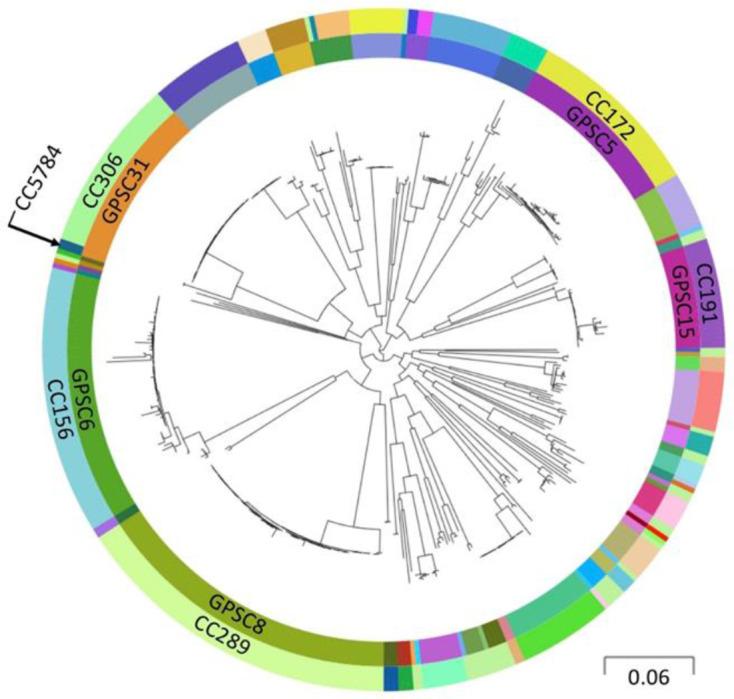
Invasive disease caused by (IPD) is one of the leading causes of morbidity and mortality in young children worldwide. In Argentina, PCV13 was introduced into the childhood immunization programme nationwide in 2012 and PCV7 was available from 2000, but only in the private market. Since 1993 the National IPD Surveillance Programme, consisting of 150 hospitals, has conducted nationwide pneumococcal surveillance in Argentina in children under 6 years of age, as part of the SIREVA II-OPS network. A total of 1713 pneumococcal isolates characterized by serotype (Quellung) and antimicrobial resistance (agar dilution) to ten antibiotics, belonging to three study periods: pre-PCV7 era 1998-1999 (pre-PCV), before the introduction of PCV13 2010-2011 (PCV7) and after the introduction of PCV13 2012-2013 (PCV13), were available for inclusion. Fifty-four serotypes were identified in the entire collection and serotypes 14, 5 and 1 represented 50 % of the isolates. Resistance to penicillin was 34.9 %, cefotaxime 10.6 %, meropenem 4.9 %, cotrimoxazole 45 %, erythromycin 21.5 %, tetracycline 15.4 % and chloramphenicol 0.4 %. All the isolates were susceptible to levofloxacin, rifampin and vancomycin. Of 1713 isolates, 1061 (61.9 %) were non-susceptible to at least one antibiotic and 235(13.7 %) were multidrug resistant. A subset of 413 isolates was randomly selected and whole-genome sequenced as part of Global Pneumococcal Sequencing Project (GPS). The genome data was used to investigate the population structure of defining pneumococcal lineages using Global Pneumococcal Sequence Clusters (GPSCs), sequence types (STs) and clonal complexes (CCs), prevalent serotypes and their associated pneumococcal lineages and genomic inference of antimicrobial resistance. The collection showed a great diversity of strains. Among the 413 isolates, 73 known and 36 new STs were identified belonging to 38 CCs and 25 singletons, grouped into 52 GPSCs. Important changes were observed among vaccine types when pre-PCV and PCV13 periods were compared; a significant decrease in serotypes 14, 6B and 19F and a significant increase in 7F and 3. Among non-PCV13 types, serogroup 24 increased from 0 % in pre-PCV to 3.2 % in the PCV13 period. Our analysis showed that 66.1 % (273/413) of the isolates were predicted to be non-susceptible to at least one antibiotic and 11.9 % (49/413) were multidrug resistant. We found an agreement of 100 % when comparing the serotype determined by Quellung and WGS-based serotyping and 98.4 % of agreement in antimicrobial resistance. Continued surveillance of the pneumococcal population is needed to reveal the dynamics of pneumococcal isolates in Argentina in post-PCV13. This article contains data hosted by Microreact.
(侵袭性疾病)导致的疾病是全球幼儿发病率和死亡率的主要原因之一。在阿根廷,PCV13 于 2012 年被纳入全国儿童免疫计划,PCV7 于 2000 年开始供应,但仅在私人市场供应。自 1993 年以来,由 150 家医院组成的国家侵袭性疾病监测计划一直在阿根廷开展 6 岁以下儿童的全国肺炎球菌监测,作为 SIREVA II-OPS 网络的一部分。共有 1713 株肺炎球菌分离株,通过血清型(Quellung)和对十种抗生素的药物敏感性(琼脂稀释法)进行了特征描述,这些分离株来自三个研究期:PCV7 时代之前的 1998-1999 年(PCV7 之前)、PCV13 引入之前的 2010-2011 年(PCV7)和 PCV13 引入之后的 2012-2013 年(PCV13),可供纳入研究。整个集合中鉴定出 54 种血清型,血清型 14、5 和 1 占分离株的 50%。青霉素耐药率为 34.9%,头孢噻肟耐药率为 10.6%,美罗培南耐药率为 4.9%,复方磺胺甲噁唑耐药率为 45%,红霉素耐药率为 21.5%,四环素耐药率为 15.4%,氯霉素耐药率为 0.4%。所有分离株均对左氧氟沙星、利福平、万古霉素敏感。在 1713 株分离株中,有 1061 株(61.9%)对至少一种抗生素不敏感,235 株(13.7%)为多药耐药。从 413 株分离株中随机选择了一个子集,并作为全球肺炎球菌测序项目(GPS)的一部分进行了全基因组测序。基因组数据用于使用全球肺炎球菌序列簇(GPSCs)、序列类型(STs)和克隆复合体(CCs)、流行血清型及其相关肺炎球菌谱系以及抗生素耐药性的基因组推断来研究种群结构。该集合显示了菌株的多样性。在 413 株分离株中,确定了 73 个已知和 36 个新 ST,属于 38 个 CC 和 25 个单体,分为 52 个 GPSCs。当比较 PCV7 之前和 PCV13 时期时,观察到疫苗类型之间发生了重要变化;血清型 14、6B 和 19F 显著减少,7F 和 3 显著增加。在非 PCV13 类型中,血清群 24 从 PCV7 之前的 0%增加到 PCV13 时期的 3.2%。我们的分析表明,66.1%(273/413)的分离株被预测至少对一种抗生素不敏感,11.9%(49/413)为多药耐药。我们发现,当比较 Quellung 确定的血清型和基于 WGS 的血清型时,结果完全一致,在抗生素耐药性方面,有 98.4%的一致性。需要继续监测肺炎球菌种群,以揭示阿根廷在 PCV13 之后肺炎球菌分离株的动态变化。本文包含由 Microreact 托管的数据。



 Zotero 插件