
2 小时夜间小睡对 12 小时模拟夜间工作期间褪黑素浓度和警觉性的影响。
Effects of 2-hour nighttime nap on melatonin concentration and alertness during 12-hour simulated night work.
机构信息
Laboratory of Environmental Ergonomics, Faculty of Engineering, Hokkaido University, Japan.
Graduate School of Integrated Frontier Sciences, Kyushu University, Japan.
出版信息
Ind Health. 2021 Nov 29;59(6):393-402. doi: 10.2486/indhealth.2020-0245. Epub 2021 Sep 28.
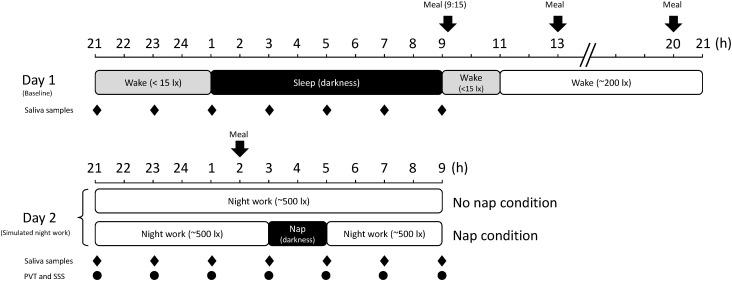
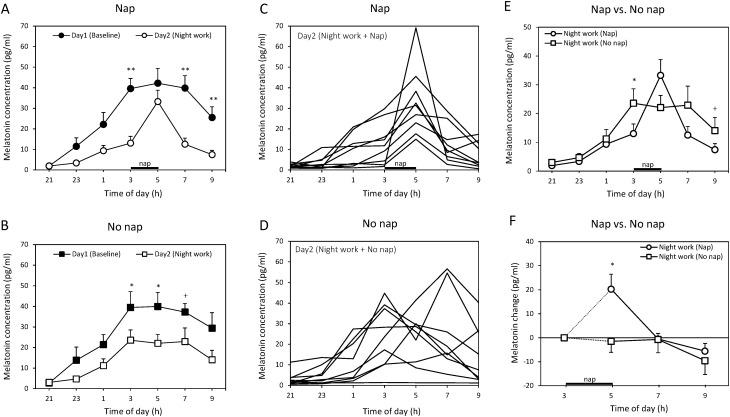
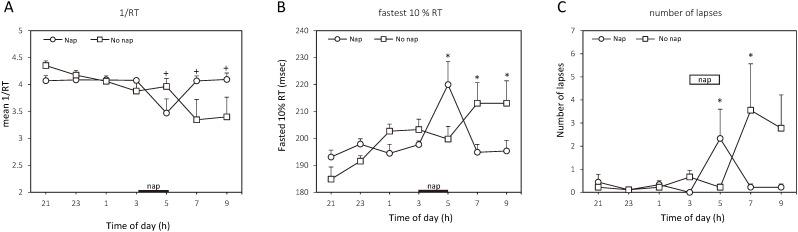
A nighttime nap is expected to mitigate melatonin suppression during night work by blocking light input to the retina, but it is unclear. In the present study, we investigated the effects of a nap break on melatonin level, subjective sleepiness, and vigilance performance during simulated night work. Eleven healthy young males (mean ± SD age: 22.2 ± 4.1 years) participated in counterbalanced crossover design experiments with two conditions (nap vs. no nap). The subjects performed 12-hour simulated night work from 21:00 to 09:00 h (illuminance: ~500 lx). Subjects with a nap condition took a nap for 2 hours in a dark room from 03:00, while subjects with a no nap condition continued the simulated night work. The results showed that immediately after the 2-h nap break, the melatonin level at 05:00 h temporarily recovered from light-induced melatonin suppression during the simulated night work but significantly suppressed again at 07:00 and 09:00 h. Subjective alertness and vigilance performance were impaired immediately after the nap break but subsequently enhanced. The results suggest that a single nap break for 2 hours could be a strategy to enhance alertness during the last part of night shift but inadequate for mitigating melatonin suppression.
夜间小睡有望通过阻止光线进入视网膜来减轻夜间工作时褪黑素的抑制,但目前尚不清楚。在本研究中,我们调查了小睡对褪黑素水平、主观困倦和模拟夜间工作期间警觉性表现的影响。11 名健康年轻男性(平均±SD 年龄:22.2±4.1 岁)参与了两种条件(小睡与不小睡)的交叉设计实验。受试者从 21:00 到 09:00 进行 12 小时模拟夜间工作(照度:约 500 lx)。小睡条件下的受试者在 03:00 时在黑暗的房间里小睡 2 小时,而不小睡条件下的受试者继续进行模拟夜间工作。结果表明,小睡 2 小时后,5:00 时的褪黑素水平暂时从模拟夜间工作中光诱导的褪黑素抑制中恢复,但在 7:00 和 9:00 时再次显著抑制。小睡后警觉性和警觉性表现立即受损,但随后增强。结果表明,2 小时的单次小睡可能是增强夜班最后部分警觉性的策略,但不足以减轻褪黑素抑制。


 Zotero 插件