
抗PD-1抗体调节的适应性自然杀伤细胞疗法在胃癌模型中的研究
Adaptive NK Cell Therapy Modulated by Anti-PD-1 Antibody in Gastric Cancer Model.
作者信息
Abdolahi Shahrokh, Ghazvinian Zeinab, Muhammadnejad Samad, Ahmadvand Mohammad, Aghdaei Hamid Asadzadeh, Ebrahimi-Barough Somayeh, Ai Jafar, Zali Mohammad Reza, Verdi Javad, Baghaei Kaveh
机构信息
Department of Applied Cell Sciences, School of Advanced Technologies in Medicine, Tehran University of Medical Sciences, Tehran, Iran.
Cell-Based Therapies Research Center, Digestive Diseases Research Institute, Tehran University of Medical Sciences, Tehran, Iran.
出版信息
Front Pharmacol. 2021 Sep 13;12:733075. doi: 10.3389/fphar.2021.733075. eCollection 2021.
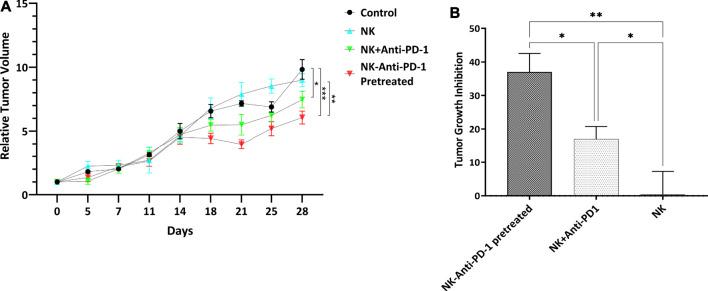
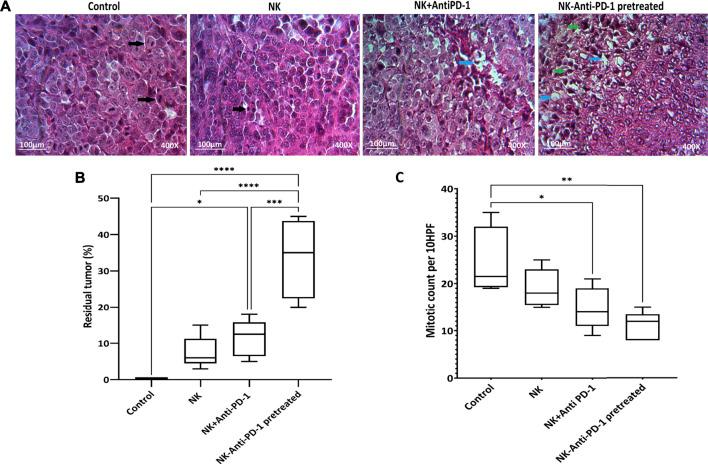
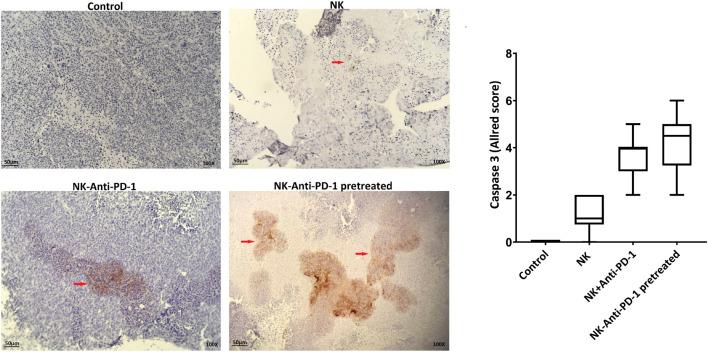
Recently, adaptive NK cell therapy has become a promising treatment but has limited efficacy as a monotherapy. The identification of immune checkpoint inhibitor (ICI) molecules has opened a new horizon of immunotherapy. Herein, we aimed to demonstrate the cytotoxic effects of a polytherapy consisting of expanded IL-2-activated NK cells combined with human anti-PD-1 antibody as an important checkpoint molecule in a xenograft gastric cancer mouse model. EBV-LCL cell is used as a feeder to promote NK cell proliferation with a purity of 93.4%. Mice (NOG, female, 6-8 weeks old) with xenograft gastric tumors were treated with PBS, IL-2-activated NK cells, IL-2-activated NK cell along with human anti-PD-1 (Nivolumab), and IL-2-activated pretreated NK cells with anti-PD-1 antibody. The cytotoxicity of expanded NK cells against MKN-45 cells was assessed by a lactate dehydrogenase (LDH) assay. Tumor volume was evaluated for morphometric properties, and tumor-infiltrating NK cells were assessed by immunohistochemistry (IHC) and quantified by flow cytometry. Pathologic responses were considered by H and E staining. LDH evaluation showed the cytotoxic potential of treated NK cells against gastric cancer cell line. We indicated that the adoptive transfer of IL-2-activated NK cells combined with anti-PD-1 resulted in tumor growth inhibition in a xenograft gastric cancer model. Mitotic count was significantly decreased (* < 0.05), and the tumor was associated with improved infiltration of NK cells in the NK-anti-PD-1 pretreated group (* < 0.05). In conclusion, the combination approach of activated NK cells and anti-PD-1 therapy results in tumor growth inhibition, accompanied by tumor immune cell infiltration in the gastric tumor model.
最近,适应性自然杀伤细胞(NK细胞)疗法已成为一种有前景的治疗方法,但作为单一疗法其疗效有限。免疫检查点抑制剂(ICI)分子的鉴定开启了免疫治疗的新篇章。在此,我们旨在证明在异种移植胃癌小鼠模型中,由扩增的白细胞介素-2激活的NK细胞与人抗程序性死亡蛋白1(PD-1)抗体(一种重要的检查点分子)组成的联合疗法的细胞毒性作用。EB病毒转化的B淋巴细胞(EBV-LCL细胞)用作饲养细胞,以促进NK细胞增殖,纯度为93.4%。将患有异种移植胃肿瘤的小鼠(非肥胖型糖尿病/严重联合免疫缺陷小鼠,雌性,6 - 8周龄)分别用磷酸盐缓冲盐水(PBS)、白细胞介素-2激活的NK细胞、白细胞介素-2激活的NK细胞与人抗PD-1(纳武单抗)联合治疗,以及用抗PD-1抗体预处理的白细胞介素-2激活的NK细胞进行治疗。通过乳酸脱氢酶(LDH)测定评估扩增的NK细胞对MKN-45细胞的细胞毒性。评估肿瘤体积的形态学特征,并通过免疫组织化学(IHC)评估肿瘤浸润性NK细胞,并用流式细胞术进行定量。通过苏木精和伊红(H&E)染色评估病理反应。LDH评估显示了经处理的NK细胞对胃癌细胞系的细胞毒性潜力。我们表明,在异种移植胃癌模型中,白细胞介素-2激活的NK细胞与抗PD-1联合过继性转移可抑制肿瘤生长。有丝分裂计数显著降低(<0.05),并且在NK-抗PD-1预处理组中,肿瘤与NK细胞浸润增加相关(<0.05)。总之,激活的NK细胞与抗PD-1疗法的联合方法可抑制肿瘤生长,并伴有胃肿瘤模型中的肿瘤免疫细胞浸润。


 Zotero 插件