
PD-1/PD-L1 抑制剂在非小细胞肺癌伴脑转移患者中的疗效:中国真实世界回顾性研究。
Efficacy of PD-1/PD-L1 inhibitors in patients with non-small cell lung cancer and brain metastases: A real-world retrospective study in China.
机构信息
The First Clinical Medical College of Wenzhou Medical University, Wenzhou, China.
Department of Medical Oncology, the Cancer Hospital of the University of Chinese Academy of Sciences (Zhejiang Cancer Hospital), Institute of Basic Medicine and Cancer (IBMC), Chinese Academy of Sciences, Hangzhou, China.
出版信息
Thorac Cancer. 2021 Nov;12(22):3019-3031. doi: 10.1111/1759-7714.14171. Epub 2021 Oct 1.
BACKGROUND
There is only limited knowledge of the treatment responses and clinical outcomes of immune checkpoint inhibitors (ICIs) in driver gene-negative non-small cell lung cancer (NSCLC) patients with brain metastases (BM). This study aims to assess the efficacy of immunotherapy in these patients in a real world setting.
METHODS
NSCLC-BM patients without driver gene mutations who received ICIs were retrospectively identified between July 2017 and December 2019. The primary observation endpoint was intracranial objective response rate (iORR), and secondary objectives were objective response rate (ORR), intracranial and systemic progression-free survival (iPFS, PFS), and overall survival (OS).
RESULTS
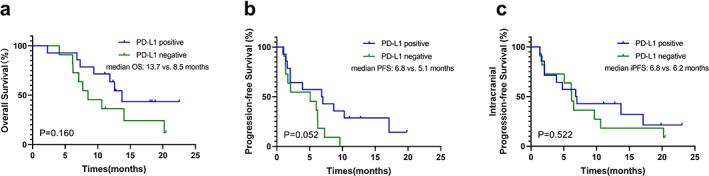
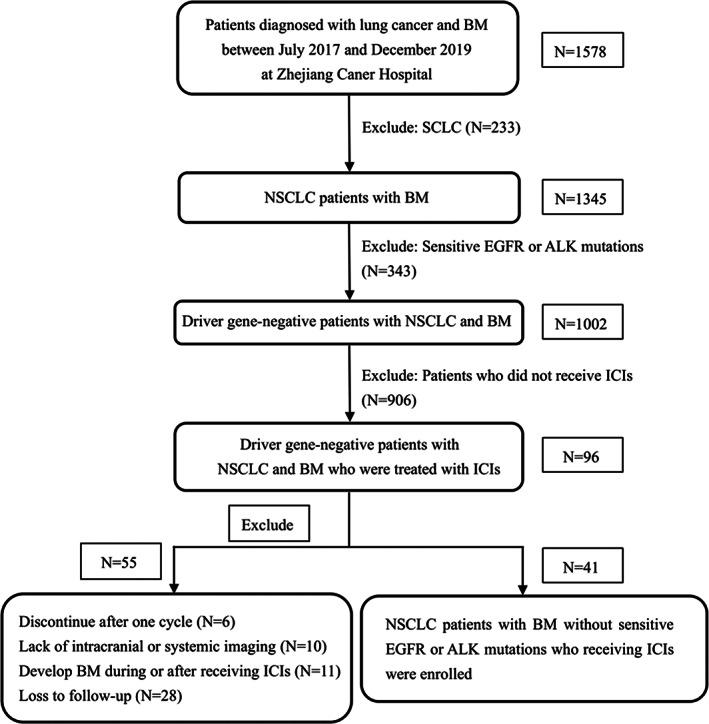
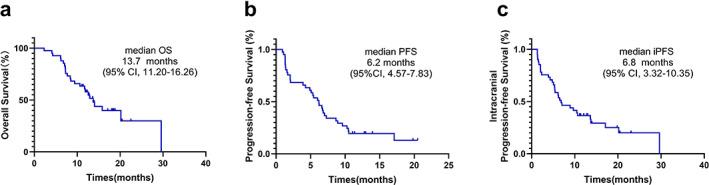
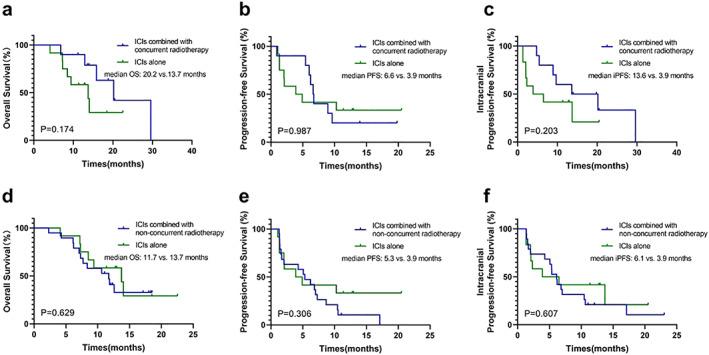
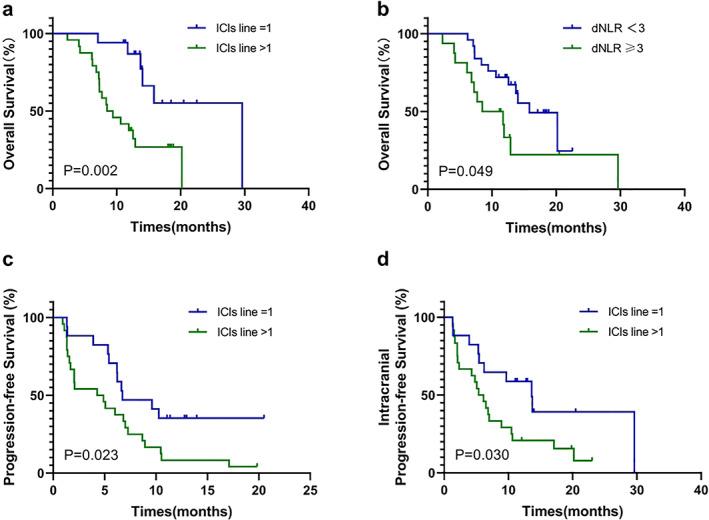
We reviewed 1578 patients with lung cancer and BM. According to the exclusion criteria, 41 patients were finally enrolled. Among these 41 patients, iORR was 36.6% (95% confidence interval [CI] = 21.2%-52.0%), whereas iPFS was 6.8 (95% CI = 3.32-10.35) months. Additionally, ORR, PFS, and OS were 24.4% (95% CI = 10.7%-38.1%), 6.2 (95% CI = 4.57-7.83) months and 13.7 (95% CI = 11.20-16.26) months, respectively. ICIs combined with concurrent radiotherapy group exhibited preferred iORR (p = 0.030) compared with no radiotherapy group, and ICIs plus chemotherapy showed improved OS (p = 0.024) compared to ICI monotherapy. Moreover, the lines of ICI treatment ≥2 (p = 0.005) and derived neutrophil-to-lymphocyte ratio (dNLR) ≥3 (p = 0.010) were independently negative factors for OS.
CONCLUSION
In NSCLC-BMs patients lacking driver genes, ICIs exhibited an effective drug regime. A combination of ICIs with concurrent radiotherapy showed a better intracranial response, whereas ICIs plus chemotherapy were associated with superior OS.
背景
在伴有脑转移(BM)的无驱动基因非小细胞肺癌(NSCLC)患者中,免疫检查点抑制剂(ICI)的治疗反应和临床结局的相关知识有限。本研究旨在评估真实世界环境中免疫疗法在这些患者中的疗效。
方法
回顾性纳入 2017 年 7 月至 2019 年 12 月间接受 ICI 治疗的无驱动基因突变的 NSCLC-BM 患者。主要观察终点为颅内客观缓解率(iORR),次要观察终点为客观缓解率(ORR)、颅内和全身无进展生存期(iPFS、PFS)和总生存期(OS)。
结果
共纳入 1578 例肺癌伴 BM 患者,根据排除标准,最终纳入 41 例患者。这 41 例患者的 iORR 为 36.6%(95%置信区间[CI]:21.2%-52.0%),iPFS 为 6.8(95%CI=3.32-10.35)个月。此外,ORR、PFS 和 OS 分别为 24.4%(95%CI:10.7%-38.1%)、6.2(95%CI:4.57-7.83)个月和 13.7(95%CI:11.20-16.26)个月。ICI 联合同步放疗组的 iORR 优于无放疗组(p=0.030),ICI 联合化疗组的 OS 优于 ICI 单药治疗组(p=0.024)。此外,ICI 治疗线数≥2(p=0.005)和衍生中性粒细胞与淋巴细胞比值(dNLR)≥3(p=0.010)是 OS 的独立负性因素。
结论
在无驱动基因的 NSCLC-BM 患者中,ICI 是一种有效的治疗方案。ICI 联合同步放疗显示出更好的颅内反应,而 ICI 联合化疗则与更好的 OS 相关。

 Zotero 插件