
模拟太阳紫外线辐射以环境相关剂量灭活 HCoV-NL63 和 SARS-CoV-2 冠状病毒。
Solar simulated ultraviolet radiation inactivates HCoV-NL63 and SARS-CoV-2 coronaviruses at environmentally relevant doses.
机构信息
Department of Pharmacology and Toxicology, College of Pharmacy and UA Cancer Center, University of Arizona, Tucson, AZ, United States of America.
Department of Pharmacology and Toxicology, College of Pharmacy and UA Cancer Center, University of Arizona, Tucson, AZ, United States of America.
出版信息
J Photochem Photobiol B. 2021 Nov;224:112319. doi: 10.1016/j.jphotobiol.2021.112319. Epub 2021 Sep 21.
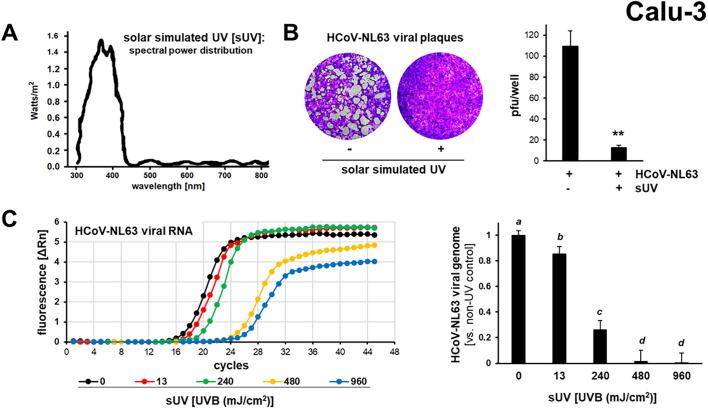
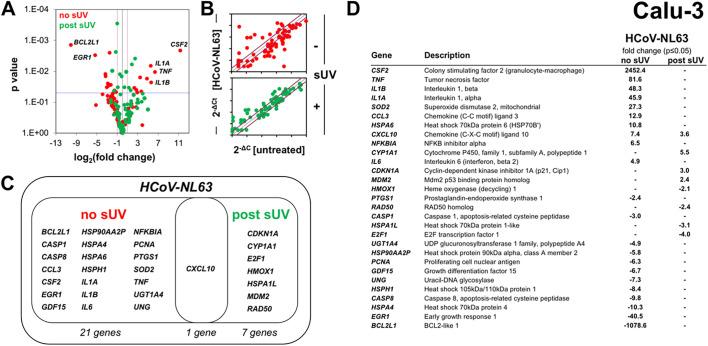
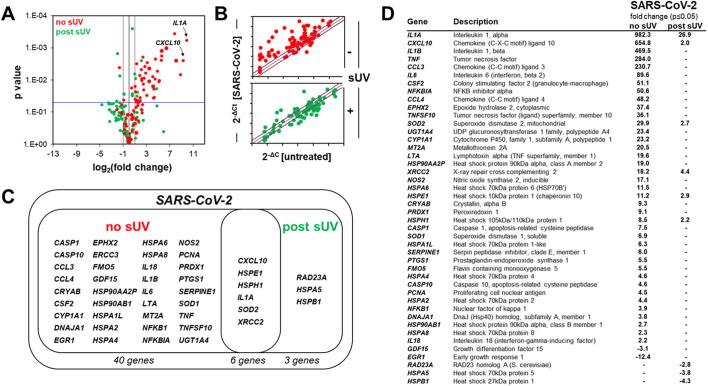
The germicidal properties of short wavelength ultraviolet C (UVC) light are well established and used to inactivate many viruses and other microbes. However, much less is known about germicidal effects of terrestrial solar UV light, confined exclusively to wavelengths in the UVA and UVB regions. Here, we have explored the sensitivity of the human coronaviruses HCoV-NL63 and SARS-CoV-2 to solar-simulated full spectrum ultraviolet light (sUV) delivered at environmentally relevant doses. First, HCoV-NL63 coronavirus inactivation by sUV-exposure was confirmed employing (i) viral plaque assays, (ii) RT-qPCR detection of viral genome replication, and (iii) infection-induced stress response gene expression array analysis. Next, a detailed dose-response relationship of SARS-CoV-2 coronavirus inactivation by sUV was elucidated, suggesting a half maximal suppression of viral infectivity at low sUV doses. Likewise, extended sUV exposure of SARS-CoV-2 blocked cellular infection as revealed by plaque assay and stress response gene expression array analysis. Moreover, comparative (HCoV-NL63 versus SARS-CoV-2) single gene expression analysis by RT-qPCR confirmed that sUV exposure blocks coronavirus-induced redox, inflammatory, and proteotoxic stress responses. Based on our findings, we estimate that solar ground level full spectrum UV light impairs coronavirus infectivity at environmentally relevant doses. Given the urgency and global scale of the unfolding SARS-CoV-2 pandemic, these prototype data suggest feasibility of solar UV-induced viral inactivation, an observation deserving further molecular exploration in more relevant exposure models.
短波紫外线 C(UVC)光的杀菌特性已得到充分证实,可用于灭活许多病毒和其他微生物。然而,人们对陆地太阳紫外线的杀菌作用知之甚少,仅限于 UVA 和 UVB 区域的波长。在这里,我们探索了人类冠状病毒 HCoV-NL63 和 SARS-CoV-2 对环境相关剂量的模拟全光谱紫外线(sUV)的敏感性。首先,通过(i)病毒斑试验,(ii)RT-qPCR 检测病毒基因组复制,以及(iii)感染诱导的应激反应基因表达谱分析,证实了 sUV 暴露对 HCoV-NL63 冠状病毒的灭活作用。接下来,详细阐明了 sUV 对 SARS-CoV-2 冠状病毒灭活的剂量反应关系,表明 sUV 低剂量下病毒感染力的半最大抑制。同样,sUV 暴露对 SARS-CoV-2 的延长也阻止了细胞感染,如通过斑块测定和应激反应基因表达谱分析所揭示的那样。此外,通过 RT-qPCR 的比较(HCoV-NL63 与 SARS-CoV-2)单基因表达分析证实,sUV 暴露会阻断冠状病毒引起的氧化还原、炎症和蛋白毒性应激反应。基于我们的发现,我们估计环境相关剂量的地面全光谱太阳紫外线会损害冠状病毒的感染力。鉴于正在发生的 SARS-CoV-2 大流行的紧迫性和全球性,这些原型数据表明太阳紫外线诱导的病毒失活是可行的,这一观察结果值得在更相关的暴露模型中进一步进行分子探索。



 Zotero 插件