
超越胆碱酯酶抑制:有机磷酸酯酯类阻燃剂和增塑剂的发育神经毒性。
Beyond Cholinesterase Inhibition: Developmental Neurotoxicity of Organophosphate Ester Flame Retardants and Plasticizers.
机构信息
College of Sciences, North Carolina State University, Raleigh, North Carolina, USA.
National Institute of Environmental Health Sciences, National Institutes of Health, Department of Health and Human Services, Research Triangle Park, North Carolina, USA.
出版信息
Environ Health Perspect. 2021 Oct;129(10):105001. doi: 10.1289/EHP9285. Epub 2021 Oct 6.
BACKGROUND
To date, the toxicity of organophosphate esters has primarily been studied regarding their use as pesticides and their effects on the neurotransmitter acetylcholinesterase (AChE). Currently, flame retardants and plasticizers are the two largest market segments for organophosphate esters and they are found in a wide variety of products, including electronics, building materials, vehicles, furniture, car seats, plastics, and textiles. As a result, organophosphate esters and their metabolites are routinely found in human urine, blood, placental tissue, and breast milk across the globe. It has been asserted that their neurological effects are minimal given that they do not act on AChE in precisely the same way as organophosphate ester pesticides.
OBJECTIVES
This commentary describes research on the non-AChE neurodevelopmental toxicity of organophosphate esters used as flame retardants and plasticizers (OPEs). Studies in humans, mammalian, nonmammalian, and models are presented, and relevant neurodevelopmental pathways, including adverse outcome pathways, are described. By highlighting this scientific evidence, we hope to elevate the level of concern for widespread human exposure to these OPEs and to provide recommendations for how to better protect public health.
DISCUSSION
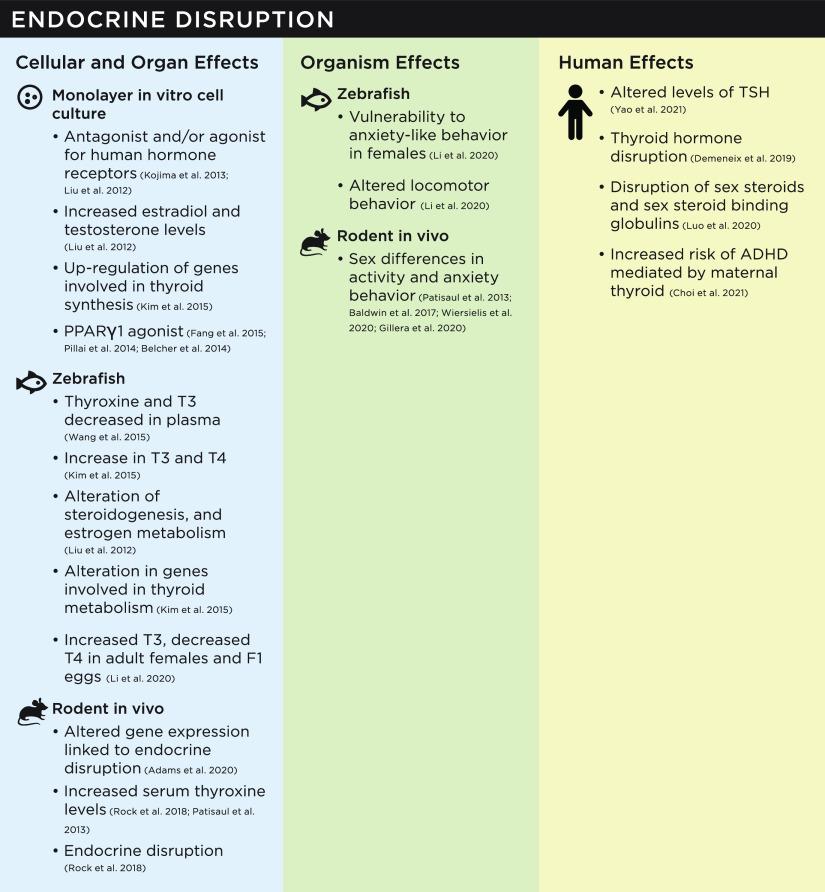
Collectively, the findings presented demonstrate that OPEs can alter neurodevelopmental processes by interfering with noncholinergic pathways at environmentally relevant doses. Application of a pathways framework indicates several specific mechanisms of action, including perturbation of glutamate and gamma-aminobutyric acid and disruption of the endocrine system. The effects may have implications for the development of cognitive and social skills in children. Our conclusion is that concern is warranted for the developmental neurotoxicity of OPE exposure. We thus describe important considerations for reducing harm and to provide recommendations for government and industry decision makers. https://doi.org/10.1289/EHP9285.
背景
迄今为止,有机磷酸酯的毒性主要是研究其作为农药的用途及其对神经递质乙酰胆碱酯酶(AChE)的影响。目前,阻燃剂和增塑剂是有机磷酸酯的两个最大市场领域,它们存在于各种产品中,包括电子产品、建筑材料、车辆、家具、汽车座椅、塑料和纺织品。因此,有机磷酸酯及其代谢物在全球范围内的人类尿液、血液、胎盘组织和母乳中经常被发现。有人断言,由于它们与有机磷酸酯农药的作用方式不完全相同,因此它们对神经系统的影响微不足道。
目的
本评论描述了用作阻燃剂和增塑剂的有机磷酸酯(OPEs)的非 AChE 神经发育毒性研究。介绍了人类、哺乳动物、非哺乳动物和 模型中的研究,并描述了相关的神经发育途径,包括不良结局途径。通过强调这些科学证据,我们希望提高人们对广泛接触这些 OPEs 的关注程度,并为如何更好地保护公众健康提供建议。
讨论
综上所述,提出的研究结果表明,OPEs 可以通过在环境相关剂量下干扰非胆碱能途径来改变神经发育过程。途径框架的应用表明了几种特定的作用机制,包括谷氨酸和γ-氨基丁酸的扰动以及内分泌系统的破坏。这些影响可能对儿童认知和社交技能的发展产生影响。我们的结论是,有理由对 OPE 暴露的发育神经毒性表示关注。因此,我们描述了减少危害的重要考虑因素,并为政府和行业决策者提供了建议。https://doi.org/10.1289/EHP9285.


 Zotero 插件