
快速高通量逆转录实时定量 PCR(RT-qPCR)检测方法,用于鉴定和区分 SARS-CoV-2 变异株 B.1.1.7 和 B.1.351
Rapid and High-Throughput Reverse Transcriptase Quantitative PCR (RT-qPCR) Assay for Identification and Differentiation between SARS-CoV-2 Variants B.1.1.7 and B.1.351.
机构信息
Central Virology Laboratory, Public Health Services, Ministry of Health, Chaim Sheba Medical Center, Ramat Gan, Israel.
School of Public Health, Sackler Faculty of Medicine, Tel-Aviv University, Tel-Aviv, Israel.
出版信息
Microbiol Spectr. 2021 Oct 31;9(2):e0050621. doi: 10.1128/Spectrum.00506-21. Epub 2021 Oct 6.
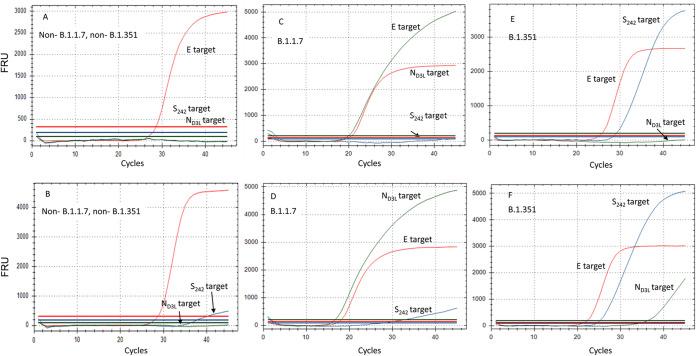
Emerging SARS-CoV-2 (SC-2) variants with increased infectivity and vaccine resistance are of major concern. Rapid identification of such variants is important for the public health decision making and to provide valuable data for epidemiological and policy decision making. We developed a multiplex reverse transcriptase quantitative PCR (RT-qPCR) assay that can specifically identify and differentiate between the emerging B.1.1.7 and B.1.351 SC-2 variants. In a single assay, we combined four reactions-one that detects SC-2 RNA independently of the strain, one that detects the D3L mutation, which is specific to variant B.1.1.7, one that detects the 242 to 244 deletion, which is specific to variant B.1.351, and the fourth reaction, which identifies the human RNAseP gene, serving as an endogenous control for RNA extraction integrity. We show that the strain-specific reactions target mutations that are strongly associated with the target variants and not with other major known variants. The assay's specificity was tested against a panel of respiratory pathogens ( = 16), showing high specificity toward SC-2 RNA. The assay's sensitivity was assessed using both transcribed RNA and clinical samples and was determined to be between 20 and 40 viral RNA copies per reaction. The assay performance was corroborated with Sanger and whole-genome sequencing, showing complete agreement with the sequencing results. The new assay is currently implemented in the routine diagnostic work at the Central Virology Laboratory, and may be used in other laboratories to facilitate the diagnosis of these major worldwide-circulating SC-2 variants. This study describes the design and utilization of a multiplex reverse transcriptase quantitative PCR (RT-qPCR) to identify SARS-COV-2 (SC2) RNA in general and, specifically, to detect whether it is of lineage B.1.1.7 or B.1.351. Implementation of this method in diagnostic and research laboratories worldwide may help the efforts to contain the COVID-19 pandemic. The method can be easily scaled up and be used in high-throughput laboratories, as well as small ones. In addition to immediate help in diagnostic efforts, this method may also help in epidemiological studies focused on the spread of emerging SC-2 lineages.
新兴的具有更高传染性和疫苗抗性的 SARS-CoV-2(SC-2)变体引起了极大的关注。快速识别此类变体对于公共卫生决策非常重要,并为流行病学和政策决策提供有价值的数据。我们开发了一种多重逆转录定量 PCR(RT-qPCR)检测方法,可特异性识别和区分新兴的 B.1.1.7 和 B.1.351 SC-2 变体。在一个单一的检测中,我们结合了四个反应 - 一个检测独立于毒株的 SC-2 RNA,一个检测特定于变体 B.1.1.7 的 D3L 突变,一个检测特定于变体 B.1.351 的 242 到 244 缺失,第四个反应则识别人类 RNAseP 基因,作为 RNA 提取完整性的内源性对照。我们表明,株特异性反应针对与目标变体强烈相关而不是与其他主要已知变体相关的突变。该检测方法的特异性通过对一组呼吸道病原体进行了测试(= 16),表明对 SC-2 RNA 具有很高的特异性。该检测方法的灵敏度使用转录 RNA 和临床样本进行了评估,确定为每个反应 20 到 40 个病毒 RNA 拷贝。该检测方法的性能与 Sanger 和全基因组测序结果相吻合,完全与测序结果一致。新检测方法目前已在中央病毒学实验室的常规诊断工作中实施,也可在其他实验室中用于促进这些主要的全球传播的 SC-2 变体的诊断。本研究描述了一种多重逆转录定量 PCR(RT-qPCR)的设计和应用,用于一般情况下识别 SARS-COV-2(SC2)RNA,具体来说,用于检测它是否属于谱系 B.1.1.7 或 B.1.351。该方法在全球范围内的诊断和研究实验室中的实施可能有助于控制 COVID-19 大流行的努力。该方法易于扩展,可用于高通量实验室以及小型实验室。除了在诊断工作中立即提供帮助外,该方法还可能有助于针对新兴 SC-2 谱系传播的流行病学研究。


 Zotero 插件