
重大创伤后中性粒细胞动力学与功能:一项系统综述。
Neutrophil kinetics and function after major trauma: A systematic review.
作者信息
Finlay Liam Db, Conway Morris Andrew, Deane Adam M, Wood Alexander Jt
机构信息
Melbourne Medical School, University of Melbourne, Melbourne 3052, Victoria, Australia.
Department of Medicine, University of Cambridge, Cambridge 01223, United Kingdom.
出版信息
World J Crit Care Med. 2021 Sep 9;10(5):260-277. doi: 10.5492/wjccm.v10.i5.260.
BACKGROUND
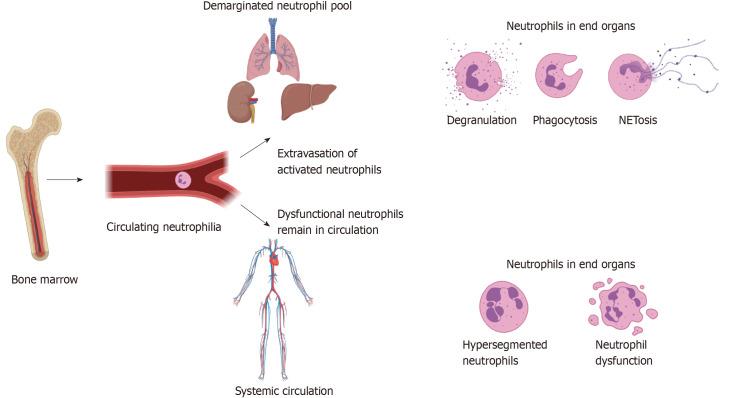
Immune dysfunction following major traumatic injury is complex and strongly associated with significant morbidity and mortality through the development of multiple organ dysfunction syndrome (MODS), persistent inflammation, immunosuppression, and catabolism syndrome and sepsis. Neutrophils are thought to be a pivotal mediator in the development of immune dysfunction.
AIM
To provide a review with a systematic approach of the recent literature describing neutrophil kinetics and functional changes after major trauma in humans and discuss hypotheses as to the mechanisms of the observed neutrophil dysfunction in this setting.
METHODS
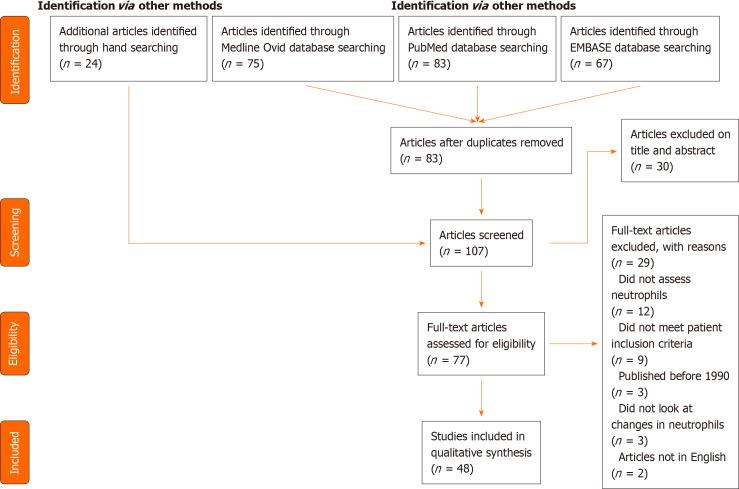
Medline, Embase and PubMed were searched on January 15, 2021. Papers were screened by two reviewers and those included had their reference list hand searched for additional papers of interest. Inclusion criteria were adults > 18 years old, with an injury severity score > 12 requiring admission to an intensive care unit. Papers that analysed major trauma patients as a subgroup were included.
RESULTS
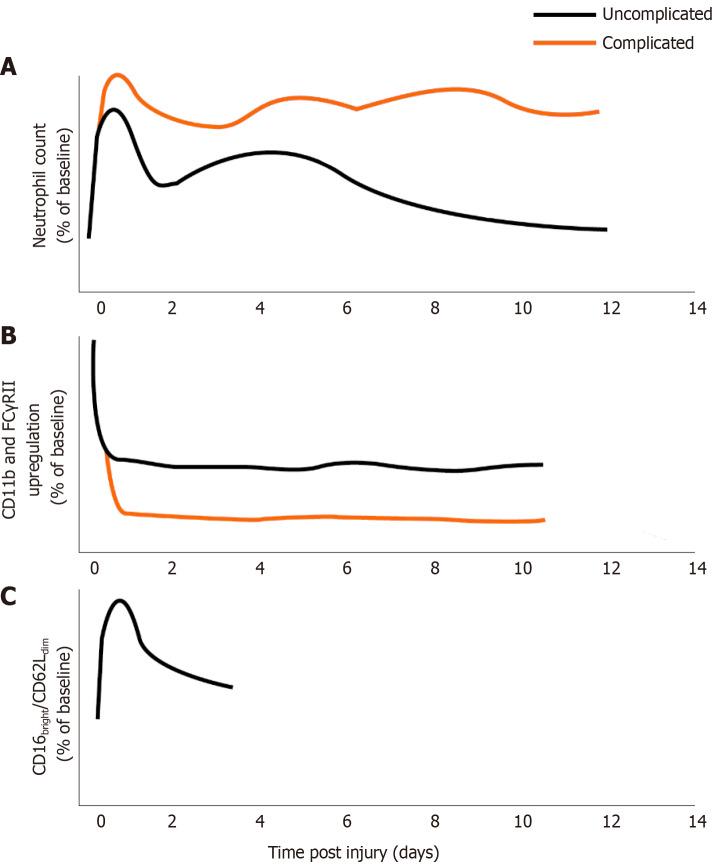
Of 107 papers screened, 48 were included in the review. Data were heterogeneous and most studies had a moderate to significant risk of bias owing to their observational nature and small sample sizes. Key findings included a persistently elevated neutrophil count, stereotyped alterations in cell-surface markers of activation, and the elaboration of heterogeneous and immunosuppressive populations of cells in the circulation. Some of these changes correlate with clinical outcomes such as MODS and secondary infection. Neutrophil phenotype remains a promising avenue for the development of predictive markers for immune dysfunction.
CONCLUSION
Understanding of neutrophil phenotypes after traumatic injury is expanding. A greater emphasis on incorporating functional and clinically significant markers, greater uniformity in study design and assessment of extravasated neutrophils may facilitate risk stratification in patients affected by major trauma.
背景
重大创伤后的免疫功能障碍很复杂,通过多器官功能障碍综合征(MODS)、持续性炎症、免疫抑制、分解代谢综合征和脓毒症的发展,与显著的发病率和死亡率密切相关。中性粒细胞被认为是免疫功能障碍发展中的关键介质。
目的
对近期描述人类重大创伤后中性粒细胞动力学和功能变化的文献进行系统综述,并讨论在此背景下观察到的中性粒细胞功能障碍机制的假说。
方法
于2021年1月15日检索了Medline、Embase和PubMed。由两名审稿人筛选论文,并对纳入论文的参考文献列表进行人工检索以查找其他相关论文。纳入标准为年龄>18岁的成年人,损伤严重程度评分>12且需要入住重症监护病房。分析重大创伤患者作为亚组的论文被纳入。
结果
在筛选的107篇论文中,48篇被纳入综述。数据具有异质性,由于其观察性质和样本量小,大多数研究存在中度至显著的偏倚风险。主要发现包括中性粒细胞计数持续升高、活化细胞表面标志物的刻板改变,以及循环中细胞的异质性和免疫抑制群体的形成。其中一些变化与MODS和继发感染等临床结果相关。中性粒细胞表型仍然是免疫功能障碍预测标志物开发的一个有前景的途径。
结论
对创伤后中性粒细胞表型的理解正在不断扩展。更加强调纳入功能和临床显著标志物、研究设计的更大一致性以及对渗出中性粒细胞的评估,可能有助于对受重大创伤患者进行风险分层。
 Zotero 插件