
美国患者对肺部 CT 筛查报告和数据系统推荐筛查间隔的依从性:系统评价和荟萃分析。
Patient Adherence to Lung CT Screening Reporting & Data System-Recommended Screening Intervals in the United States: A Systematic Review and Meta-Analysis.
机构信息
Department of Bioengineering, University of California Los Angeles, Los Angeles, California; Medical & Imaging Informatics Group, Department of Radiological Sciences, University of California Los Angeles, Los Angeles, California.
Medical Informatics Home Area, Department of Bioinformatics, University of California Los Angeles, Los Angeles, California.
出版信息
J Thorac Oncol. 2022 Jan;17(1):38-55. doi: 10.1016/j.jtho.2021.09.013. Epub 2021 Oct 6.
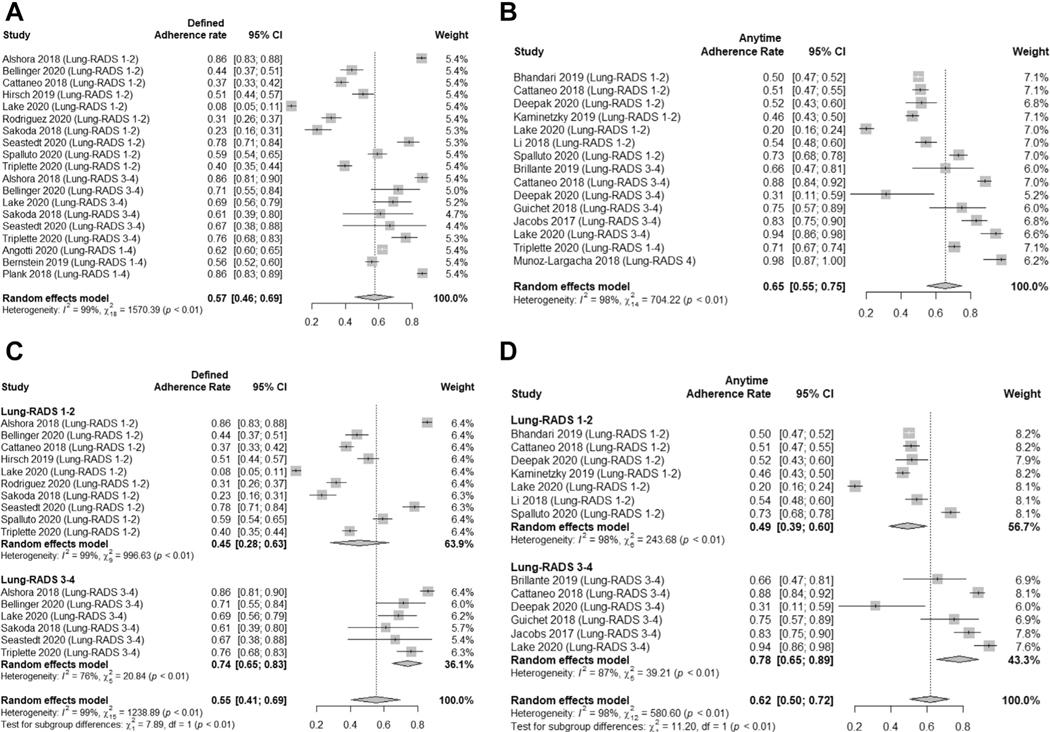
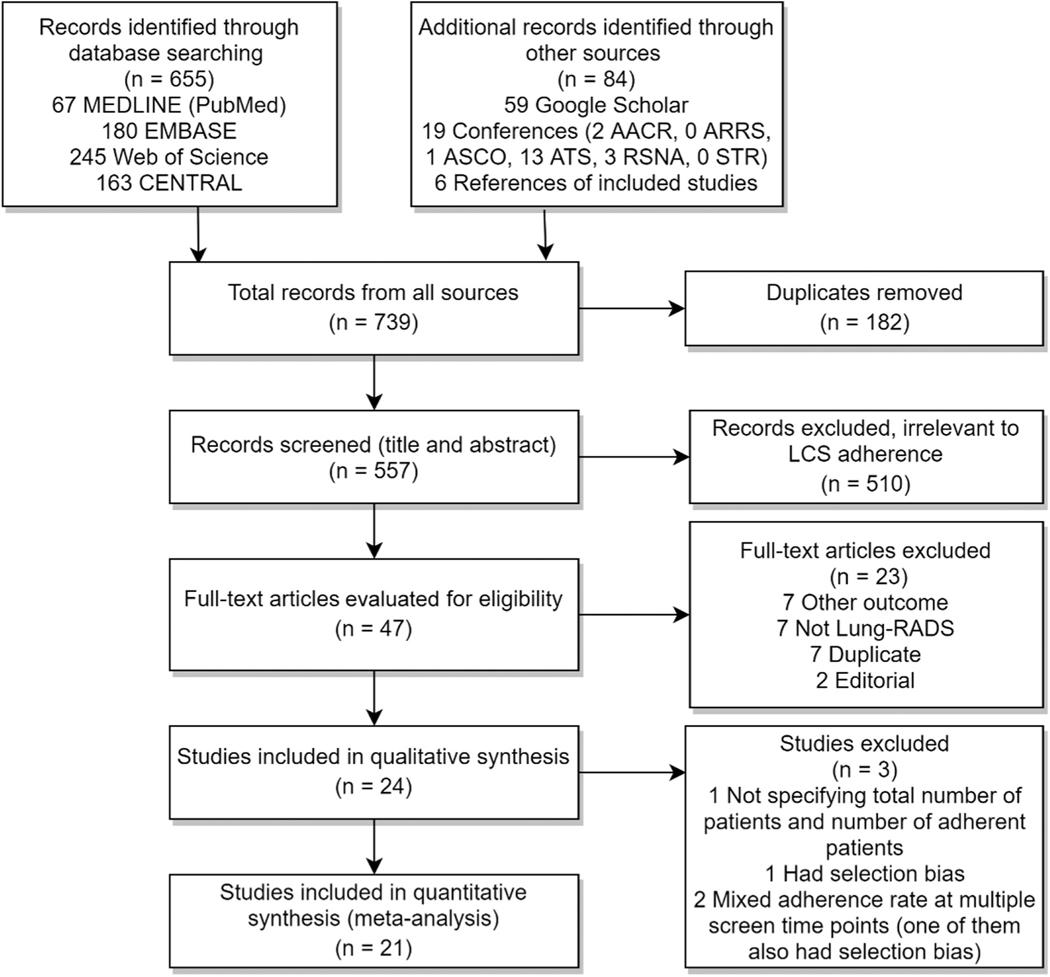
Lung cancer screening (LCS) is effective in reducing mortality, particularly when patients adhere to follow-up recommendations standardized by the Lung CT Screening Reporting & Data System (Lung-RADS). Nevertheless, patient adherence to recommended intervals varies, potentially diminishing benefit from screening. We conducted a systematic review and meta-analysis of patient adherence to Lung-RADS-recommended screening intervals. We systematically searched MEDLINE, EMBASE, Web of Science, the Cochrane Central Register of Controlled Trials, and major radiology and oncology conference archives between April 28, 2014, and December 17, 2020. Eligible studies mentioned patient adherence to the recommendations of Lung-RADS. The review protocol was registered with PROSPERO (CRD42020189326). We identified 24 eligible studies for qualitative summary, of which 21 were suitable for meta-analysis. The pooled adherence rate was 57% (95% confidence interval: 46%-69%) for defined adherence (e.g., an annual incidence screen was performed within 15 mo) among 6689 patients and 65% (95% confidence interval: 55%-75%) for anytime adherence among 5085 patients. Large heterogeneity in adherence rates between studies was observed (I = 99% for defined adherence, I = 98% for anytime adherence). Heterogeneous adherence rates were associated with Lung-RADS scores, with significantly higher adherence rates among Lung-RADS 3 to 4 than Lung-RADS 1 to 2 (p < 0.05). Patient adherence to Lung-RADS-recommended screening intervals is suboptimal across clinical LCS programs in the United States, especially among patients with results of Lung-RADS categories 1 to 2. To improve adherence rates, future research may focus on implementing tailored interventions after identifying barriers to LCS. We also propose a minimum standardized set of data elements for future pooled analyses of LCS adherence on the basis of our findings.
肺癌筛查(LCS)在降低死亡率方面是有效的,尤其是当患者遵循由 Lung CT Screening Reporting & Data System(Lung-RADS)标准化的随访建议时。然而,患者对推荐间隔的依从性各不相同,这可能会降低筛查的获益。我们对 Lung-RADS 推荐的筛查间隔的患者依从性进行了系统评价和荟萃分析。我们系统地检索了 MEDLINE、EMBASE、Web of Science、Cochrane 中央对照试验注册库以及 2014 年 4 月 28 日至 2020 年 12 月 17 日期间的主要放射学和肿瘤学会议档案。符合条件的研究均提到了患者对 Lung-RADS 建议的依从性。该综述方案在 PROSPERO(CRD42020189326)中进行了注册。我们对 24 项定性总结的合格研究进行了分析,其中 21 项适合荟萃分析。在 6689 例患者中,定义性依从率(例如,在 15 个月内进行年度发病率筛查)为 57%(95%置信区间:46%-69%),在 5085 例患者中,任意时间的依从率为 65%(95%置信区间:55%-75%)。观察到研究之间的依从率存在很大的异质性(定义性依从的 I²=99%,任意时间依从的 I²=98%)。依从率的异质性与 Lung-RADS 评分相关,Lung-RADS 3 至 4 级的依从率明显高于 Lung-RADS 1 至 2 级(p<0.05)。在美国,临床肺癌筛查计划中,患者对 Lung-RADS 推荐的筛查间隔的依从性并不理想,尤其是在 Lung-RADS 1 至 2 级的患者中。为了提高依从率,未来的研究可能需要在确定肺癌筛查障碍后,集中精力实施有针对性的干预措施。基于我们的发现,我们还提出了一套用于未来 Lung-RADS 筛查依从性的标准化最小数据集。
 Zotero 插件