
天气、空气污染与 SARS-CoV-2 传播:全球分析。
Weather, air pollution, and SARS-CoV-2 transmission: a global analysis.
机构信息
Department of Allied Health Sciences, University of Connecticut, Storrs, CT, USA.
Sloan School of Management, Massachusetts Institute of Technology, Cambridge, MA, USA.
出版信息
Lancet Planet Health. 2021 Oct;5(10):e671-e680. doi: 10.1016/S2542-5196(21)00202-3.
BACKGROUND
Understanding how environmental factors affect SARS-CoV-2 transmission could inform global containment efforts. Despite high scientific and public interest and multiple research reports, there is currently no consensus on the association of environmental factors and SARS-CoV-2 transmission. To address this research gap, we aimed to assess the relative risk of transmission associated with weather conditions and ambient air pollution.
METHODS
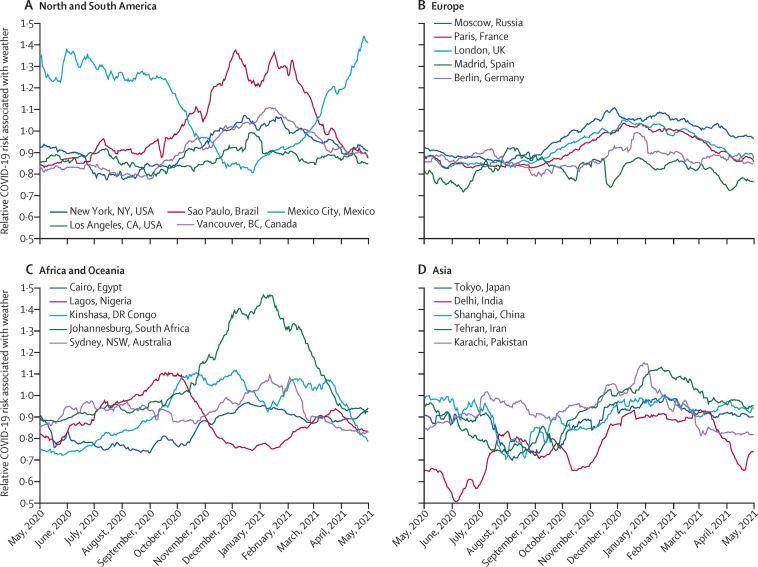
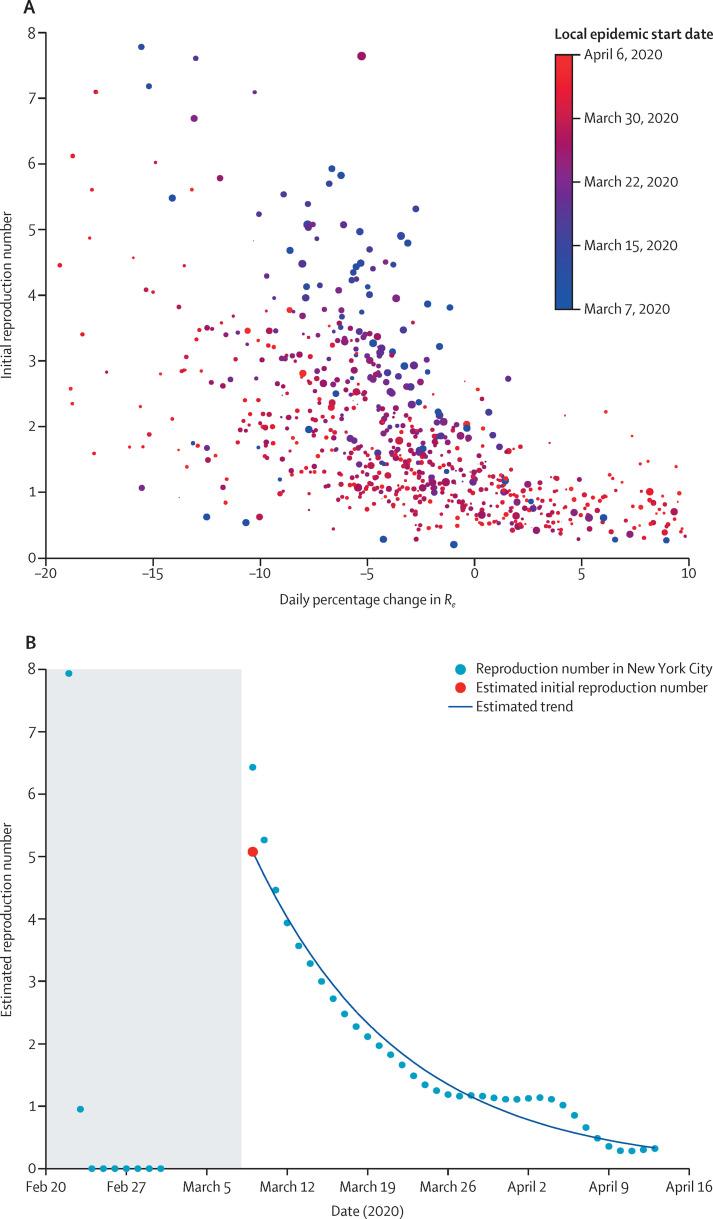
In this global analysis, we adjusted for the delay between infection and detection, estimated the daily reproduction number at 3739 global locations during the COVID-19 pandemic up until late April, 2020, and investigated its associations with daily local weather conditions (ie, temperature, humidity, precipitation, snowfall, moon illumination, sunlight hours, ultraviolet index, cloud cover, wind speed and direction, and pressure data) and ambient air pollution (ie, PM, nitrogen dioxide, ozone, and sulphur dioxide). To account for other confounding factors, we included both location-specific fixed effects and trends, controlling for between-location differences and heterogeneities in locations' responses over time. We built confidence in our estimations through synthetic data, robustness, and sensitivity analyses, and provided year-round global projections for weather-related risk of global SARS-CoV-2 transmission.
FINDINGS
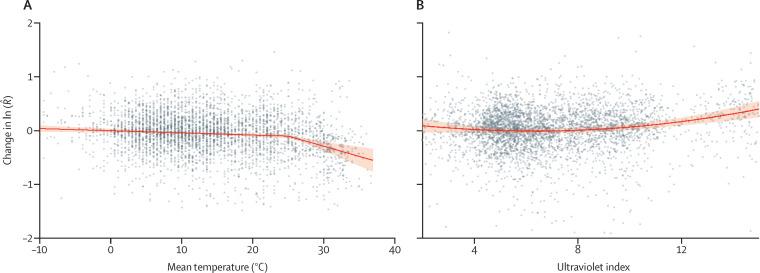
Our dataset included data collected between Dec 12, 2019, and April 22, 2020. Several weather variables and ambient air pollution were associated with the spread of SARS-CoV-2 across 3739 global locations. We found a moderate, negative relationship between the estimated reproduction number and temperatures warmer than 25°C (a decrease of 3·7% [95% CI 1·9-5·4] per additional degree), a U-shaped relationship with outdoor ultraviolet exposure, and weaker positive associations with air pressure, wind speed, precipitation, diurnal temperature, sulphur dioxide, and ozone. Results were robust to multiple assumptions. Independent research building on our estimates provides strong support for the resulting projections across nations.
INTERPRETATION
Warmer temperature and moderate outdoor ultraviolet exposure result in a slight reduction in the transmission of SARS-CoV-2; however, changes in weather or air pollution alone are not enough to contain the spread of SARS-CoV-2 with other factors having greater effects.
FUNDING
None.
背景
了解环境因素如何影响 SARS-CoV-2 的传播,可以为全球防控工作提供信息。尽管科学界和公众对此高度关注,并且已经有多项研究报告,但目前对于环境因素与 SARS-CoV-2 传播之间的关联仍没有共识。为了解决这一研究空白,我们旨在评估天气条件和环境空气污染与传播相关的相对风险。
方法
在这项全球分析中,我们对感染与检测之间的延迟进行了调整,估计了截至 2020 年 4 月下旬 COVID-19 大流行期间全球 3739 个地点的每日繁殖数,并调查了其与当地每日天气条件(即温度、湿度、降水、降雪、月光照射、日照时间、紫外线指数、云量、风速和风向以及气压数据)和环境空气污染(即 PM、二氧化氮、臭氧和二氧化硫)之间的关联。为了考虑其他混杂因素,我们同时包含了地点特异性固定效应和趋势,控制了地点之间的差异以及随着时间推移地点反应的异质性。我们通过合成数据、稳健性和敏感性分析来建立对估计的信心,并提供了全年全球 SARS-CoV-2 传播与天气相关风险的预测。
发现
我们的数据集包括 2019 年 12 月 12 日至 2020 年 4 月 22 日期间收集的数据。在全球 3739 个地点,有几个天气变量和环境空气污染与 SARS-CoV-2 的传播有关。我们发现,估计的繁殖数与高于 25°C 的温度之间存在中度负相关(每增加 1°C,减少 3.7%[95%CI 1.9-5.4]),与室外紫外线暴露呈 U 形关系,与气压、风速、降水、日温差、二氧化硫和臭氧呈较弱的正相关。结果在多种假设下都是稳健的。基于我们的估计进行的独立研究为各国提供了强有力的支持,证明了这些预测的结果。
解释
温暖的温度和适度的室外紫外线照射会导致 SARS-CoV-2 的传播略有减少;然而,仅改变天气或空气污染本身不足以遏制 SARS-CoV-2 的传播,其他因素的影响更大。
结论
全球分析表明,天气和环境空气污染与 SARS-CoV-2 的传播有关,但不足以单独控制其传播,其他因素的影响更大。
资金
无。

 Zotero 插件