
高通量 3D 肿瘤血管模型用于实时监测免疫细胞浸润和细胞毒性。
High-Throughput 3D Tumor Vasculature Model for Real-Time Monitoring of Immune Cell Infiltration and Cytotoxicity.
机构信息
Department of Mechanical Engineering, Seoul National University, Seoul, South Korea.
Interdisciplinary Program in Bioengineering, Seoul National University, Seoul, South Korea.
出版信息
Front Immunol. 2021 Sep 24;12:733317. doi: 10.3389/fimmu.2021.733317. eCollection 2021.
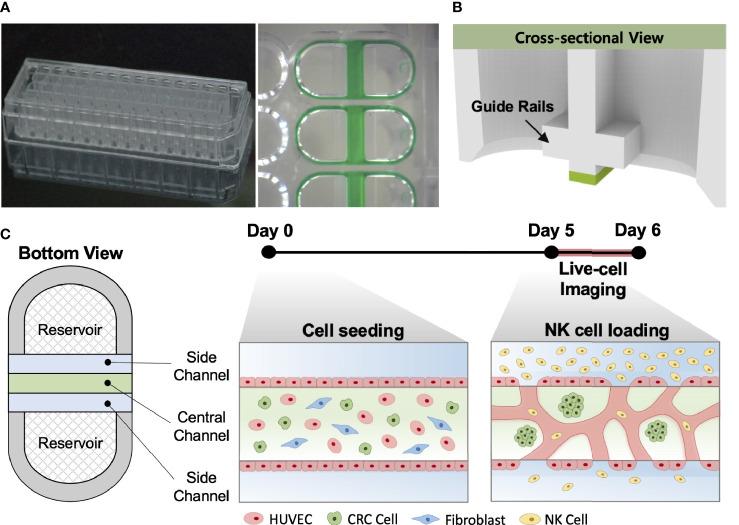
Recent advances in anticancer therapy have shown dramatic improvements in clinical outcomes, and adoptive cell therapy has emerged as a type of immunotherapy that can modulate immune responses by transferring engineered immune cells. However, a small percentage of responders and their toxicity remain as challenges. Three-dimensional (3D) models of the tumor microenvironment (TME) have the potential to provide a platform for assessing and predicting responses to therapy. This paper describes an 3D tumor model that incorporates clusters of colorectal cancer (CRC) cells around perfusable vascular networks to validate immune-cell-mediated cytotoxicity against cancer cells. The platform is based on an injection-molded 3D co-culture model and composed of 28 microwells where separate identical vascularized cancer models can be formed. It allows robust hydrogel patterning for 3D culture that enables high-throughput experimentation. The uniformity of the devices resulted in reproducible experiments that allowed 10× more experiments to be performed when compared to conventional polydimethylsiloxane (PDMS)-based microfluidic devices. To demonstrate its capability, primary natural killer (NK) cells were introduced into the vascularized tumor network, and their activities were monitored using live-cell imaging. Extravasation, migration, and cytotoxic activity against six types of CRC cell lines were tested and compared. The consensus molecular subtypes (CMS) of CRC with distinct immune responses resulted in the highest NK cell cytotoxicity against CMS1 cancer cells. These results show the potential of our vascularized tumor model for understanding various steps involved in the immune response for the assessment of adoptive cell therapy.
近年来,癌症治疗领域的进展表明,临床疗效有了显著改善,过继细胞疗法作为一种免疫疗法,通过转导工程化免疫细胞来调节免疫反应,已崭露头角。然而,应答率低和其毒性仍是挑战。肿瘤微环境(TME)的三维(3D)模型有可能为评估和预测对治疗的反应提供一个平台。本文描述了一种 3D 肿瘤模型,该模型将结直肠癌(CRC)细胞簇纳入可灌注的血管网络周围,以验证免疫细胞介导的对癌细胞的细胞毒性。该平台基于注塑 3D 共培养模型,由 28 个微井组成,可在其中形成单独的相同血管化癌症模型。它允许对 3D 培养进行稳健的水凝胶图案设计,从而实现高通量实验。该设备的均匀性导致可重复的实验,与传统的基于聚二甲基硅氧烷(PDMS)的微流控设备相比,可进行多达 10 倍的实验。为了证明其能力,将原代自然杀伤(NK)细胞引入血管化肿瘤网络,并使用活细胞成像监测其活性。测试并比较了 NK 细胞对六种 CRC 细胞系的出血管、迁移和细胞毒性活性。具有不同免疫反应的 CRC 的共识分子亚型(CMS)导致 CMS1 癌细胞对 NK 细胞的细胞毒性最高。这些结果表明,我们的血管化肿瘤模型有可能用于理解免疫反应中涉及过继细胞疗法评估的各种步骤。



 Zotero 插件