
2020 年 COVID-19 大流行期间 204 个国家和地区的抑郁和焦虑障碍的全球患病率和负担。
Global prevalence and burden of depressive and anxiety disorders in 204 countries and territories in 2020 due to the COVID-19 pandemic.
出版信息
Lancet. 2021 Nov 6;398(10312):1700-1712. doi: 10.1016/S0140-6736(21)02143-7. Epub 2021 Oct 8.
BACKGROUND
Before 2020, mental disorders were leading causes of the global health-related burden, with depressive and anxiety disorders being leading contributors to this burden. The emergence of the COVID-19 pandemic has created an environment where many determinants of poor mental health are exacerbated. The need for up-to-date information on the mental health impacts of COVID-19 in a way that informs health system responses is imperative. In this study, we aimed to quantify the impact of the COVID-19 pandemic on the prevalence and burden of major depressive disorder and anxiety disorders globally in 2020.
METHODS
We conducted a systematic review of data reporting the prevalence of major depressive disorder and anxiety disorders during the COVID-19 pandemic and published between Jan 1, 2020, and Jan 29, 2021. We searched PubMed, Google Scholar, preprint servers, grey literature sources, and consulted experts. Eligible studies reported prevalence of depressive or anxiety disorders that were representative of the general population during the COVID-19 pandemic and had a pre-pandemic baseline. We used the assembled data in a meta-regression to estimate change in the prevalence of major depressive disorder and anxiety disorders between pre-pandemic and mid-pandemic (using periods as defined by each study) via COVID-19 impact indicators (human mobility, daily SARS-CoV-2 infection rate, and daily excess mortality rate). We then used this model to estimate the change from pre-pandemic prevalence (estimated using Disease Modelling Meta-Regression version 2.1 [known as DisMod-MR 2.1]) by age, sex, and location. We used final prevalence estimates and disability weights to estimate years lived with disability and disability-adjusted life-years (DALYs) for major depressive disorder and anxiety disorders.
FINDINGS
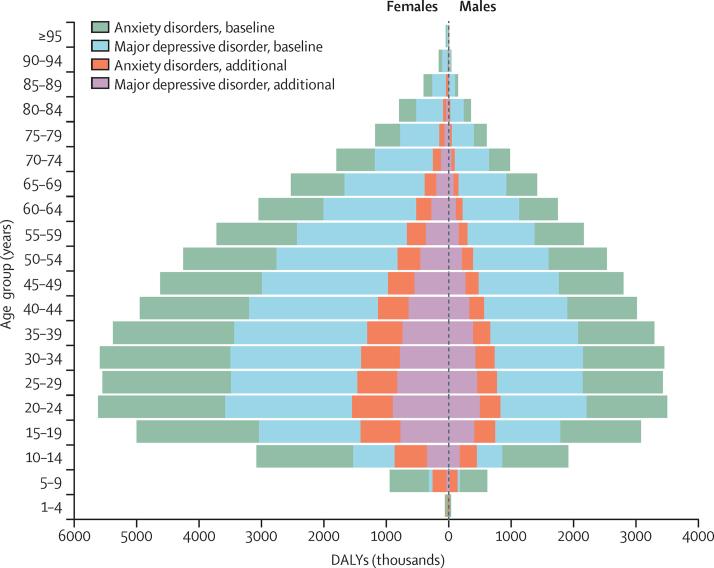
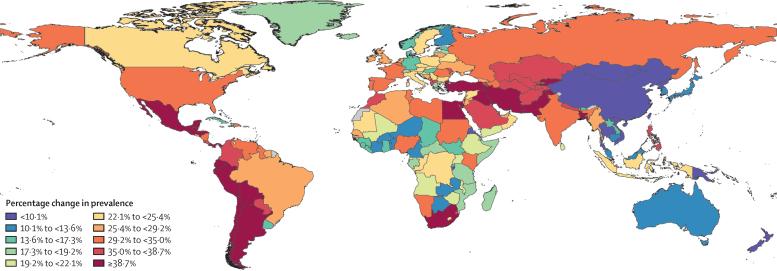
We identified 5683 unique data sources, of which 48 met inclusion criteria (46 studies met criteria for major depressive disorder and 27 for anxiety disorders). Two COVID-19 impact indicators, specifically daily SARS-CoV-2 infection rates and reductions in human mobility, were associated with increased prevalence of major depressive disorder (regression coefficient [B] 0·9 [95% uncertainty interval 0·1 to 1·8; p=0·029] for human mobility, 18·1 [7·9 to 28·3; p=0·0005] for daily SARS-CoV-2 infection) and anxiety disorders (0·9 [0·1 to 1·7; p=0·022] and 13·8 [10·7 to 17·0; p<0·0001]. Females were affected more by the pandemic than males (B 0·1 [0·1 to 0·2; p=0·0001] for major depressive disorder, 0·1 [0·1 to 0·2; p=0·0001] for anxiety disorders) and younger age groups were more affected than older age groups (-0·007 [-0·009 to -0·006; p=0·0001] for major depressive disorder, -0·003 [-0·005 to -0·002; p=0·0001] for anxiety disorders). We estimated that the locations hit hardest by the pandemic in 2020, as measured with decreased human mobility and daily SARS-CoV-2 infection rate, had the greatest increases in prevalence of major depressive disorder and anxiety disorders. We estimated an additional 53·2 million (44·8 to 62·9) cases of major depressive disorder globally (an increase of 27·6% [25·1 to 30·3]) due to the COVID-19 pandemic, such that the total prevalence was 3152·9 cases (2722·5 to 3654·5) per 100 000 population. We also estimated an additional 76·2 million (64·3 to 90·6) cases of anxiety disorders globally (an increase of 25·6% [23·2 to 28·0]), such that the total prevalence was 4802·4 cases (4108·2 to 5588·6) per 100 000 population. Altogether, major depressive disorder caused 49·4 million (33·6 to 68·7) DALYs and anxiety disorders caused 44·5 million (30·2 to 62·5) DALYs globally in 2020.
INTERPRETATION
This pandemic has created an increased urgency to strengthen mental health systems in most countries. Mitigation strategies could incorporate ways to promote mental wellbeing and target determinants of poor mental health and interventions to treat those with a mental disorder. Taking no action to address the burden of major depressive disorder and anxiety disorders should not be an option.
FUNDING
Queensland Health, National Health and Medical Research Council, and the Bill and Melinda Gates Foundation.
背景
2020 年之前,精神障碍是全球与健康相关的负担的主要原因,其中抑郁障碍和焦虑障碍是导致这种负担的主要因素。COVID-19 大流行的出现使许多导致心理健康状况不佳的因素恶化。迫切需要了解 COVID-19 对心理健康的影响,以便为卫生系统应对措施提供信息。本研究旨在量化 COVID-19 大流行对全球 2020 年主要抑郁障碍和焦虑障碍患病率和负担的影响。
方法
我们对 2020 年 1 月 1 日至 2021 年 1 月 29 日期间发表的报告 COVID-19 大流行期间抑郁障碍和焦虑障碍患病率的研究进行了系统综述。我们在 PubMed、Google Scholar、预印本服务器、灰色文献来源和咨询专家中进行了搜索。合格的研究报告了 COVID-19 大流行期间具有代表性的一般人群的抑郁或焦虑障碍患病率,且具有大流行前的基线数据。我们使用汇总数据在荟萃回归中估计了主要抑郁障碍和焦虑障碍的患病率在大流行前和大流行中期(使用每个研究定义的时期)之间的变化,通过 COVID-19 影响指标(人类流动性、每日 SARS-CoV-2 感染率和每日超额死亡率)进行评估。然后,我们使用该模型来估计使用疾病建模荟萃回归版本 2.1(称为 DisMod-MR 2.1)预测的大流行前患病率的变化。我们使用最终的患病率估计值和残疾权重来估计主要抑郁障碍和焦虑障碍的伤残年数和残疾调整生命年。
结果
我们确定了 5683 个独特的数据源,其中 48 个符合纳入标准(46 项研究符合主要抑郁障碍标准,27 项研究符合焦虑障碍标准)。两个 COVID-19 影响指标,即每日 SARS-CoV-2 感染率和人类流动性的降低,与主要抑郁障碍(回归系数 [B]0·9[95%不确定区间 0·1 至 1·8;p=0·029])和焦虑障碍(0·9[0·1 至 1·7;p=0·022]和 13·8[10·7 至 17·0;p<0·0001]的患病率增加相关。女性受大流行的影响比男性更大(B0·1[0·1 至 0·2;p=0·0001]),年轻年龄组比老年年龄组受影响更大(-0·007[-0·009 至 -0·006;p=0·0001])。我们估计,2020 年受大流行影响最严重的地区(以人类流动性和每日 SARS-CoV-2 感染率降低衡量),主要抑郁障碍和焦虑障碍的患病率增幅最大。我们估计,全球范围内,由于 COVID-19 大流行,主要抑郁障碍的新增病例数为 5332 万例(4480 万至 6290 万),患病率增加了 27·6%(25·1%至 30·3%),因此,全球每 10 万人中有 3152·9 例(2722·5 至 3654·5)。我们还估计,全球范围内焦虑障碍的新增病例数为 7620 万例(6430 万至 9060 万),患病率增加了 25·6%(23·2%至 28·0%),因此,全球每 10 万人中有 4802·4 例(4108·2 至 5588·6)。总的来说,2020 年主要抑郁障碍导致 4990 万(3360 万至 6870 万)残疾调整生命年,焦虑障碍导致 4450 万(3020 万至 6250 万)残疾调整生命年。
解释
这场大流行使大多数国家加强精神卫生系统的紧迫性大大增加。缓解策略可以包括促进精神健康的方法,以及针对不良精神健康的决定因素和干预措施,以治疗有精神障碍的人。不采取行动应对主要抑郁障碍和焦虑障碍的负担不应成为一种选择。
资金
昆士兰卫生部、澳大利亚国家卫生和医学研究委员会和比尔和梅琳达·盖茨基金会。


 Zotero 插件